 02
5 min
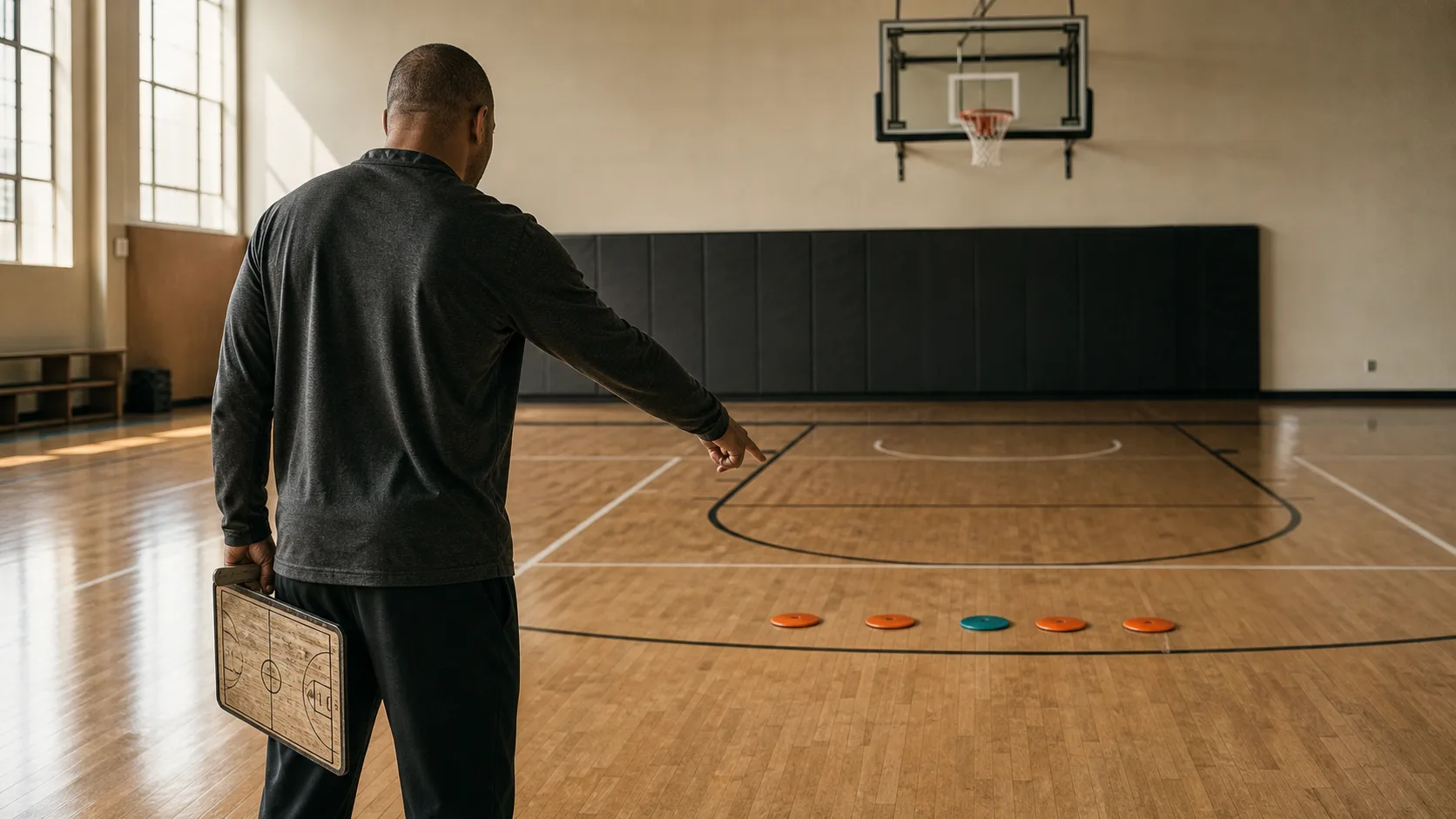
How to Ask Your Basketball Coach About Playing Time: Five Role Questions
Prepare an individual conversation around responsibilities, two examples and one next priority, without asking a box score to explain every rotation.
Read analysisBuild what translates
Footwork, shooting, decision-making, and practice design for skills that survive the speed of a real game.
Start here · Latest brief
Category archive
57 more
02Prepare an individual conversation around responsibilities, two examples and one next priority, without asking a box score to explain every rotation.
Read analysis 03
AI will not take your reps for you. What it can do is the thinking part of basketball: show you where you really score, which pro to study, how to attack the defender in front of you and which reads you keep missing. Here are four ways to use it, a real example, a four-week plan and the questions that get the best answers.
Read analysis 04
Most players copy their favorite NBA star. The ones who improve copy the star whose game matches theirs. Here are eight archetypes, the 2025-26 shot diet of the pro who best represents each one, a three-question test to find yours, and how to study him without copying the highlights.
Read analysis 05
A trainer can make film actionable by converting one matchup problem into four game-speed decisions. This workflow moves from scout to drill without building a generic workout.
Read analysis06Private basketball trainers run $50 to $150 an hour in 2026, with elite names over $200. Here is the full rate table by level and format, what a season of weekly sessions really totals, and when group training beats private.
Read analysis07The floater is the only way to score in the paint without entering the space where a shot blocker can reach you. Here is the full mechanical breakdown, the reads, and the progression that builds it.
Read analysis08Being short is not a disadvantage you overcome. It is a set of physical facts that make some skills useless and others devastating. Here is the entire system, built around what actually transfers.
Read analysis 09
Coaches notice more than makes and misses. Use this 30-day plan to sharpen your role, decisions, defense, communication, and response to mistakes before the first whistle.
Read analysis10A coaching lesson, not a trade tracker. The 2026 NBA free-agency moves show what teams actually pay for, defense, rebounding, role, and fit, and why a young player should build the same traits scouts grade.
Read analysis 11
Mikal Bridges, Herbert Jones, Aaron Nesmith, Bruce Brown. The names rarely lead a SportsCenter highlight, but every NBA champion in the last decade has had 2-3 of them. Here's what connectors actually do, and why they're worth more than $50M.
Read analysis12The 2026 NBA Draft is in the books. Here's the coaching-lens grade for every lottery pick, what the team needed, whether the prospect fits, and which picks the media is over- and underrating.
Read analysis13The 2026 NBA Draft is days away. Here's the final lottery mock paired with the coaching-lens fit analysis for each top-14 team, what they need, which prospect actually fits, and which fits are media misreads.
Read analysis14The 2026 NBA Draft is late June. Here is the coaching-lens framework for evaluating every prospect, what skills translate, what doesn't, and what each lottery team needs.
Read analysis15Brunson ran 165 pick-and-rolls across 5 Finals games at 1.12 PPP. Here is the possession-by-possession breakdown of how he won the MVP, and what every guard can steal from it.
Read analysis16SGA is the most efficient mid-range scorer in modern NBA history. The way he does it, pace, footwork, the pull-up, and the patience to wait for the defender to commit, is the most copyable game in basketball for young guards.
Read analysis17Scouts grade guards on a different rubric than wings or bigs, pick-and-roll IQ, decision speed at the rim, and pull-up symmetry weigh heaviest. Here are the seven guard-specific traits NBA scouts actually track in 2026.
Read analysis18The most valuable position in the modern NBA is the switchable, three-and-D wing. Here are the seven wing-specific traits NBA scouts grade, and how they decide which wings get drafted.
Read analysis19The traditional back-to-the-basket center is mostly extinct. The modern NBA big switches onto guards, finishes lobs, and increasingly shoots threes. Here are the seven big-specific traits scouts now grade.
Read analysis20Decision-making is the trait every NBA scout named first when we asked. Here is the rubric scouts actually use to evaluate it, and the training method any young player can use to close the gap.
Read analysis21Defensive versatility is the trait that's quietly reshaped the NBA draft over the last five years. Here is the four-part rubric scouts use, and the development plan that builds it.
Read analysis22Three of every eight scouts independently used the same phrase: 'third-quarter motor.' Here is why motor is the most-decisive trait you can choose, and the four-signal rubric scouts use to grade it.
Read analysis 23
Highlight reels can't show off-ball value because it happens on the possessions you don't touch the ball. Here is why off-ball value is the trait that separates ball-dominant scorers from winning players.
Read analysis24Decision-making is the most-trainable basketball skill, and the one scouts grade first. Here are the four drills that measurably improve your decision speed and accuracy in 30 days.
Read analysis25Off-ball value is the trait scouts grade first and fans see last. Here is the 4-week skill build that turns ball-dominant players into off-ball threats, and standers into connectors.
Read analysis26Some defensive skills get exposed at higher levels; others compound. Here are the six defensive habits that translate across levels, and the three that don't.
Read analysis27Motor is mostly a choice, not a personality trait. Here is the 90-day plan that builds a scouting-grade motor reputation, and the four signals scouts grade.
Read analysis28Positioning IQ is the difference between being in the right spot before the action happens and being in the wrong spot when it matters. Here is the 6-week build for both offense and defense.
Read analysis29Scoring sells highlight reels. NBA teams care about decision-making, defensive versatility, off-ball value, motor under fatigue, and the trust signal, the skills that decide playoff games.
Read analysis30Late physical development isn't a death sentence in basketball recruiting, but the development plan has to be different from early-bloomer plans. Here is the late-bloomer roadmap.
Read analysis31SGA gets a clean look from 18 feet against the best defenders in the world, without elite vertical or first-step burst. The reason is four specific moves. Here's how each one works.
Read analysis32Brunson scores 28 a night without elite speed. Luka does it without elite athleticism. The shared skill is three-speed pace control, and it's the most copyable elite skill in basketball.
Read analysis33When you drive from the wing, four defenders are reacting. Read the wrong one and you turn it over. Read the right one and the defense collapses. Here's the wing-driver's read pattern.
Read analysis34The pull-up jumper off the dribble is the hardest shot in basketball, and the most-leveraged offensive skill for any modern guard. Here's the 6-week mechanics build that locks the form in.
Read analysis35NBA advance scouts can build a usable profile of an unfamiliar player from a 10-possession sample. Here's the exact method they use, and how a young player or coach can apply it.
Read analysis36Pass-per-game and assist totals tell scouts almost nothing. Here's the four-lens rubric NBA scouts actually use to grade playmaking, and what each lens reveals about projection.
Read analysis37Combine measurements are easy to look up. The translation math, what those numbers mean for NBA projection, is the part scouts spend years learning. Here's the framework.
Read analysis38Highlights are downstream of processing. The pass, the shot, the finish, they're all the result of a cognitive sequence that happens in under a second. Scouts grade the sequence, not the highlight.
Read analysis39The average NBA player is 6'7". The shortest are 5'9". Here is the honest height-by-position breakdown, and why the outlier guards like Brunson, Curry, and Conley should not be your case study unless you are exactly like them.
Read analysis40Luka isn't fast. He doesn't out-jump anyone. He scores 30 a night on patience, footwork, and the step-back. Here are the seven skills that make him unguardable, and how a teenager can copy them.
Read analysis41Curry's three-point shot is what fans see. The off-ball movement that gets him open and the shot-prep mechanics that load his shot in 0.4 seconds are what young shooters should actually copy.
Read analysis42Ant Edwards combines elite vertical with a sub-6'5" frame and an old-school shot-creator's bag. Here are the five skills that translate from his NBA game to yours.
Read analysis43You can't grow to be Wemby. But you can copy the habits that made him Wemby, guard footwork in a big body, perimeter-first shot training, and the daily film routine he started at age 14.
Read analysis44Brunson is 6'1" and isn't an elite athlete, yet he's a top-five NBA scorer because of footwork, pace, and pivot control. Here are the six skills any kid 12–18 can copy.
Read analysis45Stats don't determine who plays in May. Trust does. Here's a framework, and a player breakdown, for reading the trust curve.
Read analysis46You won't always be bigger than your defender. Here's how smaller guards and wings actually finish at the rim against length.
Read analysis47New to the position? Here is what a point guard actually does: initiate the offense, control the ball, set up teammates, and lead the defense from the top.
Read analysis48Elite reaction time is mostly anticipation, not raw reflex. You get there by reading cues - the hips, the shoulders, the ball - so you are moving before the play fully happens. Here is how to train it.
Read analysis49You don't need a coaching staff to prepare like one. Here is the 5-step framework elite players use to study film, build basketball IQ, and scout opponents.
Read analysis50College coaches and NBA scouts look for specific things that most young players don't know about. Learn how to evaluate your own game like a pro.
Read analysis51Aggression is not recklessness. Attack closeouts, hunt the paint, and play decisively so you pressure the defense without turning the ball over or forcing bad shots.
Read analysis52Basketball scouts grade players on eight specific traits: decision-making speed, defensive ground covered, motor under fatigue, off-ball value, reaction to coaching, shot quality, frame projectability, and the trust signal from their own coach. Here's the rubric explained.
Read analysis53Everyone talks about basketball IQ. Few people can define it. Here is what it actually means, and the 5-component framework for building it at any age.
Read analysis54You already run the offense. Now sharpen the decisions, control the pace, read coverages by name, and run a team the way lead guards coaches trust actually do.
Read analysis55Defense wins championships. Here's a practical, step-by-step guide to becoming a better defender at any level of basketball.
Read analysis56Every kid dreams of the league. Here's the honest truth about what it actually takes - and the steps you can start taking right now, no matter where you are.
Read analysis57Whether you're a point guard or shooting guard, these are the drills and habits that develop elite guard play - from ball handling to defensive positioning.
Read analysis58Most players get better by shooting more. The faster path is a study system that trains reads, not just reps. Here is how to build one.
Read analysis