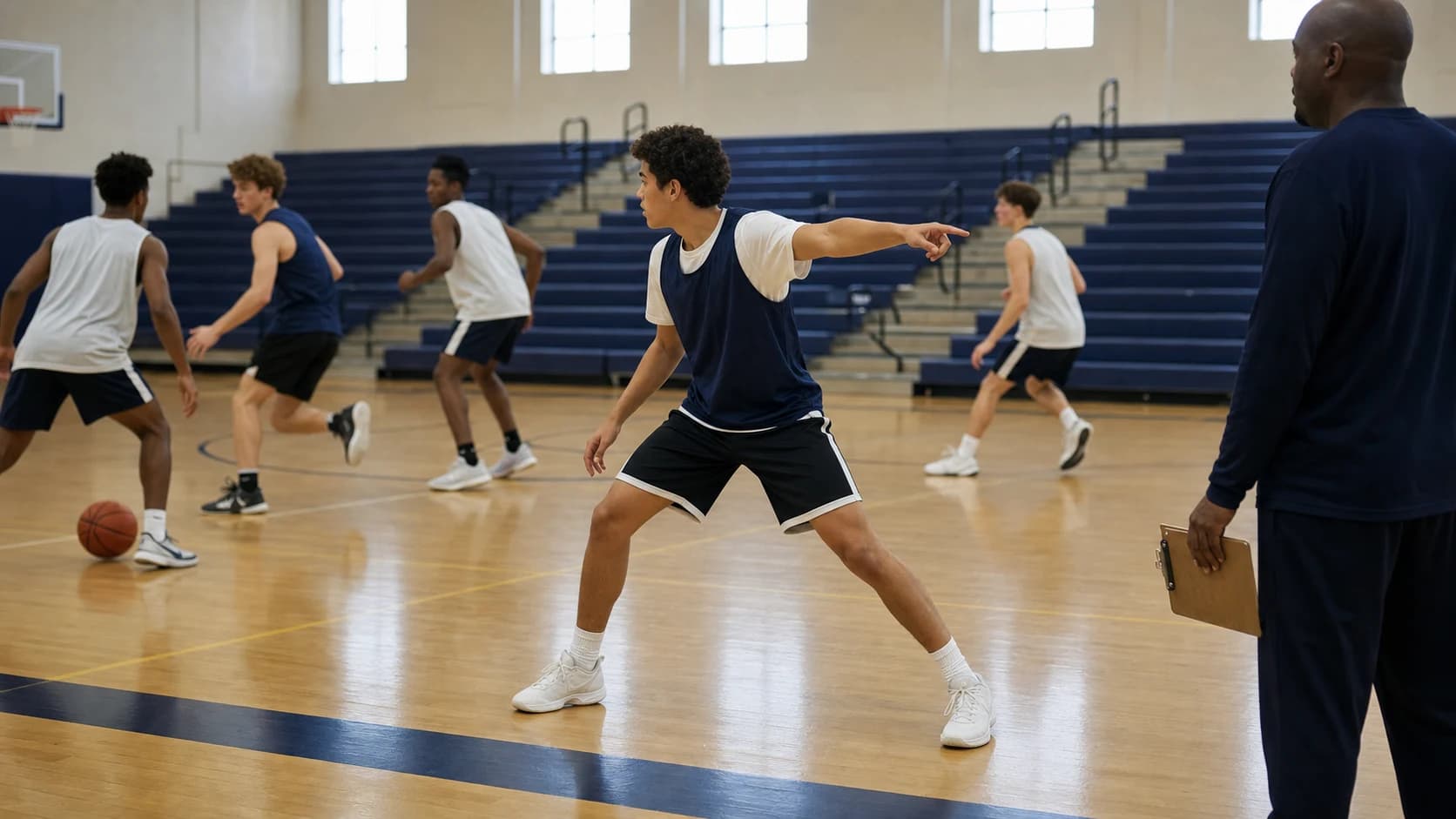
A tryout is not a highlight contest. It is a compressed test of trust.
The coach is building a lineup, not ranking isolated moves. Your job is to make your fit easy to see.
Coaches running the session can use the companion 90-minute tryout plan and evaluation rubric.
What Happens at Basketball Tryouts?
Most evaluations move from controlled actions to live play. The exact order changes, but the questions stay consistent.
| Tryout segment | What it appears to test | What coaches can actually learn |
|---|---|---|
| Warmup and footwork | Movement quality | Attention, pace, balance, and readiness |
| Ballhandling and finishing | Individual skill | Control, weak-hand comfort, and decision speed |
| Shooting | Makes and misses | Footwork, shot selection, preparation, and response |
| One-on-one | Scoring ability | Advantage creation, containment, and competitiveness |
| Small-sided games | Team play | Spacing, reads, communication, help, and role fit |
| Scrimmage | Overall performance | Whether the player can help a real lineup function |
One missed shot does not decide the day. The five seconds after it may.
Does the player sprint back, find a matchup, communicate, and make the next clean decision? Coaches remember that sequence because it predicts the next practice.
What Coaches Look For at Basketball Tryouts
Skill matters. Trust determines how the skill gets used.
A Repeatable Role
Choose one sentence that describes how you help a lineup.
Examples:
- I defend the ball and keep the offense moving.
- I space the floor, shoot clean catches, and attack long closeouts.
- I rebound, screen, protect the paint, and make the simple outlet.
- I organize pace, get two defenders involved, and find the next pass.
That sentence is not something you announce. It is something your possessions prove.
Trying to display every move usually hides the useful ones. A coach can place a dependable role into a lineup. A player who changes identity every touch is harder to trust.
Decisions Before Statistics
A make can still be a poor shot. A turnover can come from the correct read and a bad pass.
Coaches separate result from decision. They notice whether you saw the help defender, passed on time, kept spacing, and understood the score or situation. Scouts evaluate decision-making the same way.
Use a three-option rule when the ball arrives:
1. Shoot a clean, prepared catch. 2. Attack a real closeout. 3. Move it and relocate.
Do not add a fourth option called hold the ball and search for a highlight.
Defense Without Repeated Fouls
Defense is the fastest way to stay visible without demanding the ball.
Contain the first drive. See ball and assignment. Call screens. Close out under control. Finish with a rebound. If you are beaten, recover into the next useful position instead of reaching from behind.
The coach is not only watching stops. The coach is watching whether the other four defenders can trust your location.
Communication That Helps
Useful talk is early and specific.
Call the screen before contact. Point to the open matchup in transition. Say "help left," "cutter," or "shot" when the information changes a teammate's decision. Avoid noise that arrives after the play.
Communication is especially valuable during tryouts because unfamiliar players have no shared habits yet. The player who helps the group organize creates immediate value.
Response to Coaching and Mistakes
Every player will miss, turn it over, or lose an assignment. Coaches know that.
They watch the response:
- Do you make eye contact when corrected?
- Do you apply the instruction on the next repetition?
- Do you blame the passer or defender?
- Does your body language change your next possession?
- Can you recover without rushing to make up the point?
The next-play response is one of the quiet details coaches remember.
The 30-Day Basketball Tryout Plan
The plan has four phases. Each phase keeps a small number of priorities so the work transfers under pressure.
Week 1: Build an Honest Baseline
Record ten to fifteen minutes of live play. Do not use only makes.
Chart:
- Clean catch-and-shoot attempts.
- Paint touches created.
- Turnovers and the decision behind each one.
- Defensive possessions containing the first drive.
- Box-outs completed.
- Useful communication.
- Response after mistakes.
Then pick one dependable offensive skill and one defensive weakness. The offensive skill becomes your role anchor. The defensive weakness becomes your daily correction.
Keep skill work basic this week. Rebuild footwork, balance, both-hand control, and a repeatable pace.
Week 2: Make Your Role Obvious
Train the actions attached to your role.
A lead guard works on pressure releases, paint touches, early passing windows, and ball-screen reads. A wing works on shot preparation, relocation, closeout attacks, and one-more passes. A frontcourt player works on screen angles, seals, finishes, outlets, short-roll decisions, and rim protection.
Add role conditioning. Do not run only straight lines. Repeat the movements your role uses: defensive slides into a sprint, screen into a roll, cut into a closeout, or rebound into an outlet.
End sessions with five perfect role possessions. Quality is the standard, not exhaustion.
Week 3: Put Every Skill Under a Read
This is the transfer week.
Move from isolated repetitions into one-on-one, two-on-two, three-on-three, and advantage games. A skill counts only when you choose it against a defender.
Use constraints:
- A catch must become a shot, drive, or pass within one second.
- A paint touch must produce a finish or a kick-out.
- A defensive possession is not complete until the rebound is secured.
- A turnover must be followed by an organized transition-defense possession.
Ask a coach, trainer, or teammate to grade decisions instead of makes. If possible, use film like a player and review only three questions: what did I see, what did I choose, and what was open next?
Week 4: Simulate, Taper, and Organize
Run one or two tryout-style sessions early in the week. Include a warmup, short skill stations, one-on-one, three-on-three, and a scrimmage. Wear the gear you plan to use.
During the final 48 hours, reduce volume. Keep touch and rhythm. Do not chase a last-minute conditioning gain or rebuild your shot.
Write a three-line plan:
- My role: the sentence that describes how I help.
- My first defensive priority: the habit that keeps me playable.
- My reset cue: one word that returns me to the next possession.
Preparation should simplify your decisions, not add more thoughts.
How to Stand Out During the Tryout
Stand out by making the group better.
- Arrive early enough to handle registration and footwear without rushing.
- Listen through the full instruction before touching the ball.
- Sprint into formation and help reset drills.
- Learn teammate names when possible.
- Talk early on defense.
- Make the next pass when a teammate has the advantage.
- Take open shots without apology.
- Stop forcing the second action after the first one is gone.
- Rebound outside your area.
- Apply a correction on the next repetition.
None of these habits requires the coach to call a play for you. That is why they survive every tryout format.
How to Make the Team With Little Experience
Do not pretend to have a deeper bag than you do. Give the coach reliable information.
Defend with position. Pass to the open player. Sprint wide in transition. Keep the lane clear after a teammate drives. Box out. Ask one short question when an instruction is unclear, then apply the answer.
Choose low-error skills before high-difficulty moves. A simple player who learns quickly is useful in a developmental program. A player who forces difficult plays to look advanced creates more questions than answers.
Use the month before evaluations to learn basketball language too. Know the difference between ball side and help side, a closeout and a contest, a cut and a screen, and a switch and a stay. Understanding the instruction saves a coach time.
What Parents Should Do Before and After Tryouts
Parents help most by removing avoidable pressure.
Confirm the schedule, transportation, registration, physical requirements, and equipment. Let the player own the basketball preparation. Avoid turning the ride home into an instant film session.
Afterward, ask two questions:
1. What did you do that a coach could trust? 2. What is the first thing you would improve?
If the player is cut, wait for the initial emotion to settle before building a response. When appropriate, ask the coach for one or two specific development priorities. Do not ask for a debate about another player's roster spot.
The goal is not to make one evaluation painless. It is to make the player better at responding to evaluation.
The Final 24-Hour Checklist
- Registration and required forms confirmed.
- Shoes, water, reversible gear, and backup items packed.
- Route and arrival time checked.
- Normal meal and hydration routine maintained.
- No heavy new workout.
- Role sentence reviewed.
- Defensive priority reviewed.
- Phone away before entering the gym.
You do not need a perfect tryout. You need enough connected possessions for the coach to understand how you help.
Want to see the reads your position will face? Ask HoopBrief a real basketball question and get a scouting-style answer before the next workout.