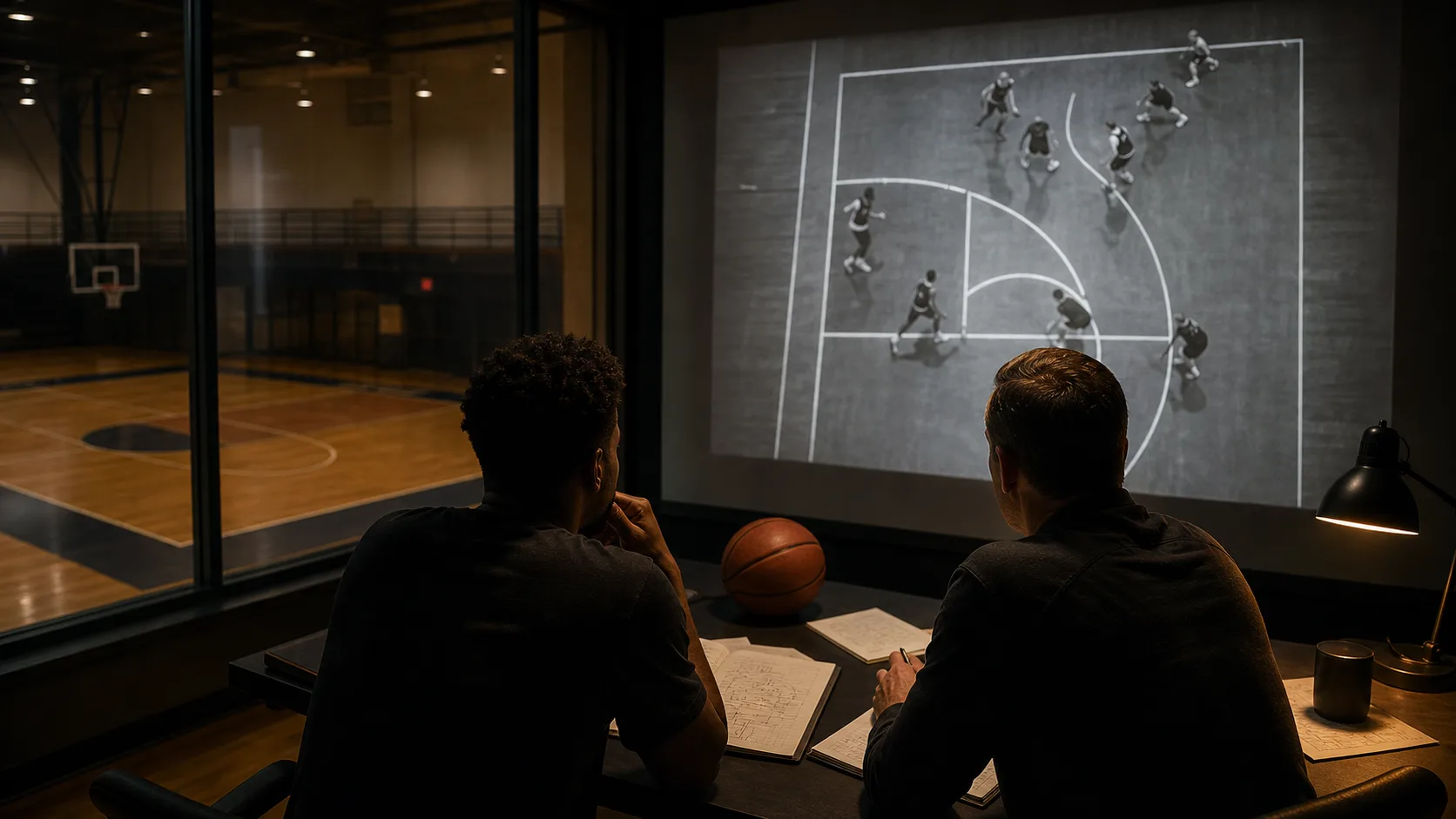
Coaches watch film to solve the whole defense. You do not have that job. As a player, film is for turning next week's game into a series of decisions you have already rehearsed. The goal is not to watch more, it is to walk onto the floor already knowing what your matchup does when you drive left. This is the same habit that separates players who plateau from players who keep climbing, and it is a core piece of basketball IQ.
How do you watch film of yourself as a player?
Watch your own tape in two passes with two different jobs. The first pass is a counting pass: tally every possession you touched the ball, how many clean looks you created, and how many turnovers plus their type. The second pass is a decision pass: pause the clip a half second before each choice and ask what the defense gave you, then whether you took it. Grade the read, not the make or miss.
Separating the read from the result is the whole point. If you come off a ball screen, the big is in drop, and you take the open pull-up at the free-throw line, that is a correct read whether or not it goes in. Reward the process and you will repeat it. Punish yourself for a missed good shot and you will start passing up good shots. Keep a running list of your three most frequent mistakes, turnovers into help, settling for contested pull-ups, missing the weak-side skip, and watch only for those the following week. A short, specific error list is how you actually improve, not a vague sense that you "played bad."
What should a player look for in an opponent's film?
Look for repeatable tendencies you can turn into if-then reads before the ball even moves. Focus on your direct matchup first: which hand they force you to, whether they go under or over ball screens, and how they close out. Then note your opponent's two or three most-run sets and the visual tell that starts each one. You are compiling a cheat sheet, not admiring highlights.
Concrete targets to write down:
- Your matchup's stance and hand. Do they load to your right hand every time? Then your counter is a hard right jab to open the left-hand drive.
- Screen coverage. Do they go under ball screens? That is a green light to walk into a pull-up. Do they fight over the top? Now the roll and the snake dribble open up.
- Closeout length. A defender who closes out long and out of control is a drive; one who closes out short is a shot.
- Help patterns. Where does the second defender come from when a teammate drives baseline? That is where your skip pass lives.
If you want to go deeper on the matchup itself, pair this with how to exploit a matchup and how to read a defense.
A worked example: scouting one possession
Say you are a lead guard and you are watching your next opponent's point-of-attack defender. You cue up a clip: a ball screen at the left slot, the on-ball defender goes under the screen, and the big drops to the level of the dotted line inside the paint. The ball-handler in the clip pulls up from the elbow and scores.
Here is what you extract as a player, not a coach. First, this defender goes under screens, so against them your first read is the pull-up, not the drive. Second, the big drops deep, which means the pocket pass and the short-roll are available if they help harder next time. Third, watch the on-ball defender's recovery: if they trail the play and never fully catch up, you can also snake the dribble back across their body and get downhill. You now have a three-read ladder for one action: pull-up first, pocket pass second, snake and attack third. That is one possession that just made you smarter for 40 minutes of live basketball. Doing this across ten possessions is exactly the study-a-player-in-10-possessions method.
How do you turn film into a game plan you can use live?
Convert everything into three to five if-then reads and nothing more. Your brain cannot run a 20-item checklist at game speed, so the film is only useful if it compresses into a handful of triggers you can recall under pressure. Write them on an index card, read them before warmups, and let the rest go.
| What you saw on film | Your live read |
|---|---|
| Matchup forces right hand | Jab right, drive left |
| Defender goes under screens | Walk into the pull-up |
| Big drops deep in coverage | Pocket pass or short-roll |
| Help comes from the weak-side corner | Skip pass to the open shooter |
| Closeouts are long and wild | Attack the front foot, get downhill |
The players who make the biggest jumps treat film as preparation for decisions, not entertainment. That mental discipline is one of the traits that shows up when scouts evaluate young players, and it is part of the honest path if your goal is making it to the next level. Want a second set of eyes on a matchup? Ask HoopBrief what your read should be against a specific coverage and get a possession-level answer back.