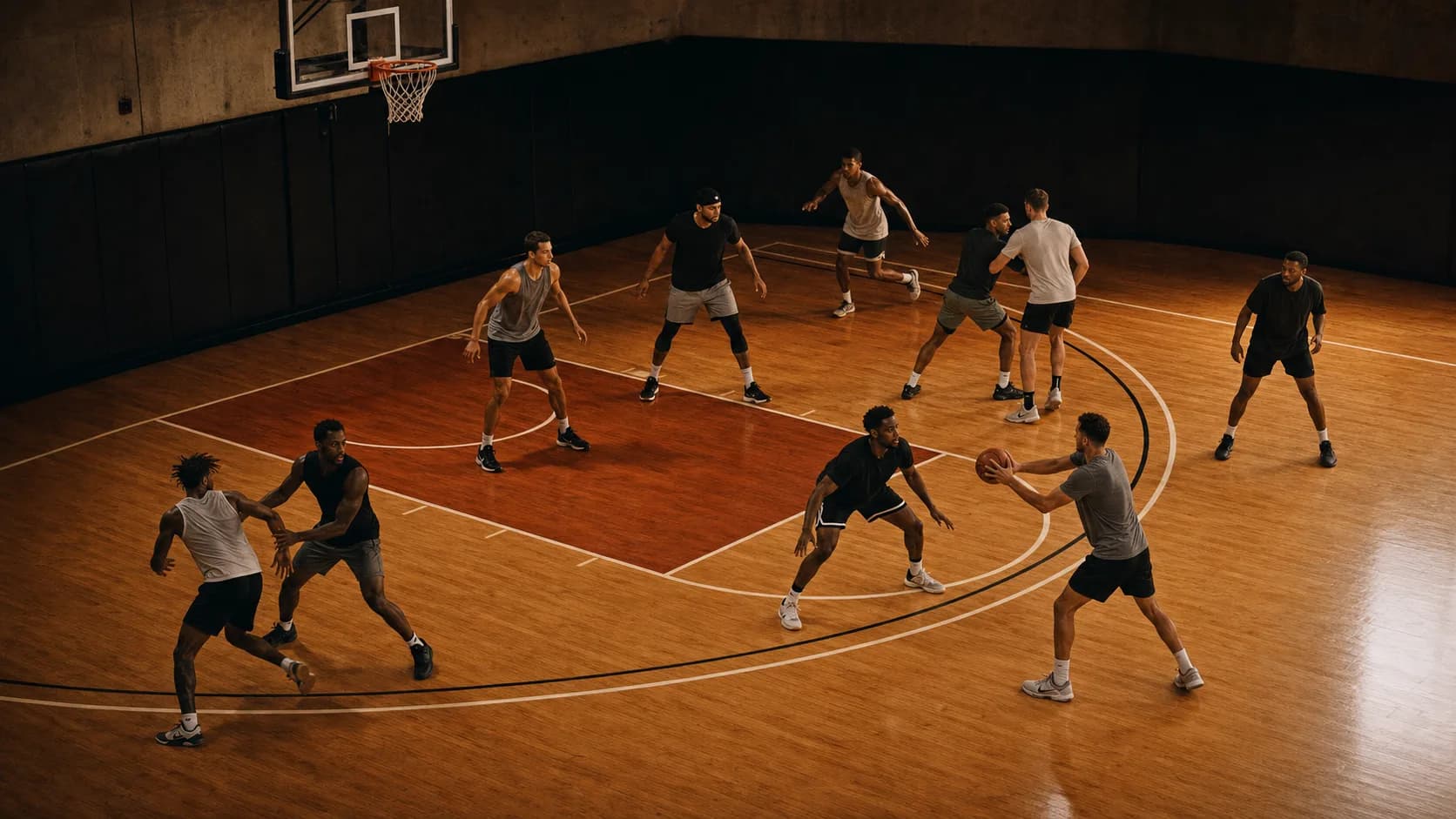
Basketball IQ is the speed and accuracy of your decisions on the floor - reading the defense, knowing where to be before the ball arrives, and picking the right action under pressure. It is trainable. The players coaches call "high IQ" built it on purpose: studying the game with a specific question, watching their own film honestly, and banking decision reps against better competition. Here is the exact method.
The loop that builds basketball IQ: - Study film with one lens per session, not ten - Learn to name what the defense is doing before the play develops - Self-scout your own film honestly every week - Take decision reps against players who are better than you - Repeat until the read is automatic
Most players train their body and their skills and never train their mind. That is the gap. Talent gets you into the gym. The quality and speed of your reads is what decides whether coaches trust you on the floor when the game is close.
What Is Basketball IQ, Really?
Basketball IQ is not memorizing plays or knowing every rule. It is decision quality under speed. A high-IQ player reads what the defense gives, anticipates the next action, and chooses the option that keeps the offense a step ahead - all in the time it takes the ball to travel from one hand to another.
The full definition, with examples of what high and low IQ actually look like on tape, is in basketball IQ, explained. The short version: IQ is what you do in the half-second before and after you touch the ball.
How Do You Actually Improve Basketball IQ?
You improve it by turning passive watching into active study. The difference is a question. A fan watches the ball. A high-IQ player watches one specific thing on every possession and builds a pattern library from it.
Start with one focused question per film session. Not "how do I get better," but something answerable: where does the help defender come from on a middle drive? What does this scorer do after two contested pull-ups get cut off? The film study guide walks through the structured habit, and how to study basketball like a pro covers the exact process staffs use.
How Do You Learn to Read a Defense?
Reading a defense means naming what it is doing before it fully happens. Defenses are not random. They run a small number of coverages, and each one gives up something specific. Once you can name the coverage, you know the counter.
Start with the pick-and-roll, because it is the most common action in basketball. Learn the four coverages - drop, switch, blitz, and ICE - and what each one concedes. Pick-and-roll coverages explained breaks down the math of each. Then add the off-ball layer: reading help defenders teaches you where the weak-side help stands and which pass is open because of it. When a switch happens, how to read a switch tells you who to attack and when.
What Role Does Decision-Making Play?
Decision-making is basketball IQ in its purest form. Two players can see the same read; the higher-IQ player chooses the option that keeps the advantage alive instead of the one that feels good. Scouts grade this directly - it is often the single trait that decides draft slot.
The skill is trainable through constrained reps: put yourself in a situation with a defined read and force the correct choice until it is automatic. How to improve basketball decision-making covers the drills and the framing. The goal is not to think faster. It is to have already seen the pattern, so you barely have to think at all.
How Do You Pre-Decide Before the Catch?
Most bad decisions are not bad reads, they are late ones. Players start reading only after they catch the ball, which leaves no time to choose, so they rush. Pre-deciding buys the time back.
The habit is simple. Before the ball comes to you, name your primary and your counter. "If the closeout is hard, I drive middle. If it is soft, I shoot." Now the defender's approach only tells you which pre-made plan to run, and the catch becomes a confirmation instead of a scramble. Spotting up in the corner and seeing your man help one gap into the lane, you have already decided to catch and shoot before he recovers, so you are in rhythm while a slower thinker is still reading the closeout.
Why Is Anticipation Worth More Than Speed?
Anticipation is what lets you arrive on time without elite quickness. Reacting means you move after the play happens, so you are always a step late. Anticipating means you move as the cue appears. A passer's eyes and shoulders point where the ball is going a beat before it leaves his hands. Read that, leave early, and the steal looks like quickness when it was really foresight.
This is why average athletes end up as the defenders coaches trust. How to anticipate plays in basketball covers the cue library worth building first.
How Do You Self-Scout Your Own Game?
You cannot fix a weakness you cannot see. Self-scouting is watching your own film with the same honesty a scout would - looking not for your best plays, but for the moments you get predictable, lazy, or emotionally reactive.
Record your games and watch them the next day, cold. The self-scouting blueprint gives you the framework, and ten blind spots coaches miss shows you what to look for. A useful drill: study a single player in 10 possessions - do it to an NBA player first, then do it to yourself. The exercise is the same one scouts run.
Where Do You Stand? Positioning IQ
A large part of basketball IQ is spatial - knowing where to be when you do not have the ball. Good positioning turns average athletes into reliable defenders and turns scorers into players who are always in the right spot to finish or kick.
Positioning IQ covers where to stand on defense so you are ready to help without giving up your own man. This is the least glamorous part of IQ and the fastest to improve, because most players simply never think about it.
Grade the Read, Not the Result
The habit that stalls most players is grading decisions by outcomes. If you judge a read by whether the shot fell, you will keep bad reads that got lucky and abandon good reads that missed. That trains you toward chaos.
A good decision that misses is still a good decision. Watch your film with that rule and the honest count changes: fewer of your makes were correct reads than you assumed, and more of your misses were. One related trap worth naming, smart is not the same as cautious. A high-IQ player is decisive, just correctly so, and he looks faster than everyone else precisely because he decided earlier.
The Weekly Basketball IQ Routine
You do not need hours. You need consistency and a question. Here is a routine that compounds:
1. One film session per week with a single lens. Pick one player, one action, or one coverage and track it every possession. Twenty focused minutes beats two passive hours. 2. One self-scout per week. Watch your last game cold and write down two things you did predictably. 3. Learn one coverage or concept per week by name, so your vocabulary grows. A read you cannot name is a read you cannot repeat. 4. Take decision reps against better competition. Pickup against players who punish bad reads teaches faster than any drill. 5. Ask one hard question and answer it with film, not opinion. The film does not lie.
One way to train the reads off the court: ask a specific basketball question and study how a scout would break it down. That is what the HoopBrief Matchup Engine does, on Starter at $9.99/mo - it turns "how would a staff attack this player" into a concrete answer you can study.
This Is Not for Everyone
If you want a shortcut, this is the wrong approach. Basketball IQ does not come from a highlight reel or a single viral drill. It comes from unglamorous, repeated study - the kind most players quit after two weeks because it does not feel like training. If you are not willing to watch your own bad possessions honestly, your IQ will stay where it is no matter how much you score.
But if you will do the weekly loop, the compounding is real and it is fast, because almost nobody else is doing it.
The Bottom Line
Basketball IQ is not a gift. It is a habit. Study with a lens, learn to name what the defense does, self-scout honestly, and bank decision reps every week. Do that for one season and you will read the game a half-second ahead of the player across from you - and that half-second is what coaches mean when they say a player "just gets it."
Keep going: basketball IQ explained, how to study basketball like a pro, and reading help defenders.