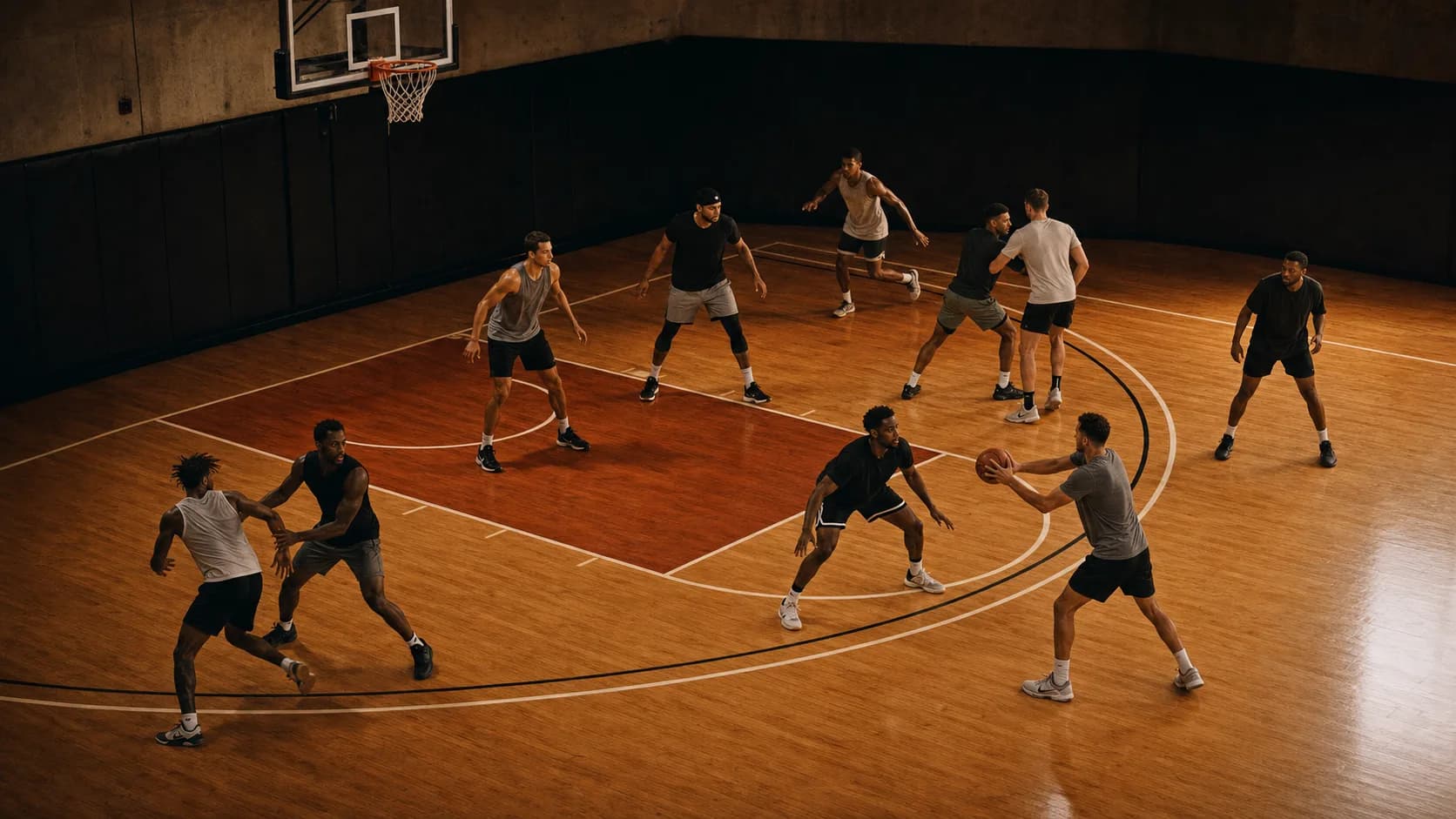
Ask any NBA scout what separates a college star from a pro. They'll all give you a version of the same answer: he sees help. The skill of reading help defenders is what turns 28-point college scorers into 12-point pros, and 18-point college scorers into All-Stars.
Why Help Reads Are Everything
In a half-court NBA possession, the on-ball defender is rarely the player who decides the possession. He's there to influence direction. The actual stop comes from one of the other four, the help defender. If you don't see him before you commit, you've already lost.
Help is the geometry of basketball. Five defenders cover five attackers. Wherever the ball goes, the other four defenders shift to cover the gaps. The shift is help. Reading help means seeing where the gap is, where help is closing, and where the next pass goes.
The Three Types of Help
1. Low-man help. When the ball drives baseline, the weak-side defender lowest to the basket rotates over to take the charge or contest the shot. He's the low man. His shift opens up the weak corner.
2. Nail help. When the ball drives middle, a defender shifts to the nail (the dot in the middle of the free-throw line). He's the nail helper. His shift opens up either elbow.
3. Weak-side rotation. When the ball is in the paint and the low man has stepped over, the next defender out (usually on the weak wing) rotates to cover the corner the low man left. His shift opens up the weak wing.
Every drive triggers all three. The IQ test: which one happens first, where does it leave a gap, and how do you find it?
The Eye Discipline
Most young players watch the rim or the on-ball defender. Pros watch help.
The cue is simple. As you drive, your peripheral picks up the help defender's first step. If you see him commit toward the ball, you don't finish, you kick. If you see him stay home, you finish. The decision happens in the half-second between gathering the ball and going up.
The drill: pick a help defender at the start of every possession. Watch his shoulders. The shoulders tell you everything. Shoulders square to the ball means he's committing. Shoulders square to his man means he's staying home. Read shoulders, not feet. Feet lie. Shoulders don't.
Pre-Reading Help
Elite scorers don't read help mid-action. They pre-read. Before they catch the ball, they already know where help is, who's distracted, and what their first move should be.
Pre-reading is what makes Steph Curry's catch-and-shoot look so easy. Before the ball arrives, he's already seen the closeout angle, the help defender's stance, the weak-side rotation. The decision is made in the air. The execution is just muscle memory.
The drill: play possessions where you can't dribble for the first three seconds after the catch. The dribble is a thinking crutch. Without it, you have to read the floor and pass, which forces you to see help in real time.
The Skip Pass: A Help Test
The best way to test a defense's help is the skip pass. Drive hard. Force the help to commit. Skip the ball cross-court to the open shooter on the weak wing. If the defense rotates fast, they rotate to a closeout. If they rotate slow, you have a clean three.
Every skip pass is a help test. Teams that defend skips poorly, Sacramento, Indiana, Phoenix in recent years, get torched by it. Teams that defend skips well (Boston, OKC) make their living off forcing teams to skip and then closing out hard.
If you're a guard, learn to skip on demand. It's the most-undervalued passing skill in basketball.
Reading Help on Closeouts
Help works the other way too. When you're closing out to a shooter, you have to read where the next help comes from. If you closeout too hard, you're asking your help to bail you out, which means you've created a 4-on-3 elsewhere. If you closeout too soft, the shooter takes the open three.
The best closeout defenders read help backward. They see the closeout angle, see the help behind them, and adjust the closeout to match. Hard closeout if the help is loaded. Soft closeout if it's not.
Help and the Skip-Back
The skip-back is the answer to a defense that loads help. You skip to the weak side, the defense rotates, and then you swing the ball back to the original side, where the help just came from. The original-side defender, who closed out to help, is now out of position. You have a clean shot or a clean drive on his closeout.
Watch any Boston playoff possession and count the skip-backs. They're built around them. The Celtics live in the math of "force help, then attack where help came from." The result is the most-efficient half-court offense in the league.
The Quiet Edge
The next time you watch an NBA game, don't watch the ball. Watch the weak-side defender on every possession. Notice when his shoulders square to the ball. Notice when they don't. Notice the moment he commits. The whole game makes sense once you see help as the actual decision-maker.
The ball-handler is the actor. The help defender is the writer. Read the script before the actor speaks, and you'll always be a step ahead.
Keep reading: off-ball cutting, court vision development, and reading a closeout.