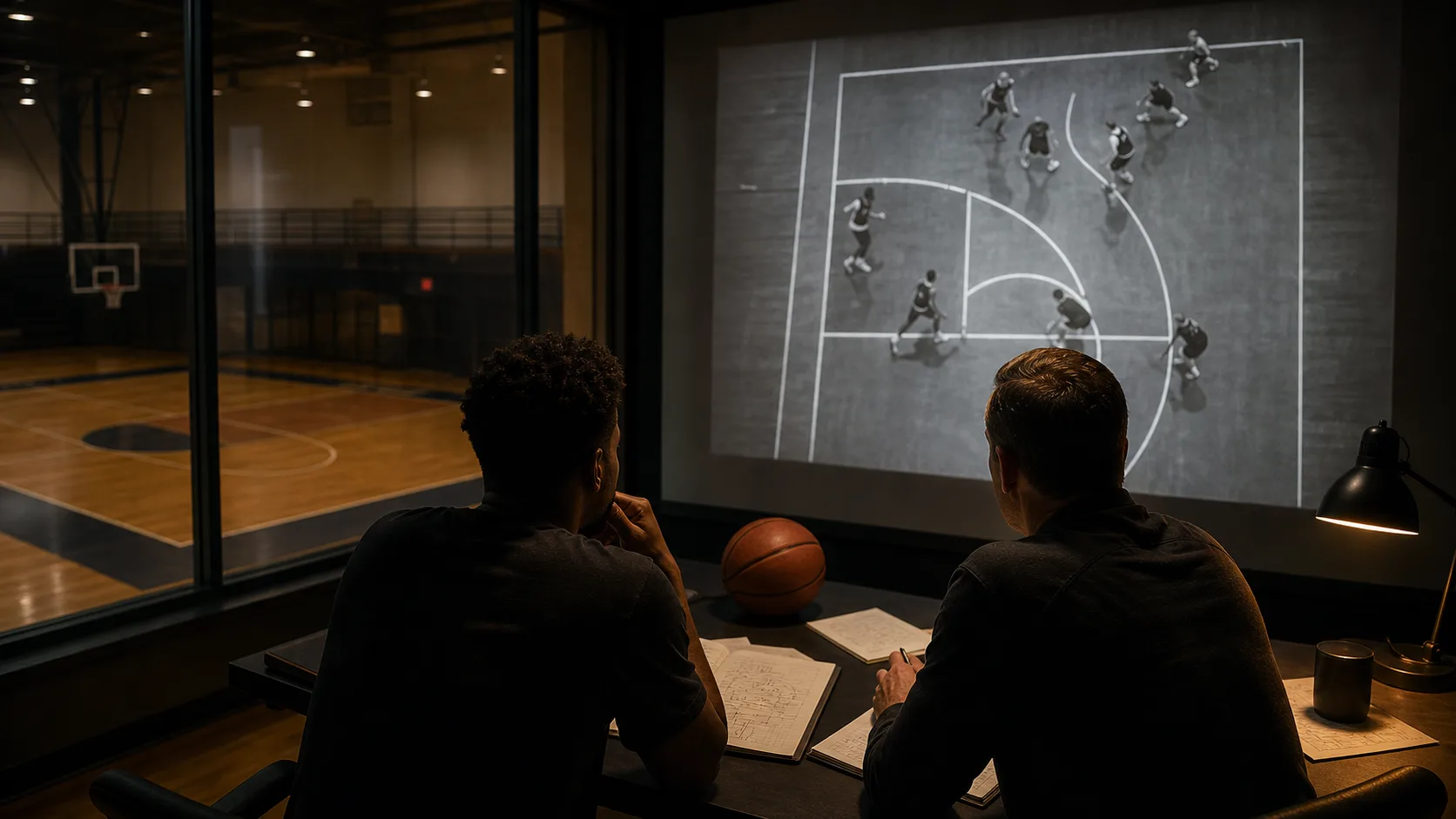
When a coach watches a Conference Finals game, his eyes are not on the ball. They're scanning everywhere else, the four off-ball players, the bench, the ref crew, the opposing coach's body language during a timeout. The ball-handler is the easiest player to see; coaches assume the broadcast will show him, and use the rest of their attention on the other 95% of the action.
You can train the same habit. Here are the five things to track that turn a casual viewing into a coaching viewing.
#1: The First Three Seconds
Before any action starts, every possession has a setup phase, the three seconds between the inbounds (or rebound) and the first play call. Coaches watch this phase obsessively because it tells you what's coming.
What to track:
- Where does the point guard pass first? The first pass tells you which side the play is going to.
- Who sets up at the elbows? If both bigs are at the elbows, expect Horns. If one big is on the block, expect a side action.
- Is the off-ball wing moving or static? A wing who walks to the corner and stops is a decoy. A wing who's already moving on the catch is the cutter.
Three seconds of setup tell you 80% of what the action will be. A coach has already predicted the play before the first dribble.
#2: Weak-Side Gravity
The weak side of the floor is where games are won. Watch the two weak-side players on every possession, not the ball.
- Where do they stand? A shooter at the weak-side corner with a defender 4 feet off has more "gravity" than a shooter at the wing with a defender face-guarding him.
- When does the help defender step in? If the help arrives early, the corner is open. If it arrives late, the rim is open.
- Does the weak-side shooter cut? A simple lift cut from the corner to the wing changes the help geometry entirely.
Weak-side gravity is the single largest "advantage created" lever in modern basketball. The team with more of it wins more possessions, regardless of who has the ball.
#3: Closeout Discipline
When a defender is closing out on a shooter, three things can happen: he can be square (good), he can have his hips open (bad), or he can over-pursue (worst). The closeout determines whether the next move is a shot, a drive, or a kick-out.
Track every closeout in a 4-minute stretch. You'll learn which defenders close out badly under what conditions, and you'll predict the next four shots that come from breakdowns. Coaches do this every game.
#4: Possession-Ending Shape
When the shot goes up, where are the five players? This is "possession-ending shape," and it's the most under-watched detail in basketball.
Two things to track:
1. Transition prep. Are players already turning the other way? If the offensive team has 4 players in the paint when the shot goes up, they're conceding transition. 2. Offensive rebounding angles. Is the strong-side wing on the boards or fading to defend? The ones who are on the boards turn into second-chance points; the ones who fade are protecting against fast breaks.
A team that wins possession-ending shape is +3 to +5 points per 100 possessions versus a team that doesn't, regardless of half-court output.
#5: ATO Reaction Time
After every timeout, the offense runs a called play. Watch how fast the defense recognizes it.
- Recognition under 2 seconds: the staff scouted the play and the defender knew the call before the cut.
- Recognition 2-4 seconds: typical.
- Recognition over 4 seconds: the staff either didn't scout the play or the offense ran something new. This is where points come.
A staff that consistently recognizes ATOs in under 2 seconds is doing elite scouting work. A staff that's at 4+ across multiple possessions has a real problem, and the offense will exploit it for the next two games.
A Cheat Sheet for Tonight's Game
For your next Conference Finals viewing:
- Pre-possession (3 seconds before the play): watch the setup
- Mid-possession (the action): watch the weak side, not the ball
- Closeouts: grade each one square / hips / over
- Shot release: where are all 5 players?
- After timeouts: how fast did the defense react?
If you do all five for a single quarter, you'll see the game differently for the rest of the series.
Final Thought
The reason coaches and players see a different game from fans isn't that they're smarter. It's that they're trained to look at the parts of the floor that the broadcast doesn't focus on. Once you train the same habit, the box score stops being the main story, the off-ball, weak-side, possession-ending details take over.
The HoopBrief Ask product is built to answer the questions that come out of this kind of viewing. "What did the weak-side defender do on that possession?" "Why did the closeout fail?" "What ATO did they run there?" The questions are the entry point. The answers are how you build the coaching eye.
Keep reading: the 12-lens system, Conference Finals adjustments, and 12 Conference Finals micro-behaviors.