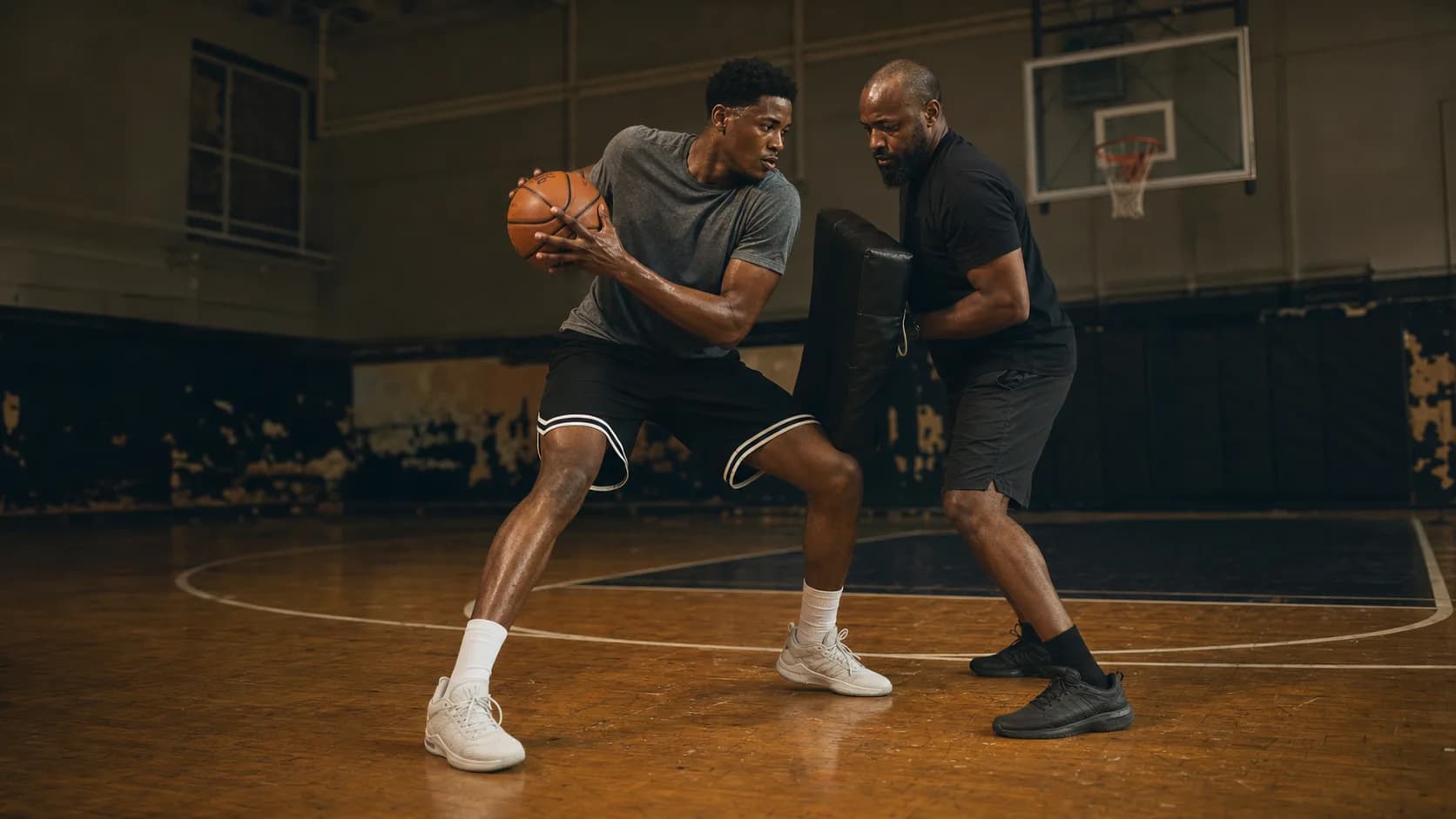
Basketball IQ is one of the most talked-about concepts in the sport. Coaches praise it. Scouts look for it. NBA front offices include it as a separate evaluation category. But what does it actually mean, and how do you train something that sounds like raw intelligence?
The Real Definition
Basketball IQ is the ability to recognize what's happening on the court and make the right decision before the moment passes. It is pattern recognition combined with decision-making speed.
A player with high basketball IQ reads the defense and knows where the open man will be before the ball gets there. They anticipate rotations, recognize mismatches, and understand spacing, not as abstract concepts, but as real-time information that drives their decisions.
The key word is "before." Average players react to what they see. High-IQ players act on what they expect. That half-second gap is the entire difference.
The 5 Components of Basketball IQ
Basketball IQ isn't one skill. It's five interlocking ones, and most player-development programs only train two of them. The complete framework:
1. Pattern Recognition. Seeing the action before it develops. A defender's hip angle, a screener's footwork, a teammate's eye contact, each is a signal that predicts what's about to happen. Pattern recognition is built through reps plus film study, not through theory.
2. Decision Speed. Choosing the right action in 0.5 seconds or less. Decision speed is what converts pattern recognition into output. You can see everything correctly and still lose the possession by hesitating.
3. Spacing Awareness. Knowing where the four other offensive players are at all times. Spacing awareness is rarer than pattern recognition because it requires constant updating, every cut, every rotation, every defensive rotation changes the floor.
4. Anticipation. Knowing what's about to happen two actions ahead. Anticipation is what separates good IQ from elite IQ. Pattern recognition reads the current action; anticipation reads the next one.
5. Self-Awareness. Knowing your own tendencies and how defenses scout you. The self-scouting framework is the player-side version of this skill.
It's Not Just Knowledge
Knowing basketball concepts is different from having basketball IQ. You can understand pick-and-roll theory perfectly and still make bad decisions in games. Basketball IQ is applied knowledge, the ability to use what you know in real time, under pressure, with the clock running.
This is why classroom basketball doesn't transfer to game basketball. The reps have to happen at game speed, against live defense, with consequences. The film study guide walks through how to bridge the gap between theoretical understanding and live application.
How to Build It, The 5-Step Process
Step 1: Watch film with questions. Don't just watch games, study them. Before each possession, try to predict what will happen. Where will the ball go? What action will they run? Where will the help come from? The how to study basketball like a pro guide covers the structured film-study habit that compounds basketball IQ within 6-8 weeks.
Step 2: Play against better competition. Your IQ grows fastest when you're forced to make decisions quickly against players who punish mistakes. Bad defense doesn't reveal patterns; good defense does. Find the highest-level competition your situation allows and play against it as often as possible.
Step 3: Study tendencies. The more you understand about how specific players and teams operate, the better you can anticipate what's coming. This is why scouting matters at every level. NBA staffs build scouting reports precisely so their players can rely on pattern recognition instead of in-game decision-making.
Step 4: Slow down mentally. High-IQ players often look like they're playing slowly because they've already processed the situation before it develops. They're not faster, they're earlier. The mental skill is staying calm enough to see the floor instead of reacting to your defender.
Step 5: Get coached. A good coach will explain not just what to do, but why. Understanding the reasoning behind decisions accelerates your IQ development dramatically. Look for coaches who narrate the read after the play, not just the result.
The Specific Reads That Define High Basketball IQ
Five specific reads that the highest-IQ players make consistently:
- Reading help defense. Where is the second defender, and which direction is he leaning? The reading help defenders framework covers the three help types and how to exploit each.
- Reading screens. Coverage type, drop, switch, blitz, ICE, has to be diagnosed in 0.5 seconds. The pick-and-roll coverage guide covers both the coverages and the counters that beat them.
- Reading closeouts. The closing defender's hip angle and hand position dictate whether to shoot, drive, or pump-fake. The closeout reading piece walks through the three signals.
- Reading rotations. When the help arrives, where is the next gap? Anticipation of where the kick-out will be open before the dribble is killed.
- Reading the clock. What play call works at 8 seconds vs 4 seconds? Late-clock IQ is its own subskill that NBA staffs evaluate separately.
The Payoff
Basketball IQ is the great equalizer. It allows less athletic players to compete with more athletic ones. It turns good scorers into complete players. It transforms defenders from reactive to anticipatory.
And unlike vertical leap or sprint speed, basketball IQ has no ceiling. You can always get smarter. You can always see more. You can always make better decisions. Players in their thirties who lose a step often see their basketball IQ continue to climb, which is why role players with elite IQ extend their careers years past their athletic primes. The role-player blueprint walks through exactly how this compounds.
How NBA Scouts Evaluate Basketball IQ
Scouts grade basketball IQ on a 1-10 scale, with the score weighting roughly 25% of total prospect evaluation by 2026, up from ~15% a decade ago. The grading inputs:
- Decision rate (correct reads per possession, derived from possession-by-possession film tagging)
- Anticipation quality (defensive rotations, off-ball cuts that arrive with timing)
- Late-clock execution (what you do in the last 4 seconds)
- Body language between possessions (do you reset, recover, communicate?)
Elite prospects (top 30 in any draft) sit above 70% on the decision-rate metric. Average college players sit around 55-60%. The gap is not skill, it's pattern recognition built through film and reps.
The Bottom Line
Basketball IQ is trainable. It is not innate. The players who develop it are the players who watch film with questions, study tendencies, play against tougher competition, and seek out coaches who explain *why*. The five-component framework above is the structure; the daily practice is what builds it.
Keep reading: reading help defenders, studying basketball like a pro, and the film study guide.