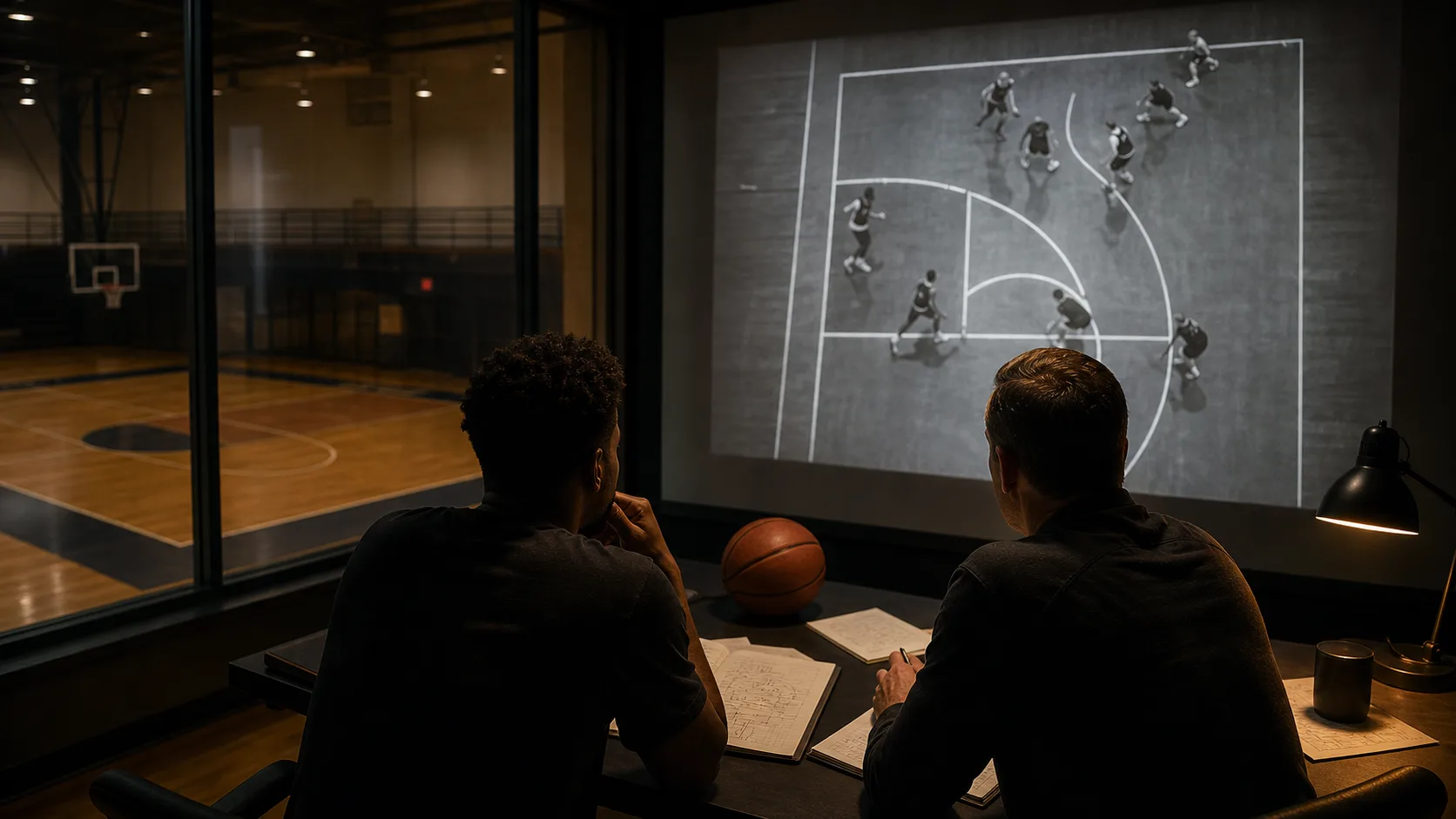
Basketball film study works when every viewing has one question and produces one adjustment. Watch the same possessions in two passes: first identify the repeated action, then pause immediately before the decision and write the read that was available. A player should leave with one behavior to rehearse. A coach should leave with three opponent priorities the team can execute.
Passive game watching does not count. Full possessions, a narrow question, and notes written as if-then rules are what turn film into decisions on the floor.
For Players: How to Watch Your Own Film
Watch full possessions, not highlights. Your best plays are nice to see, but they don't teach you anything. Focus on the possessions where things didn't work. What went wrong? Was it a decision problem, a positioning problem, or an execution problem?
Watch without sound. Sound is distracting. It adds emotional context that clouds your judgment. Watch the action, not the commentary.
Focus on one thing at a time. Don't try to evaluate everything in one viewing. First pass: watch only your offensive decisions. Second pass: watch only your defensive positioning. Third pass: watch only your off-ball movement.
Take notes. Write down specific things you notice. "I caught the ball too low on the wing - should catch higher." "I went under the screen when I should have fought over." Specific notes lead to specific improvements.
For Coaches: How to Scout Opponents
First viewing: understand their system. What do they want to do? What's their primary offense? What's their defensive scheme? Don't take notes - just watch and understand.
Second viewing: personnel. Now focus on individual players. What are their tendencies? What do they do well? Where are they vulnerable? What are their micro-behaviors?
Third viewing: specific situations. What do they run after timeouts? What's their end-of-game offense? How do they defend specific actions? What adjustments do they make?
Build the scouting report from your notes, not from stats. Stats tell you what happened. Film tells you why - and what you can do about it.
For Fans: How to Watch Basketball Like a Coach
Watch away from the ball. The camera follows the ball. You should watch what's happening away from it. Watch the weak-side defenders. Watch the spacing. Watch how players position themselves before the action starts.
Count the ball movements. On great possessions, the ball moves. On bad possessions, it sticks. Count the passes. Great offense usually involves three or more ball movements before a shot.
Watch the defense. Pick one defender and follow them for an entire possession. Watch their stance, their positioning, their help rotations, their closeouts. This is how you learn to see defense.
The Weekly Film-Study Routine
Most people who say they study film actually watch it. The difference is the routine. Here is the structured weekly schedule that NBA assistant coaches and elite trainers actually use:
Monday: Self-scout (60 minutes). Watch your own most recent game. Filter to your individual possessions. Tag every decision moment with a 1-5 rating. Write three notes: one decision pattern to fix, one positioning fix, one off-ball fix. The self-scouting blueprint covers this routine in detail.
Tuesday: Opponent prep (45 minutes). If you have an upcoming opponent, watch their last 2 games. Focus on personnel, your matchup, then their primary scorer, then their playmaker. Note 3 tendencies per player. The scouting report build framework covers the structure.
Wednesday: Skill-specific film (45 minutes). Pick one skill you're working on. Watch 30 NBA possessions of the best players in the league doing that skill. Take notes on technique. The pick-and-roll coverage guide is the right primer for defensive film work.
Thursday: Tactical film (45 minutes). Pick one offensive or defensive concept. Watch how 5 different NBA teams execute it. Look for the variations that succeed and the variations that fail.
Friday: Free study (60 minutes). Watch whatever interests you. Curiosity is the most-underrated source of basketball IQ.
Saturday/Sunday: Game day or rest. No prescribed film work.
Total: ~4 hours/week. The same volume the most-disciplined college players invest in film. Sustained across a season, this routine produces basketball-IQ gains visible by week 6.
The Three Most-Common Film-Study Mistakes
1. Watching highlights instead of full games. Highlights show outcomes; full games show patterns. The boring possessions are where decision-making, defensive habits, and off-ball positioning are visible. Skip the highlights. 2. Watching too much, too soon. A 4-hour film session produces less retention than four focused 60-minute sessions across a week. Spaced repetition outperforms cramming, just like academic learning. 3. Watching without a question. Passive watching is entertainment, not study. Every session starts with a specific question, "how does this defender handle drop coverage?", and ends with a written answer.
What Coaches Catch That You Won't (Yet)
Five things experienced coaches see in film that novice viewers miss entirely:
- Pre-snap looks. What defenders are doing in the 2 seconds before the play starts, hip angles, hand positions, eye direction.
- Off-ball gravity. How shooters affect the geometry of the help defense without touching the ball.
- Possession-ending shape. Where the five offensive players are positioned at the moment the shot goes up (for transition defense).
- Communication timing. Verbal calls happen on a clock, too early and they're not heard, too late and they're useless. Coaches read the timing as a discipline signal.
- Body language between possessions. What does a player do in the 5 seconds after a mistake? Reset or sulk? This is the trait that decides playoff minutes. The coach trust framework covers why.
The 12-lens framework is the structure that experienced coaches use to keep all five of these in view simultaneously. Read it next.
The Bottom Line
Film study isn't a chore, it's a competitive advantage. The more you watch, the more you see. The more you see, the better your decisions become. And better decisions win games.
But the volume matters less than the structure. A player who watches 60 minutes per week with questions outproduces a player who watches 4 hours per week passively. Build the routine. Stick to it. Compound it across a season. The basketball-IQ gain is the most reliable improvement available to a serious player.
Keep reading: how to study basketball like a pro, reading help defenders, and 12 coaching lenses.