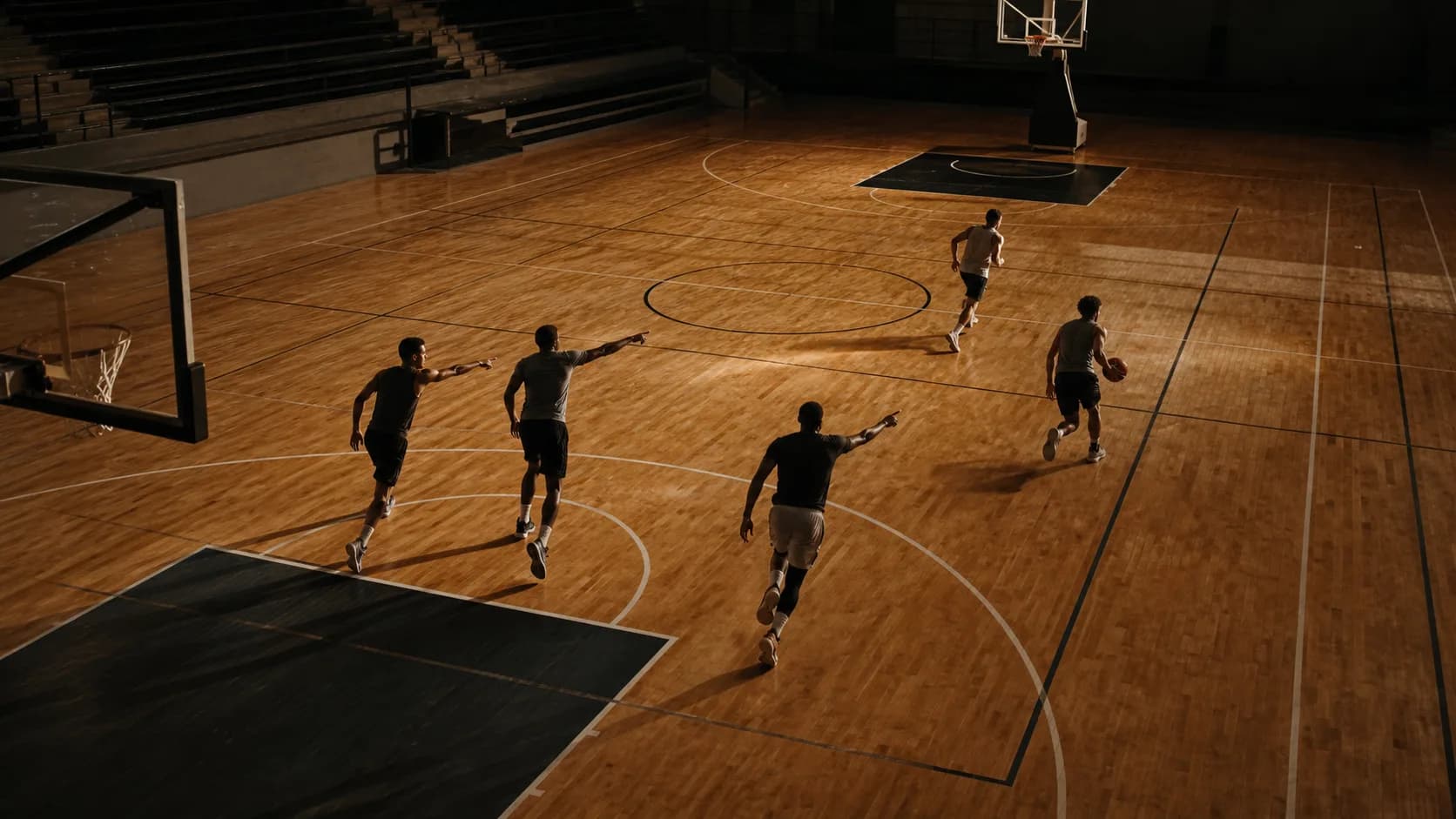
Statistically, transition is the most efficient offense in basketball. League-wide, transition possessions yield around 1.31 points per possession; half-court possessions yield about 1.04. If you want to win games, the first thing to fix is often the last thing to get coached: the five seconds after a missed shot or a turnover.
This piece is the primer, the foundational principles every coach teaches at every level. For the pro-level deep dive on communication and live reads, read NBA transition defense: the 5-second rules.
Why Transition Is Where Games Are Lost
The math is unforgiving. A team that gives up 12 transition possessions a game will lose to a team that gives up 6, even if the half-court defenses are identical. The PPP framework explains why: a 0.27 PPP gap, multiplied across 6 extra possessions, costs 1.6 points per game. That single bucket separates an average defense from a top-five one.
Principle 1: The Shot Creates the Transition
Transition defense starts before the shot goes up. The offensive players' floor balance at the moment of the shot determines whether you can recover.
Most transition breakdowns happen when:
- The shooter crashes the rim looking for an offensive rebound
- Two players cut on the same side simultaneously
- The point guard doesn't get back to the three-point line
- The big trails the play after a rebound attempt and never recovers
Before the shot, one player should already have their head back. That's non-negotiable. Most coaches assign a designated safety, usually the point guard, who never crashes the offensive glass.
Principle 2: Sprint the First Three Steps
Every possession, the first three steps back determine everything. Jog, and you lose five feet you'll never get back. Sprint, and you reset the math.
This is a conditioning issue more often than a discipline issue. Players who aren't in condition default to jogging. Fix the conditioning, you fix 40% of your transition D. The basketball conditioning framework covers the energy-system work that produces sprint-back ability in the fourth quarter, not just the first.
Principle 3: Protect the Paint First, Then Match
The first defender back sprints to the paint, not to their man. You stop the ball at the rim first. Matching up happens once the paint is protected.
Teams that match first get scored on layups. Teams that protect the paint first give up kickouts they can close out to. The closeout footwork piece covers the technique for the closeout that follows.
Principle 4: Communicate Early
The first defender back calls: "I got ball!" The second calls their assignment. Early communication prevents double-guarding and leaving shooters. Every NBA transition possession has at least three verbal calls before the ball reaches half-court. Most amateur transition defenses run in silence, which is why they lose.
The Common Mistake: Watching the Ball
Players who stand and watch the ball after a shot are the single biggest source of transition breakdowns. The eyes track the ball to the rim. The body needs to already be moving back.
Train this out. It's a habit, not a decision. Drill it in practice by penalizing every player who watches the rim after a shot, sprint, no exceptions.
The Floor-Balance Discipline
Floor balance is the underrated cousin of transition defense. The four offensive players who aren't crashing the glass have specific positioning responsibilities:
- One safety at the foul line, head turned back
- Two players in the slot positions
- One player on the wing, ready to retreat
This shape means the defense recovers into a five-man unit with two players already at the line of the basket. The offense has to score against a defense; not against chaos.
Fixing Transition in Practice
- End every offensive drill with a transition rep. The offense must sprint back every time, even if the coach blows the whistle to end the play.
- Grade transition D on the first three steps, not the outcome. Process, not result.
- Show film every week. Watching your own transition mistakes is the fastest way to fix them.
- Drill the 4-on-3 / 5-on-4 cascade. The first defender stops the ball. The second protects the rim. The third sorts assignments. The fourth and fifth fill into a shell.
Where to Go Deeper
These four principles are the foundation. The 5-second rules piece walks through the communication-bound NBA version, the cross-match problem, the outlet-pass denial, and the verbal cues every player has to make in the first five seconds after a possession ends. If this primer was the *what*, that piece is the *how* at pace and speed.
Transition defense is the single largest fix a team can make. Start with the principles. Master the principles. Then move to the live-rep version, and watch the rest of your defense compound.