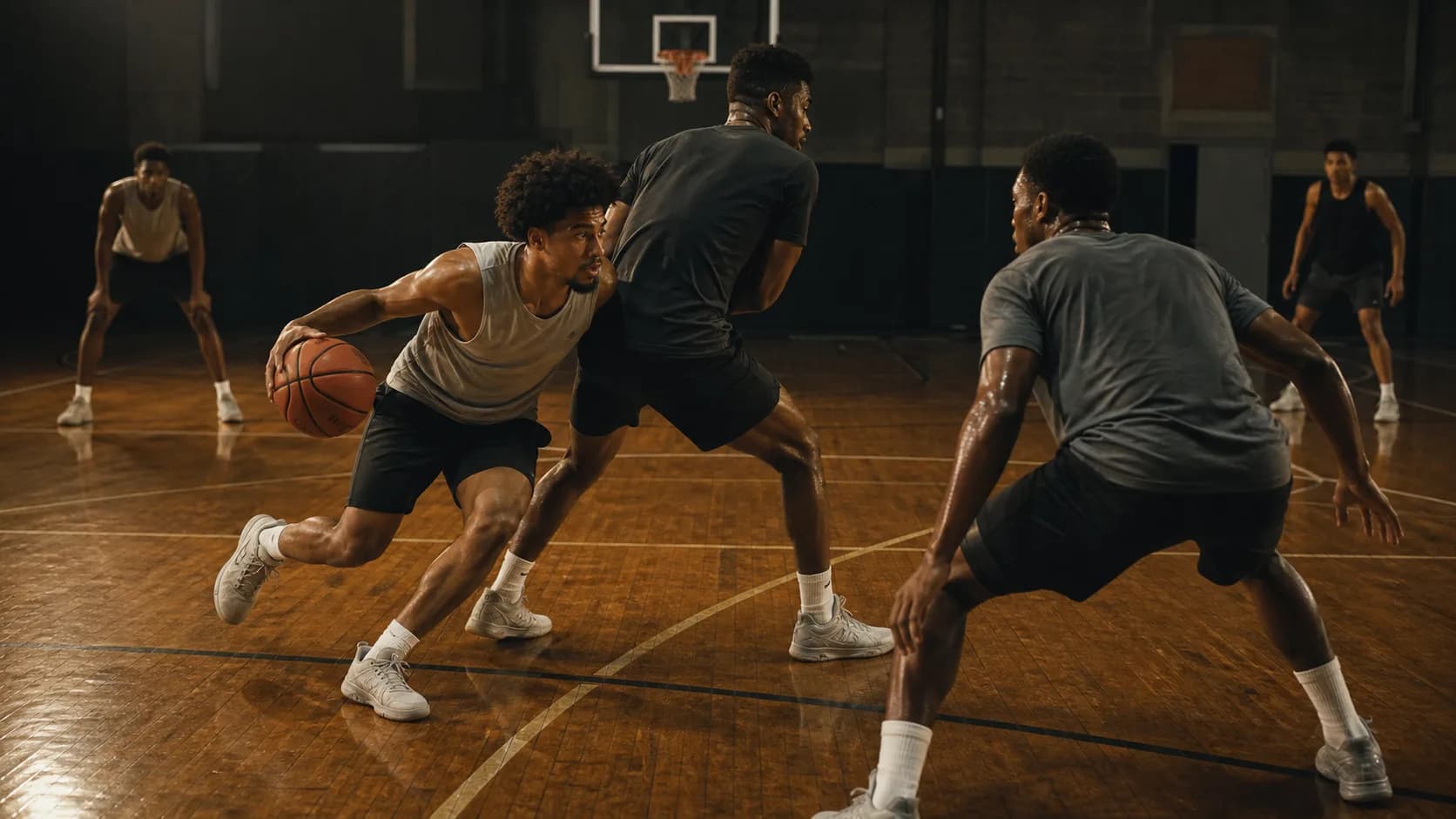
- ball
- defender
- offense
- the read
The pick-and-roll is the most-run action in basketball, accounting for roughly a third of all NBA half-court possessions and more than 40% of playoff half-court possessions in 2026. Good pick-and-roll defense isn't about stopping it. It's about choosing what you give up, and then living with that choice for 48 minutes.
This is the pillar of the HoopBrief pick-and-roll cluster. It covers what each coverage actually is, the math behind each, when NBA staffs call it, the read for the ballhandler, and the full counter library the offense answers with. The drop-to-ICE switch shows when staffs change coverage mid-series.
The Four Primary Coverages
Every NBA half-court defense reduces to four primary pick-and-roll calls plus a handful of hybrids. The four are:
- Drop, the screener's defender sags into the paint
- Switch, defenders trade assignments on contact
- Blitz / Hedge, both defenders pressure the ball
- ICE (Down / Blue), refuse the screen, force sideline
What follows is each coverage in depth.
Drop Coverage
The screener's defender, usually the center, sags into the paint, sometimes as deep as the dotted line. The on-ball defender chases over the top of the screen, top shoulder above the screener. The trade is explicit: you concede the mid-range pull-up to protect the rim and the corners.
The math. League-wide, drop coverage gives up around 1.00-1.05 PPP on direct ballhandler shots, with the rim protected at ~52% FG. Against a ballhandler shooting 38%+ on pull-up middies, drop is a losing trade. Against anyone below 35%, it's a winning one. The threshold matters: drop is the league's most personnel-sensitive call.
When to call it. Slow-footed rim-protecting center. Ballhandler with sub-35% pull-up percentage. Star perimeter scorer you'd rather force into long twos than threes. Late-clock situations where the time eats the next read.
The ballhandler's read. The pocket pass to the rolling big is the first option, drop's geometry creates a four-on-three behind the show. If the pass isn't there, the pull-up at 12-15 feet is the layup of this coverage. The shot drop coverage doesn't want you to take is the deep three, drop wants the long two, not the launch.
Common mistakes. The on-ball defender riding under the screen turns drop into nothing. The big stepping up to the level of the screen turns drop into a soft hedge with the rim unguarded. The corner defender stunting too hard opens the kick-and-skip.
The closeout footwork on the kick is where drop coverage actually breaks down.
Switch
Two defenders trade assignments at the moment of the screen. Clean, simple, kills the action cold. Switch is the dominant playoff coverage of the last five years, every team that's reached the Conference Finals since 2022 has switched as their primary first-shell call for stretches of every series.
The math. Switch yields ~0.92-0.96 PPP league-wide when the personnel fits. The number depends entirely on whether the resulting matchups create a hunt-able mismatch. A 1-5 switch with a six-foot-three guard on a seven-foot center is bait, the offense will isolate that mismatch until you re-rotate.
When to call it. All five defenders are credibly switchable across at least three positions. Star ballhandler operates better at full-court tempo than half-court iso. Late-game last-shot situations where you'd rather force the contested-shot variance.
The ballhandler's read. Hunt the worse defender one-on-one, but with a clock discipline. The window to attack a switched mismatch closes around four seconds; after that, help arrives, the defense resets, and the ball has to move. The right counter isn't always isolation: a quick relocate, a re-screen by a third player, or a give-and-go to break the geometry beats a static iso.
Common mistakes. Late switch calls (verbal switch after the screen lands) get screened twice. Switching screens between non-credible matchups creates a permanent mismatch. Switching with a poor-rebounding lineup compounds: every switch creates rebound responsibility you didn't have a second earlier.
Blitz / Hedge
Both defenders commit to the ball above the screen. Blitz is the aggressive form, a true two-on-one trap with the ballhandler. Hedge is the conservative form, a hard show by the screener's defender that recovers before the ball escapes. Same logic, different commitment.
The math. Blitz is bimodal. Against unprepared offenses it suppresses scoring to ~0.85 PPP and generates 18-22% turnover rate on those possessions. Against offenses with a competent short-roller and a movement shooter in the strong-side corner, blitz bleeds 1.15+ PPP because the help geometry can't cover the trail.
When to call it. Elite pull-up shooter you'd rather make anyone else beat. Late-clock situations where you can absorb a recovery. Possessions after a make where the defense is set. Against ballhandlers who don't pass well out of pressure (you're hunting the turnover).
Hedge specifically. Call the hard show instead of the true trap when the ballhandler needs space to operate and the screener is a roller rather than a pop shooter. The hedge keeps the big's recovery alive, which is the whole reason to prefer it. The cost is that a slow recovery hands the roller a free run at the rim, so hedge demands the cleanest communication of any coverage on this list.
The ballhandler's read. Split the trap with a bounce pass between the two defenders. Or hit the short roller, the screener flashing to the foul-line area, who now has a four-on-three behind him. The short roll is the single highest-PPP outcome in modern basketball (~1.25 PPP league-wide); blitzing teams know this and load weakside help accordingly.
The DHO and short-roll reads cover how offenses set up these reads with handoff actions specifically.
Common mistakes. Blitzing without the help loaded. The trapping defender turning his back to the ball. The screener's defender showing instead of trapping (an ineffective half-measure). Recovering at full sprint without a hand back to the ball.
ICE (Down / Blue)
ICE refuses to let the ballhandler use the screen. The on-ball defender jumps to the high side and forces the dribble toward the sideline or baseline. The screener's defender shows at the level of the screen with hips angled to push the ball further sideline. Help loads to one side because the ball is going somewhere predictable.
The math. ICE yields ~0.93-0.97 PPP and concedes baseline drives and sideline pull-ups, which are lower-EV than centered drives. The geometry kills the cross-court skip, the ball is too far from the weakside corner for a clean ground pass.
When to call it. Sidelined pick-and-roll, where the screen is on the sideline anyway. Against teams that only have one offensive trigger you can predict. Against ballhandlers whose left-hand finishing is materially worse than their right (you ICE based on handedness). Late-clock possessions where you can sit in the sideline geometry and force the contested shot.
The ballhandler's read. Reject the screen entirely and drive the open side, ICE concedes the open weakside. Or re-screen with a better angle that puts the screen perpendicular instead of parallel to the sideline. Or hit the short roller as the screener slips when his defender shows.
The no-middle rule explains the broader scheme that ICE is the cleanest expression of.
Common mistakes. The on-ball defender getting the high side late (after the screen lands). The screener's defender showing without angling his hips toward the sideline. Weakside help not pre-rotated to the strong side.
The Counter Library: What the Offense Does Back
Every coverage is a trade, and every trade has a counter. The defense picks the call that takes away what the offense does best, and whatever is left over is the counter target. Name the trade and you have named the counter. The hard part is recognizing the trade in real time.
Against drop. Three counters work at scale. Pull-up volume from a shooter who hits 45%+ on contested mid-range inverts the math the coverage is built on. A stack or veer screen on the dropping big vacates the paint entirely, so the drop has no rim protector left to drop into. And a re-screen on the same angle within three seconds kills the chase before the on-ball defender recovers.
Against switch. Hunt the worse defender, then punish the second switch. A guard switched onto a center attacks downhill or shoots over the top; a big switched onto a guard gets posted immediately with full clock. The ghost screen is the sharper counter: the screener fakes the pick and slips to the rim before the switch call lands, catching one defender committed and one not. A stagger forces the defense to switch twice in three seconds, and the second switch is almost never as clean as the first.
Against blitz. The early short-roll pass, thrown before the trap arrives, turns the possession into a four-on-three. Kick-and-relocate beats the recovery: hit the strong-side corner before the blitz commits, then relocate to the weak slot while the defense rotates twice. A trained passer can also skip the ball over the top of the trap to the weak corner, which is the highest-leverage counter when the offense has a non-handler forward who can deliver it.
Against ICE. Reject the screen and attack the on-ball defender directly, because ICE shades sideline before the screen lands and that shade is just bad position if you never use the pick. Re-screen back to the middle and the defense has to switch the second screen live, which it is almost always late to. Or swing and attack the weak corner, which ICE strips of help to fortify the sideline.
Most teams know one or two of these. The teams that break a series know all four and chain them inside a single possession when the defense reads the trigger late. By Game 4 every counter has been scouted, so the edge is not knowing one counter, it is having a second and third ready when the first gets taken away.
How NBA Staffs Choose Coverage by Possession
The worst defenses run the same coverage regardless of who's in the screen. The best teams change coverage by ballhandler, by screener, by score, by time remaining on the shot clock, sometimes by half-step.
The decision tree most staffs work from:
1. Who is the ballhandler? A pull-up sniper gets switched or blitzed. A downhill guard with a shaky pull-up gets dropped. A playmaking big who passes out of the short roll gets stayed-with. 2. Who is the screener? A roll-and-finish big triggers more drop. A pop-shooter triggers more switch. A short-roll playmaker triggers ICE to deny the screen entirely. 3. What's the score and clock? Down by less than three, last possession: switch to deny the open three. Up by less than three, late: ICE the sideline to force a contested shot. Mid-quarter, no urgency: the staff's default coverage. 4. What did Game 1 show? Scouting reports evolve game-by-game, and pick-and-roll coverage is the most-adjusted variable in a playoff series.
Reading Coverage as the Ballhandler
The same set of cues tells offense which coverage is coming, often a full half-second before the screen lands:
- On-ball defender's hip angle. Hips already turned to chase = drop. Hips square to the ball with hand up = blitz. Hips angled to the sideline = ICE.
- Screener-defender's depth. Below the free-throw line = drop. At the level of the screen = blitz or ICE. Stepping out to the screen = switch.
- Weakside help shape. Three defenders loaded to the strong side = blitz or hedge incoming. Help in shell positions = switch. Help at the nail = drop.
Reading these cues is what separates the all-NBA pick-and-roll operators from the rest. Chris Paul, Stephen Curry, Luka Dončić, and Tyrese Haliburton are all elite at calling the right counter pre-screen because they read coverage in advance.
Drilling the Coverage Reads
A team practicing pick-and-roll defense should be drilling four specific reps every session:
1. Hip-angle recognition. Walk-through reps where the on-ball defender pre-calls the coverage by hip angle. 2. Verbal-trigger reps. Every coverage gets called by name before the screen lands. Silent reps are useless reps. 3. Recovery footwork. Each coverage has a recovery pattern, the big bumping back to the roller out of switch, the on-ball defender recovering from blitz, the help defender closing out from a stunt. 4. Live-clock script. Run all four coverages in sequence against a constant offensive action so the read becomes pattern.
The Bottom Line
There is no single best pick-and-roll coverage. There is only the right coverage for this personnel, this opponent, this score, and this clock. The teams that win playoff series in 2026 aren't the ones with the cleverest defense, they're the ones who change coverage three times in a series and force the offense to scout *them* in real time.
HoopBrief's matchup reports tell you which coverage each player struggles with, and which counter their offense runs best. The same lens that NBA staffs use, applied to every player in the league. See plans, or read how to read a switch next.
More From the Playoff Prep Hub
Beyond coverages, the matchup prep context: what coaches look for in matchup prep, how to break down opponent tendencies, and how to analyze a team's offensive weaknesses.
Series-level adjustment context: conference finals adjustments by Game 3, playoff adjustments, what changes in 7 games.
Hub: Playoff Prep Hub.