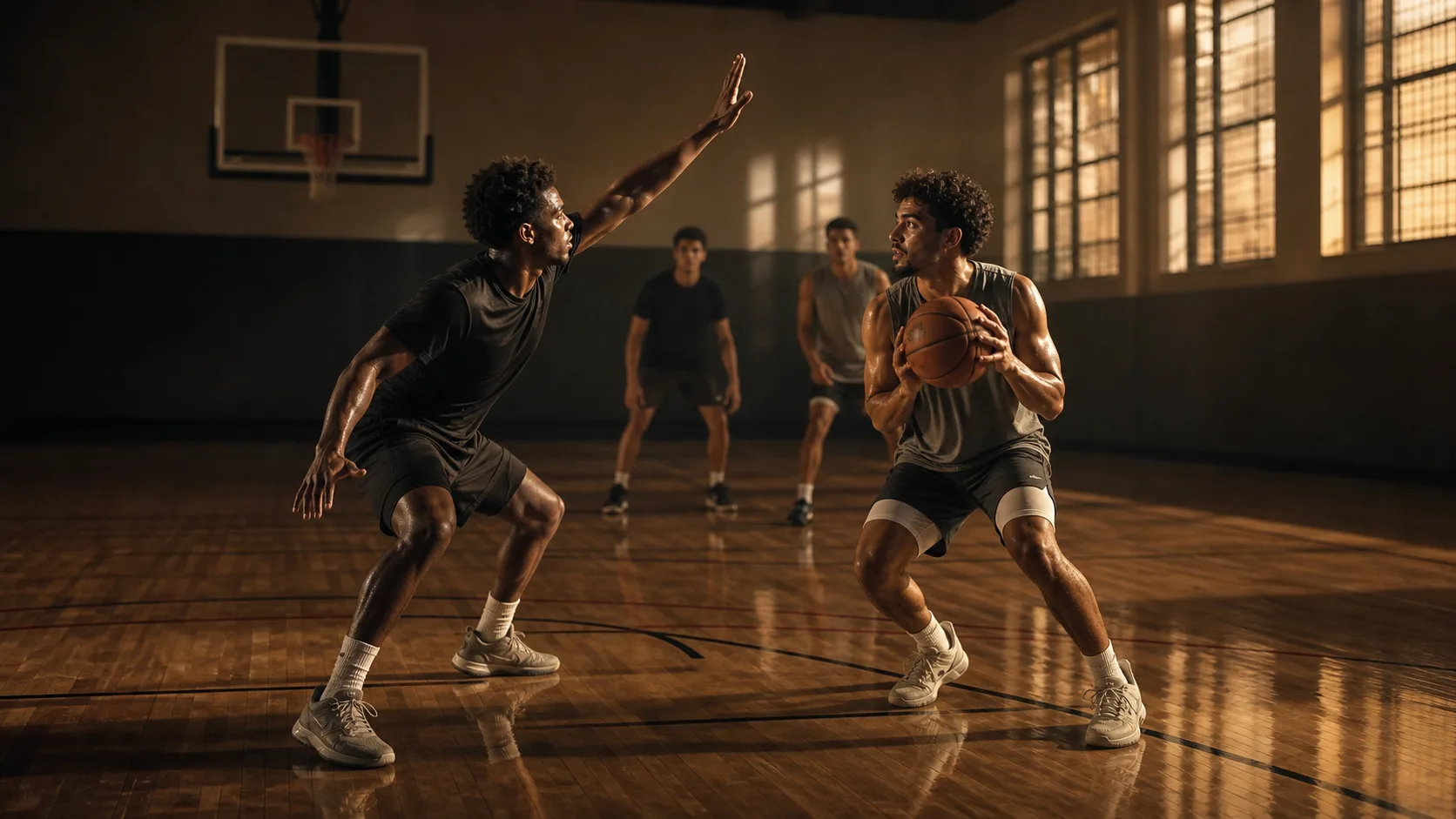
The short answer: Three things to read on every closeout, the defender's hip alignment (tells you which direction to drive), their hand position (tells you whether to pump fake or pull the trigger), and their momentum (tells you the timing window before they recover). Read all three in under 0.4 seconds and you've seen the play before it happens.
Most young scorers see a closeout and immediately decide what to do. Most veterans see a closeout and immediately read what's available. The difference between deciding and reading is the difference between a 1.04-PPP scorer and a 1.18-PPP scorer.
The Three Signals
1. Hip alignment. The defender's belt buckle tells you which way they can move. If the buckle is squared to your face, they can move either direction equally. If it's angled, even by 15 degrees, they've already committed. Drive the open side.
2. Hand position. Both hands at chest height means the defender is contesting the shot. One hand high and one low means they're contesting the shot AND ready to swat at the ball, vulnerable to the pump fake. Hands at hip height means they're playing for the drive, take the three.
3. Momentum. Defenders sprinting at full speed cannot stop laterally for ~0.3 seconds. If they're still arriving at speed, attack with one dribble in either direction. If they've already chopped to a stop, attack with the read above (hip + hands).
Read these three in sequence and you have a complete picture of the closeout in less than half a second. Drill it until it's automatic.
The Pump Fake Question
Most pump fakes get blown for one reason: they're identical to a real shot from the waist down. The defender bites because the legs say "shoot" and only the hands say "fake."
A high-leverage pump fake doesn't lift the heels. The legs stay loaded. The shoulders dip into shooting position. The hands raise the ball to release height. Then, instead of releasing, the hands come back down to gather, the loaded legs explode laterally, and the defender (who's already left his feet) is two seconds behind.
If you can't pump fake without unloading your legs, drill it stationary against a wall until you can. It's a 1-3 PPP swing per use against a defender who bites.
Sweep-Through vs Side-Step vs Straight Drive
Three offensive moves answer three different closeouts:
Sweep-through: the defender's hands are high. You sweep the ball low across your body, through their armpits, and explode in either direction. The high hands can't recover in time. James Harden built a Hall of Fame career on this single move.
Side-step (or step-back): the defender's momentum is committed. You take a hard lateral step away from their direction of momentum, creating a 4+ foot gap, and rise for the three. Luka, Booker, Trae all live here.
Straight drive: the defender is over-extended (too close, hands chasing the contest). You drive directly at the chest. They can't recover laterally because they have no balance. One dribble, layup or pull-up.
The right move is the move the defender's body has already decided for you. Read, don't choose.
When to Take the Three
If the defender is more than 4 feet away when you catch, shoot. Don't drive. Don't pump fake. Don't read. Shoot.
The 4-foot rule comes from contest research: defenders within 4 feet reduce shot percentage by ~6%. Defenders 4-6 feet away reduce it by ~2%. Defenders 6+ feet away, no effect at all. An uncontested three is statistically a free shot.
Most amateur scorers fail this test. They see the closeout coming and start dribbling instead of just rising. The result is a worse shot than the one they were given. The shot you don't take is the worst shot. Catch and shoot when the catch is open.
The Eye-Discipline Drill
Coach passes from the top of the key. Defender starts in the help position and sprints to closeout. Player has to call out one of three words before they make a move: - "Drive!" (read: hip angled) - "Fake!" (read: hands high) - "Shoot!" (read: defender too far)
Coach awards a point for correct reads, takes a point away for wrong ones. Run for 10 minutes. Track score over weeks.
By the third week, the calls become automatic. By the sixth, the player no longer needs to call them out, the read happens silently and the body responds. That's the skill.
Frequently Asked
Should I shoot every open three? Yes, if you've earned the volume. If you're a 28% shooter, no, your "open" three is still a worse shot than a drive into help.
What if the defender is mid-tier, neither over-committed nor backing off? Drive once, force a help rotation, kick. Most defenders only have one extreme tendency; if you can't read it, force the defense to make a decision.
How do I practice reading closeouts alone? Film NBA closeouts. Pause as the defender arrives. Predict the right read. Resume and check. Do 50 reps a session.
The Quiet Edge
The next time you watch an NBA game, ignore the ball-handler and watch the closeout defender. Notice how often their body has already decided the next 0.4 seconds before the offensive player has done anything. Elite scorers have spent their careers training to see what the defender's body has already shown them.
The closeout is a question with three answers. Knowing which question is being asked is the entire skill.
Keep reading: the defender's side of the closeout, reading help defenders, and off-ball cutting.