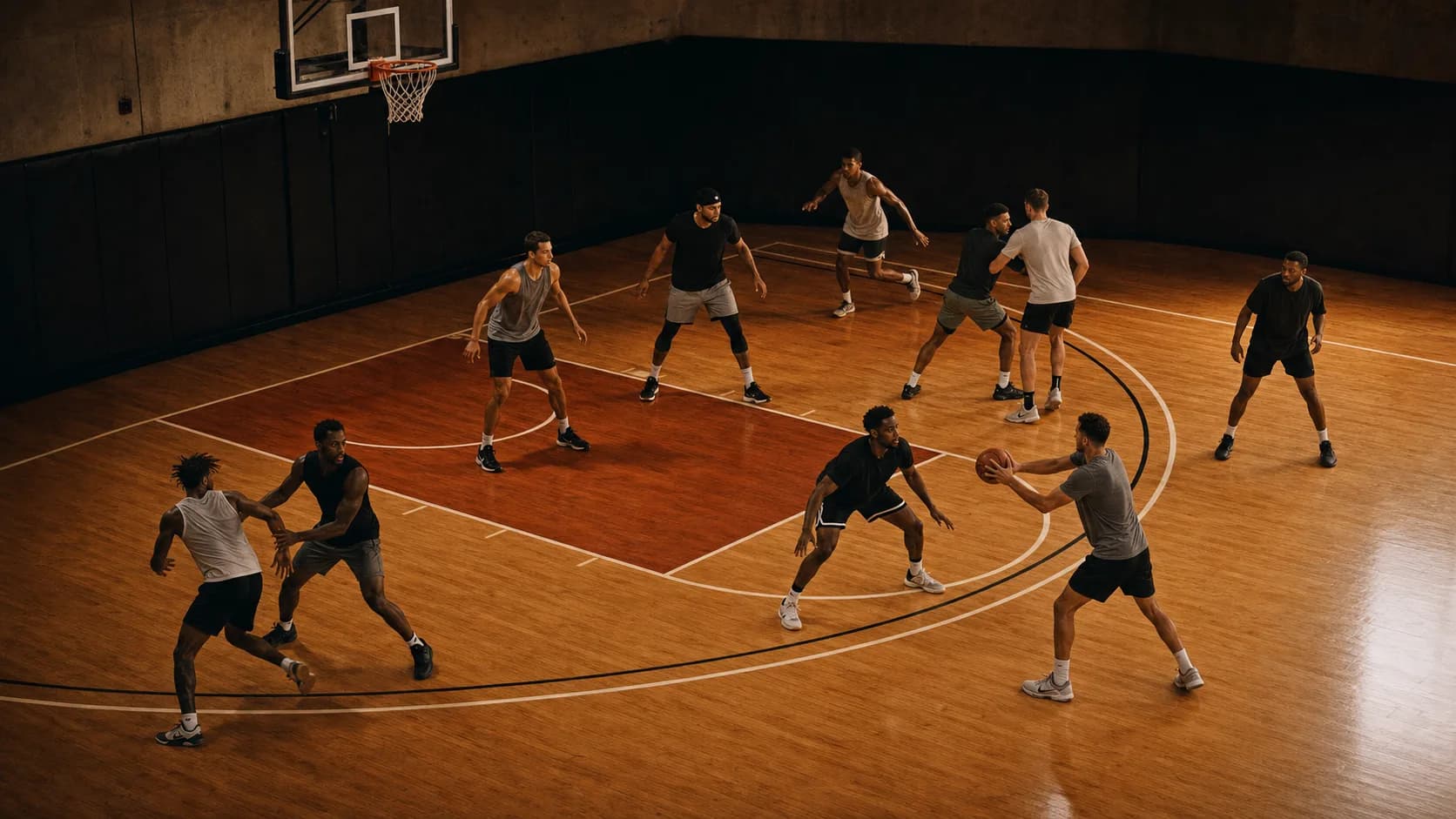
Look at the leading-scorer list in any modern NBA game and you'll find a pattern. The top scorer attempted 18 shots. He held the ball for 87 seconds total in a 48-minute game. He had eight assists. He was in the lane 14 times. And he scored 32 points.
How? By moving without the ball. Off-ball cutting is the most-undervalued skill in basketball at every level, and the highest-paid one in the NBA, even though nobody tracks it on a stat sheet.
Why Cutting Beats Iso
An iso possession at the high level converts at about 0.86 points per possession. A cut converts at 1.27. The reason: cuts attack a defender who isn't watching the ball-handler attentively, who's reading help, who's lost a step worrying about the shooter on his side. By the time he sees the cutter, the cut is already at the rim.
The math is so lopsided that every modern offense, Boston, Denver, Indiana, Sacramento under any iteration, is built around finding three cuts per possession. The ball just delivers what the cuts already opened.
The Five Cuts Every Scorer Needs
1. The V-Cut
The V-cut is the foundation. You walk your defender toward the basket, plant hard with your inside foot, and explode back to the catch. The cut works because defenders relax when offensive players move slowly. The plant breaks the rhythm. The explosion gets you a step.
The mistake: most players V-cut at half speed. The plant has to be violent. If your defender doesn't audibly react ("hh!"), you didn't sell it.
2. The L-Cut
The L-cut is a V-cut that goes baseline first. You start at the elbow, walk to the corner, plant, sprint back to the wing. It works against defenders who are over-shading the high side. By the time you arrive at the wing, your defender has to navigate around your body to recover.
3. The Flash Cut
A flash cut is the weak-side equivalent of a V. You're standing on the weak corner. The ball is at the strong wing. The defender's eyes are on the ball, that's the moment. You sprint to the high post, hand up, demanding the ball. The pass arrives at chest height with the defender three steps behind.
The flash cut is what separates intelligent off-ball players from drifters. Drifters watch the ball. Cutters watch the defender's eyes, and move the moment the eyes leave them.
4. The Backdoor
The backdoor cut is the answer to overplay. When your defender is shading high to deny the catch, the answer isn't to fight for it. It's to plant, drop a shoulder, and cut behind. The pass goes between the defender and the basket, and the cutter has a free run to the rim.
The cue: when you can feel your defender's hand on your hip, he's overplayed. Cut. Always.
5. The Relocation Cut
This one is modern. After you make a pass, you don't stand still. You relocate to a new spot, usually the corner or the slot. The ball-handler attacks. Help loads off you. You spot up at your new location with a clean look.
The relocation cut is why Steph Curry's gravity is what it is. He never stands still. Every pass triggers a relocation. By the time the defense rotates, he's already at the next high-EV spot.
Setting Up The Cut
A cut without setup is a sprint. The setup is the part where you're slow on purpose.
Walk your defender. Make him relax. Cross his face once, just to plant the seed of overplay. Then plant. The window for a cut is about 0.4 seconds. If your defender is reading you, the window closes. If you've put him to sleep, it stays open.
The best cutters in the NBA, Tatum, Embiid (yes, Embiid), Mikal Bridges, Andrew Wiggins, all share one thing: they're patient. They don't run unless the cut is open.
Reading the Defender's Eyes
Your defender's eyes tell you when to cut. If he's looking at the ball, his peripheral on you is gone. Cut.
If he's looking at you, his peripheral on the ball is gone. Wait. The ball-handler will draw his attention back, and then his eyes will leave you. That's the cut.
The eye-read is the entire IQ of off-ball offense. Practice it in every drill. By the time it's automatic, you'll never have to worry about getting open again.
Drill: 30-Second Cutting
Three offensive players, three defenders. The ball stays with the coach. For 30 seconds, the offense cuts continuously, V, L, flash, backdoor, without dribbling. Defenders try to deny. Score is kept by who gets open the most.
The drill teaches reading defenders, setting up cuts, and the rhythm of off-ball offense. Done daily, it builds the highest-paid skill in basketball.
The Quiet Edge
Watch any great team in transition. Notice the wings. They're not running in straight lines. Every step has a slight arc, a setup for the cut they know is coming. Off-ball excellence isn't a series of explosions. It's a constant low-level conversation with your defender, won by the one who's paying closer attention.
You don't need the ball to be the best player on the floor. You need to know where to be, and how to get there before the defense does.
Keep reading: the give-and-go, reading help defenders, and elite court vision.