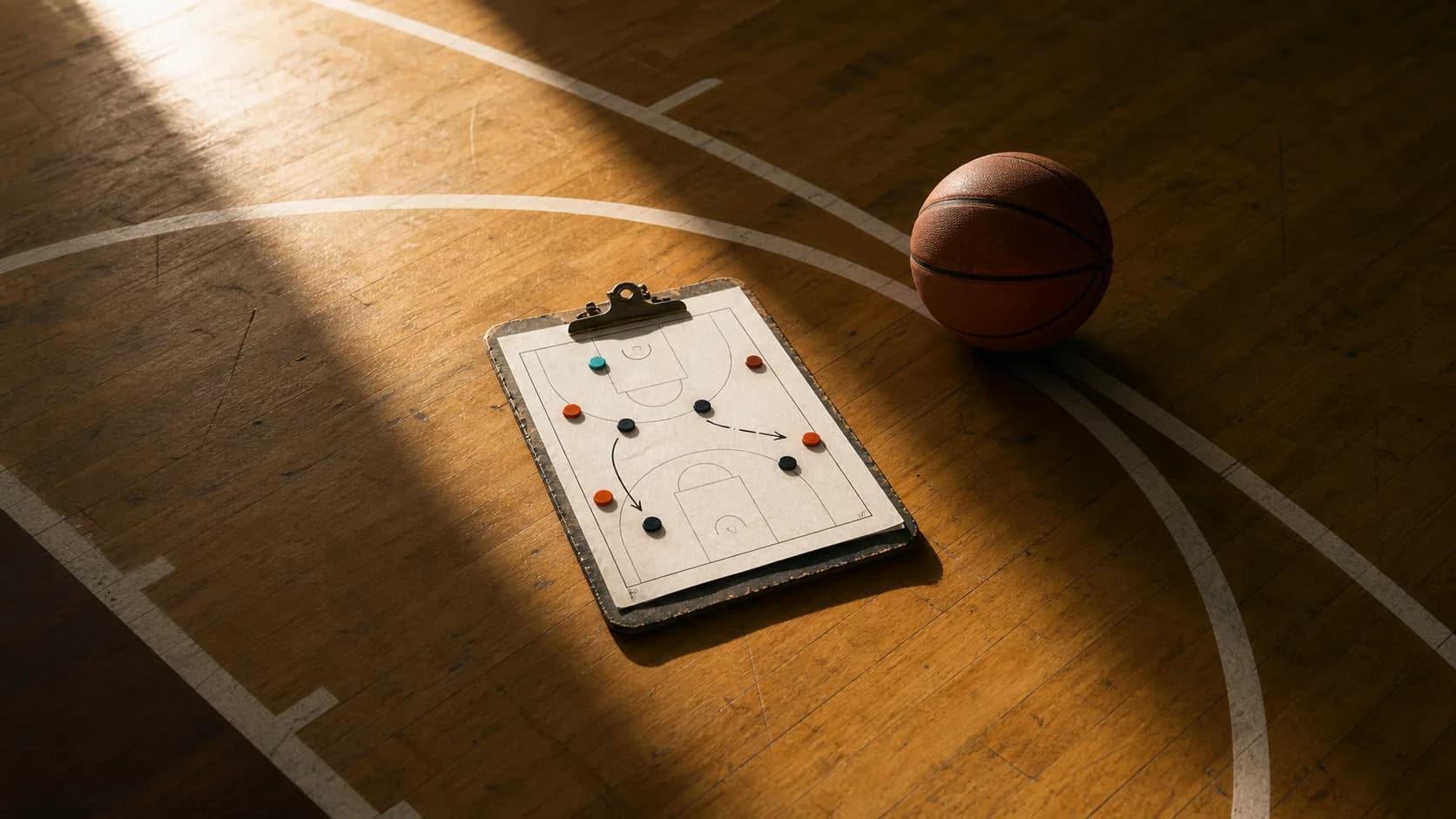
The short answer: The give-and-go converts at ~1.18 points per possession league-wide, higher than every action except a clean dunk. It works because passing the ball lulls the defender into help-mode. The cut starts the moment the defender's eyes leave you to follow the ball. Master this play and you've mastered basketball's most-efficient action.
The give-and-go is the first play kids learn. Pass to a teammate, cut to the basket, get the ball back. It's so simple that intermediate players stop running it because it feels childish.
This is a mistake. The give-and-go is the highest-efficiency action in basketball at every level above middle school. The reason: it exploits a universal defensive habit (relaxing after the ball leaves your man) that no amount of coaching erases.
Why It Still Works at Every Level
After a defender's man passes the ball, three things happen in 0.5 seconds: 1. The defender's eyes follow the ball. 2. The defender's body weight shifts toward help-side. 3. The defender's awareness of his own man drops.
That 0.5-second window is where the give-and-go lives. Cut hard during it, and you're a step ahead before the defender has registered what's happening. By the time he turns his head back, you're at the rim.
This habit doesn't go away with coaching. It's a perception bottleneck, defenders can't watch the ball and their man simultaneously, and the ball wins every time. The give-and-go exists because of this universal limitation.
The Cut Timing
Most amateur give-and-goes fail because the cut is too early or too late.
Too early: the cut starts before the pass leaves the hand. The defender hasn't shifted yet. The cut runs into a defender who's still home.
Too late: the cut starts after the receiver has caught. The defender has had a full second to relocate. The cut runs into help that has already arrived.
Right timing: the cut starts at the moment the ball leaves your hand. By the time the ball arrives at your teammate, you've taken your first hard step toward the rim. By the time your teammate has the ball, you're three steps in.
The rhythm is: pass, step, step, step, open hand. Counted out loud, that's three beats. Drill it until the rhythm is automatic.
Reading the Defender's Eyes
The cue for when to cut isn't a count, it's the defender's eyes. The moment their eyes leave you, cut.
Most defenders' eyes leave at the same time their man's pass leaves. That's the standard timing. But against an elite defender (one who keeps eyes on you longer), the cut window opens later. Watch their eyes. Cut when they leave.
This is why the give-and-go is harder against elite defenders. Their habit is weaker. The window is narrower. But it still exists, even Lakers/Celtics-level defenders have a 0.2-second window where their eyes leave to track the ball. That's enough.
Setting Up the Play
A give-and-go runs into help if the defense is loaded. The best version of the play is set up by off-ball action that pulls help away first.
Two common setups:
1. The down-screen setup. A teammate sets a down-screen for you on the wing. Your defender goes over the screen. You catch, immediately pass to the screener (who has popped), and cut. Your defender, already a half-step out of position from going over the screen, has no chance.
2. The dribble-handoff fake. Your teammate appears to come at you for a handoff. Both defenders adjust. Instead of taking the handoff, you pass it forward and cut. The defender, expecting the handoff, has shifted out of his stance and can't recover laterally.
Both setups create the half-step the give-and-go needs.
Why This Is the First Action You Should Master
If you're a young player learning offense, the give-and-go is the action that teaches you everything important: - Passing under pressure - Cutting hard - Reading defenders' eyes - Off-ball movement after a pass - Looking for the ball back
Master the give-and-go and you've built the foundation for every more complex action. Most amateur players skip past it. That's why their offense is bad.
The Drill
Two-on-two, half court. Offense can only score off a give-and-go. No isolations, no PnR, no shots from the perimeter. Run for 5 minutes.
The constraint forces every possession to use the action. By the third minute, the offense is reading the defenders' eyes and timing cuts off the pass. By the fifth, they're scoring 1.20+ PPP, at the same rate as the NBA average.
Frequently Asked
Does the give-and-go work in modern switch-everything defenses? Yes. The cut still beats the recovery on a switch. The mechanics are slightly different (you're cutting against a different defender than you're playing) but the principle holds.
What if the receiver doesn't see the cut? Train the chemistry. The cutter should always look to receive the ball back; the receiver should always look up after the catch. If they never connect, it's a chemistry problem, not a play problem.
Why don't NBA teams run more give-and-go? They do. Watch any modern offense in slow motion: 30-40% of possessions include a give-and-go element somewhere in the action.
The Quiet Edge
The simplest play in basketball is also the most-efficient because it exploits a defensive habit nobody can train away. Your job as an offensive player is to keep running it. The defense will keep falling for it. The math will keep working.
The play your coach taught you when you were eight is still the best play in basketball. Don't outgrow it.
Keep reading: off-ball cutting, court vision, and PPP explained.