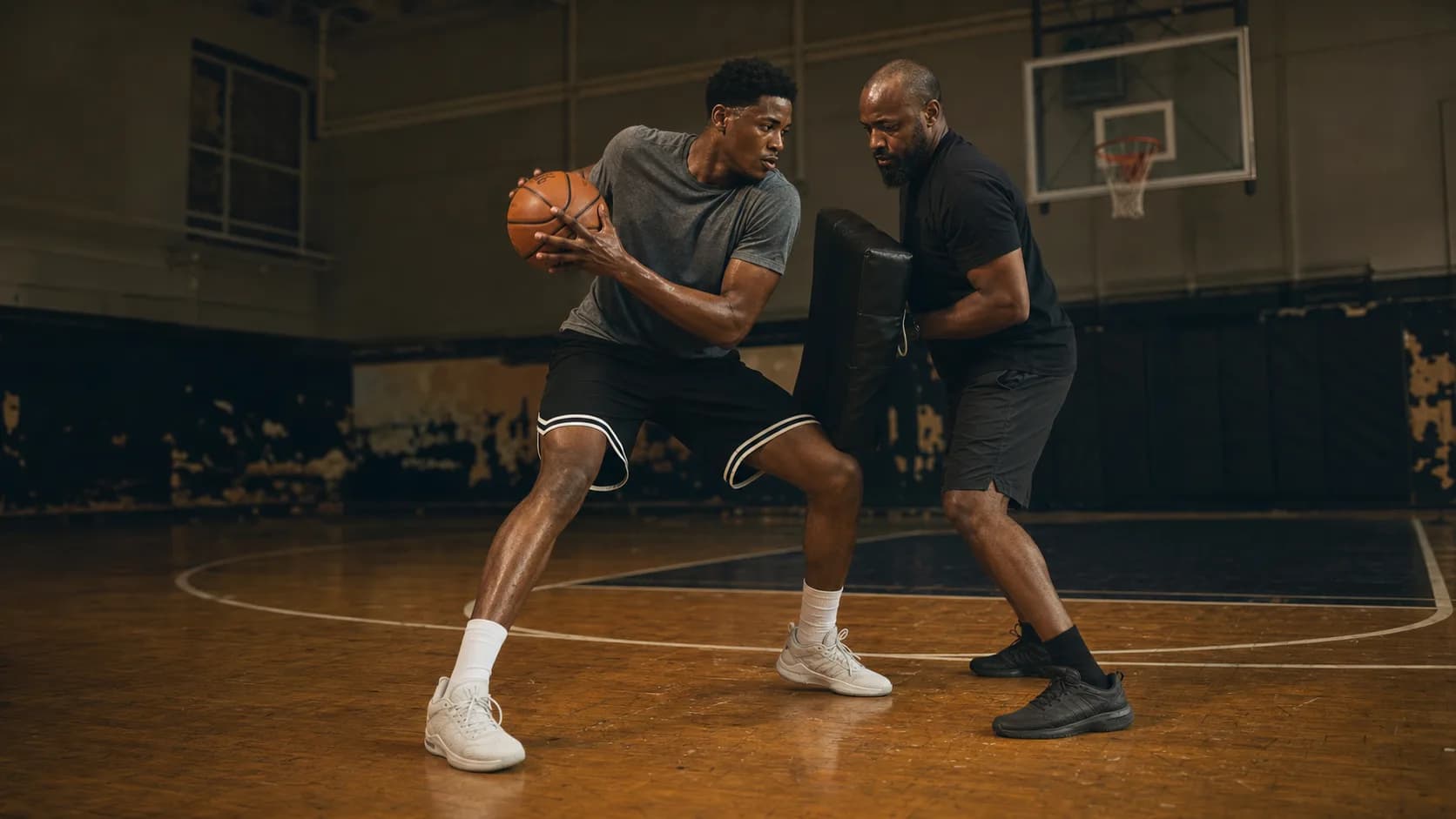
Decision-making is the most-trainable basketball skill, and the one [NBA scouts grade first](/blog/how-scouts-evaluate-decision-making). Most young players over-allocate to shooting practice and under-allocate to decision-making practice because shooting feels productive and decisions feel invisible. The honest math says decision-making gains produce more recruiting impact per hour invested. This piece is the 30-day plan to measurably improve your basketball decision-making.
This is part of the Player Development Hub cluster.
The 30-Day Plan: 4 Drills, 4 Weeks
- Week 1: Pause-and-predict film study (3 sessions, 45 min each).
- Week 2: Constraint scrimmage (2 sessions/week, 30 min each).
- Week 3: Possession review on your own game tape (3 sessions/week, 20 min each).
- Week 4: Pre-game scouting routine (every game, 30 min before).
Total time commitment: roughly 4-5 hours per week. Total cost: zero. Measurable improvement in decision speed and accuracy: 100-200 milliseconds and 5-10 percentage points by end of week 4.
Drill 1: Pause-and-Predict Film Study
The single most effective decision-making drill. The mechanics:
- Pick an NBA game film.
- Watch each possession until the on-ball defender reveals coverage (or the help defender commits).
- Pause the film.
- Predict the correct offensive read out loud or in writing. Be specific, "mid-range pull-up" beats "shoot."
- Press play. Check whether your read matched the player's actual decision (and outcome).
- Track accuracy across 50 possessions per session.
Goal: 70%+ accuracy by week four. The drill takes 30-45 minutes per session.
This drill works because it forces cognitive commitment before outcome. Most film study is passive, you see what happened and learn nothing about the decision process. Constraint-based study trains the actual cognitive workflow scouts grade.
HoopBrief currently turns basketball and matchup questions into structured reports using public statistical and play-by-play context. It does not accept film uploads or provide possession-level video tagging.
Drill 2: Constraint Scrimmage
A scrimmage with deliberate decision-forcing rules:
- Rule 1: No shot allowed until the defense commits to one of two reactions on your read.
- Rule 2: Every pick-and-roll must produce a different outcome than the previous one (forces all four coverage counters).
- Rule 3: Every drive must include a read of the help defender, verbal call required.
Two scrimmage sessions per week, 30 minutes each. Players resist these rules at first because they slow the game; that's the point. By week three the slowed reads feel natural and game speed reads start arriving faster.
Drill 3: Possession Review on Your Own Tape
The drill that converts film study into personal improvement. The mechanics:
- Film a high school or AAU game.
- Within 48 hours, watch the film and identify the 5-7 possessions where your read was slow, wrong, or absent.
- For each one, document: what was the cue, what should you have read, what did you do, what should have happened.
- Plan the correction for the next game.
A player who does this for one full season improves their decision speed measurably across 30+ identified-and-corrected possessions. By season-end, the patterns scouts watch (third-quarter motor, decision recovery, pace control) are all visibly tightened.
Drill 4: Pre-Game Scouting Routine
The 30 minutes before tip:
- Review the opponent's scouting report. Know their primary pick-and-roll coverages, their preferred matchups, their key players' tendencies.
- Identify the 2-3 specific reads you'll see most often. Visualize the correct response for each.
- Identify the 1-2 risks (their primary scorer, their fastest transition trigger). Plan your awareness around those.
A player who does this before every game starts with a 1-2 second head start on every read, because the patterns are already loaded in working memory. Compound across 30+ games per season and the recruiting reputation builds.
Want to build a pre-game scouting routine with the same framework NBA staffs use? HoopBrief plans give you the 12-lens tagging system for any opponent you can find on film.
Why Decision-Making Compounds Faster Than Other Skills
Three reasons decision-making gains compound faster than physical skill gains:
- No genetic ceiling for pattern recognition. Raw reaction time has a ceiling; pattern recognition doesn't.
- Transferable across drills, scrimmages, and games. A new pattern recognized in film study shows up immediately in scrimmage, then in games.
- Multiplier on every other skill. A great shot you take at the wrong time is worth zero; an average shot at the right time is worth 1.0+ PPP. Decision-making multiplies the value of every other skill.
A player who commits to the 30-day plan above and maintains it through a full season measurably moves their position on coaching boards.
Where to Go Next
Companion development pieces: How to Become a Better Off-Ball Player, Defensive Habits That Translate to Higher Levels, How to Improve Positioning IQ, Skills NBA Teams Value More Than Scoring.
Scouting context: How Scouts Evaluate Decision-Making, What NBA Scouts Look For in Middle/High School Players.
Hub: Player Development Hub.
Foundation reading: the basketball film study guide, the 12-lens framework, basketball IQ, what it actually means.