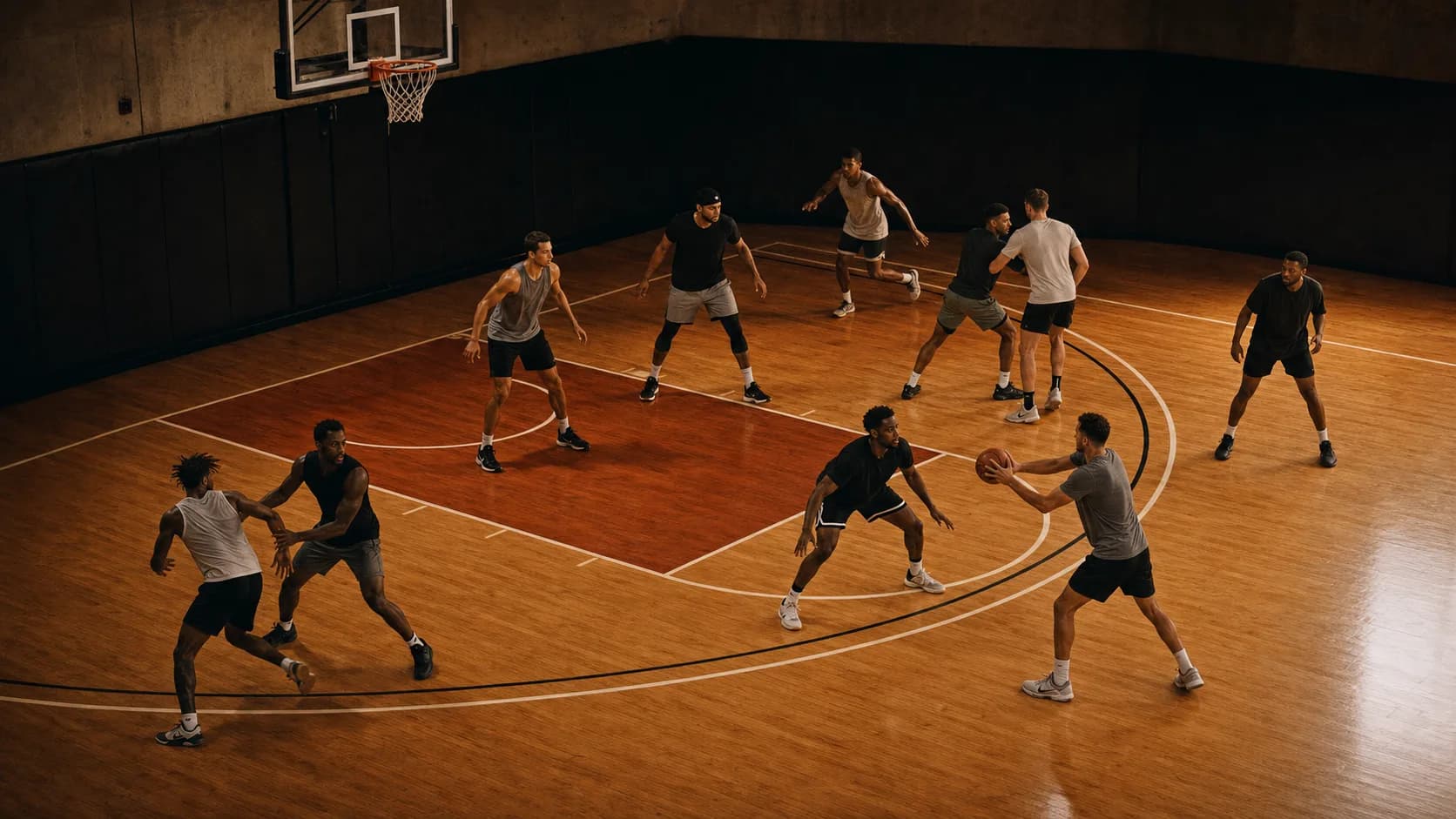
Off-ball value is the trait that turns "scorers" into "winning players." And it's the cheapest skill to add to your game because it requires habit-building, not new physical ability. This piece is the 4-week skill build that measurably improves your off-ball value, covering cuts, screens, relocations, and spacing for every position.
This is part of the Player Development Hub cluster.
Why Off-Ball Skills Move Recruiting Profiles
Three structural reasons (covered in detail in our scouting trait piece on off-ball value):
- NBA possession math, even ball-dominant stars touch the ball on only 30-40% of possessions.
- Roster construction, you can only have one or two ball-dominant players on the floor.
- Switching defenses, the off-ball player who moves intelligently breaks the defense's geometry.
A player with 60%+ off-ball action rate is a connector. A player with under 30% is a stander. Coaches at every level can see the difference within one game.
The 4-Week Build
- Week 1: Cuts, train all three types (baseline, 45, backdoor).
- Week 2: Screens, train all four types (pin-down, flare, ball, back).
- Week 3: Relocation, no standing after passes.
- Week 4: Spacing, always in the right spot based on the action.
Each week adds one habit while maintaining the previous ones. By end of week 4, all four habits run automatically.
Week 1: Cuts
The three cut types and their triggers:
- Baseline cut. Trigger: help defender's head turns toward the ball. Sprint along the baseline to the rim.
- 45-cut. Trigger: defender plays in the passing lane. Cut at a 45-degree angle from wing to rim.
- Backdoor cut. Trigger: defender denies the pass to the wing. Cut behind the defender to the rim.
Drill, Trigger recognition. Watch 20 minutes of NBA film. Pause at each moment a cut would be appropriate. Identify the trigger that made it appropriate. Practice for two weeks until trigger recognition is automatic.
In scrimmage: enforce a personal rule that every help-defender-head-turn produces a cut. Two weeks of this and the habit is automatic.
Week 2: Screens
The four screen types and their applications:
- Pin-down. Down-screen at the elbow for a wing coming up. Most-common off-ball screen in NBA offense.
- Flare. Up-screen for a shooter relocating away from the ball. Geometry-proof, defense can't take it away cleanly.
- Ball screen. On-ball screen for the handler in pick-and-roll. Sets up the most-run action in the game.
- Back screen. Surprise screen behind the defender's head for a cutter.
Drill, Screen-setting reps. Two sessions per week, 30 minutes each. Set 20 of each screen type. Get a partner or coach to grade angle, base, and timing.
In scrimmage: set at least 3 off-ball screens per quarter, of any type. After two weeks, screen-setting becomes a recognized habit by teammates and coaches.
HoopBrief currently turns basketball and matchup questions into structured reports using public statistical and play-by-play context. It does not accept film uploads or provide possession-level video tagging.
Week 3: Relocation
The most under-trained habit. Two patterns to master:
- Lift. Move from corner to wing (or wing to top) after a pass. Creates a new angle and shortens the next pass.
- Drift. Move from wing to corner. Drags the defender out of help and opens the strong-side drive.
Drill, No-standing rule. For two weeks, in every practice and scrimmage, you cannot stand after a pass. Every pass triggers a movement. Resist the urge to revert.
The habit feels unnatural at first because most players are conditioned to "spot up" in one place. By end of week 3, the movement after a pass becomes default and the spot-up feels lazy.
Week 4: Spacing
The boring habit. Stand in the right spot based on the action:
- Pick-and-roll on the right wing: weak-side shooters in the left corner and left wing.
- Post-up on the left block: strong-side shooter in the left corner, weak-side shooters in the right wing and top.
- Transition: trailer at the top of the key, fillers on each wing.
- Iso: four players spaced symmetrically with one in the dunker spot.
Drill, Spacing review. Watch your own scrimmage tape with the volume off. Pause every time the action starts. Are you in the right spot? Track your spacing accuracy across 30 possessions. Goal: 90%+ correct positioning by end of week 4.
HoopBrief currently turns basketball and matchup questions into structured reports using public statistical and play-by-play context. It does not accept film uploads or provide possession-level video tagging.
The Off-Ball Reputation Effect
By the end of the 4-week build, your in-game patterns shift visibly. By the end of 8-12 weeks of consistent execution, teammates and coaches recognize you as a "connector." That reputation is durable, once you're labeled high-off-ball-value, the label persists across seasons.
The recruiting consequence: coaches who evaluate you start grading the off-ball clips of your film at the same level as the on-ball clips. Your offer set widens because you fit more rosters.
Where to Go Next
Companion development pieces: How to Improve Basketball Decision-Making, Defensive Habits That Translate to Higher Levels, How to Improve Positioning IQ, Skills NBA Teams Value More Than Scoring.
Scouting context: Off-Ball Value: The Trait Most Fans Miss.
Hub: Player Development Hub.
Foundation reading: Play Like Steph Curry (the off-ball template), the 12-lens framework.