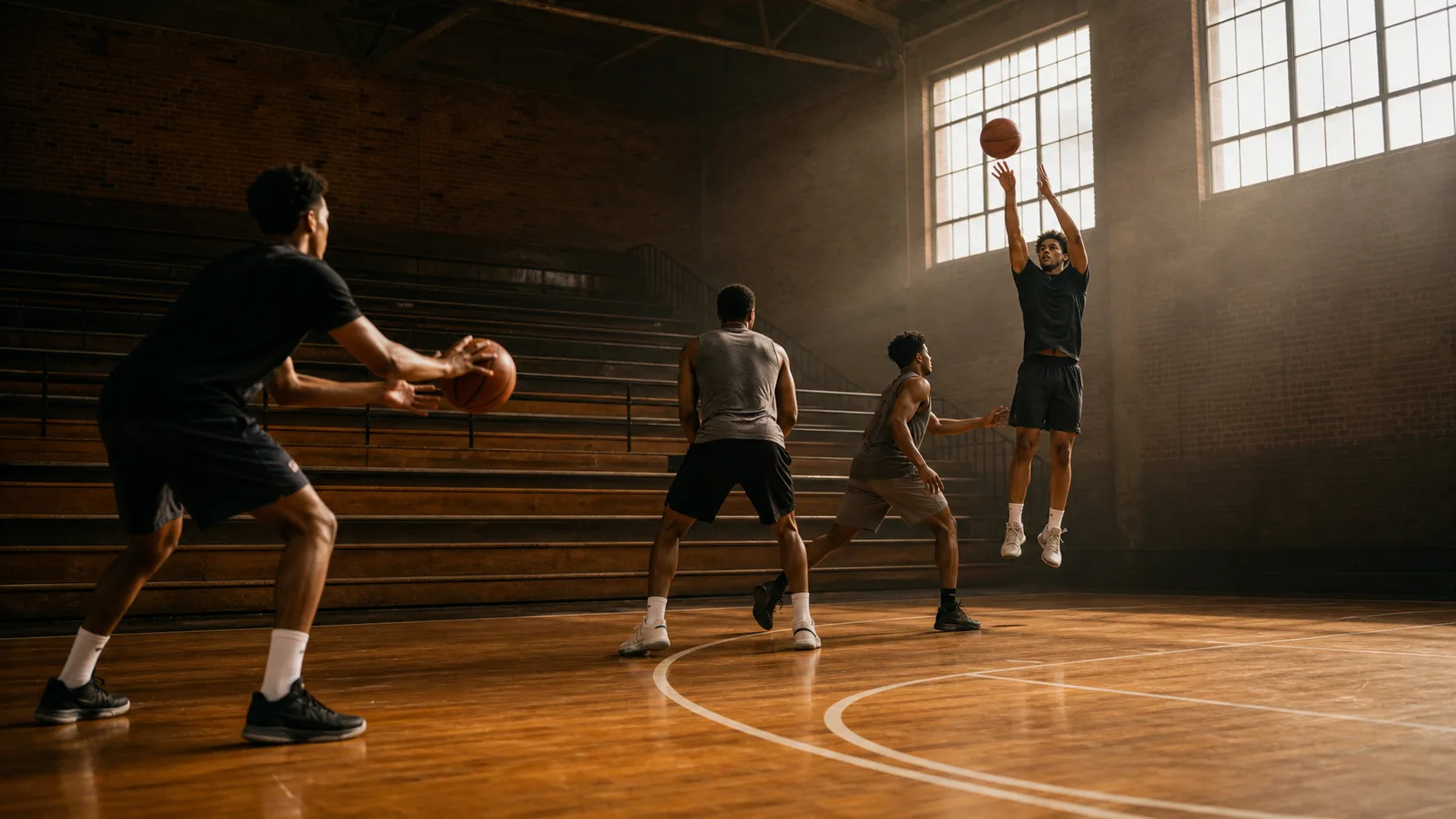
Positioning IQ is what separates "always in the right spot" from "always reacting." It's a film-study skill combined with deliberate scrimmage application. The good news: positioning IQ trains faster than most basketball skills because the cognitive patterns transfer immediately from study to live play. This piece is the 6-week build for both offensive and defensive positioning IQ.
This is part of the Player Development Hub cluster.
The 6-Week Build
- Weeks 1-2: Offensive spacing recognition via film study.
- Weeks 3-4: Defensive help geometry via film study.
- Weeks 5-6: Live scrimmage application of both.
A player who completes this build measurably improves their positioning IQ, and the gain compounds across a career because the recognition patterns get sharper each year.
Weeks 1-2: Offensive Spacing Recognition
The four core spacing patterns to recognize:
- Pick-and-roll on the right wing. Weak-side shooters in left corner + left wing. Roll big to the rim. Lift man on top.
- Post-up on the left block. Strong-side shooter in left corner. Weak-side shooters in right wing + top. No clog from the strong-side wing.
- Drive from the top. Corners stretched. Wings drifted to slightly behind the drive. Roll big to dunker spot.
- Iso from the wing. Four players symmetric, with one in the dunker spot. Avoid the strong-side corner.
Drill, Pause-and-position. Watch NBA possessions. Pause when the action begins. Identify whether each non-action player is in the correct spot. Track your recognition accuracy across 50 possessions per session.
By end of week 2, you should recognize correct vs incorrect spacing at 90%+ accuracy.
Weeks 3-4: Defensive Help Geometry
The four core help patterns:
- Ball on right wing. Weak-side defender at the nail (lane area). Helpers a step toward the ball.
- Ball at the top. Weak-side defenders even with the ball on each wing. Big in drop coverage if the action runs through them.
- Ball on the strong-side block. Weak-side defenders dig at the post, ready to recover.
- Ball in transition. Defenders sprint to the paint first, then expand out as the offense sets up.
Drill, Pause-and-help. Watch NBA defensive possessions. Pause when the ball arrives at a new location. Identify whether each defender is in the correct help position. Track accuracy.
By end of week 4, defensive help geometry recognition is automatic.
Want to study NBA spacing and help geometry with NBA-staff tagging? Start a HoopBrief plan and the 12-lens framework tags positioning quality across the league.
Weeks 5-6: Live Scrimmage Application
The transfer phase. The drills:
- Spacing call-out scrimmage. Before each offensive possession, the team calls out the action ("right-wing PnR"). All non-action players announce their correct position. Forces verbal commitment.
- Help-geometry call-out scrimmage. On defense, the help defender calls out their position relative to the ball ("at the nail!"). Reinforces the recognition.
- Positioning review. After each scrimmage, watch the film and identify the possessions where positioning was wrong. Plan the correction.
By end of week 6, positioning IQ has measurably improved in live games, and the improvement persists.
Position-Specific Notes
For guards: focus on offensive spacing (you control the action) and on-ball defensive positioning (your matchup decides the possession).
For wings: focus on weak-side help geometry (you're often the helper) and off-ball spacing (you space the floor for the primary action).
For bigs: focus on rim protection geometry (where to be in drop coverage), screen-setting angles (where to be in pick-and-roll), and offensive rebounding positioning.
Each position has specific patterns. The general principles above apply to everyone; the position-specific applications compound.
The Positioning IQ Reputation Effect
A player with high positioning IQ appears effortless in games. Coaches notice. Scouts notice. The reputation is sticky because the patterns hold up across competition levels, positioning IQ is one of the most translatable basketball skills.
HoopBrief currently turns basketball and matchup questions into structured reports using public statistical and play-by-play context. It does not accept film uploads or provide possession-level video tagging.
Where to Go Next
Companion development pieces: How to Improve Basketball Decision-Making, How to Become a Better Off-Ball Player, Defensive Habits That Translate to Higher Levels.
Tactical context: What Positioning IQ Means in a Playoff Series, pick-and-roll coverages explained.
Hub: Player Development Hub.
Foundation reading: the 12-lens framework, basketball IQ, what it actually means.