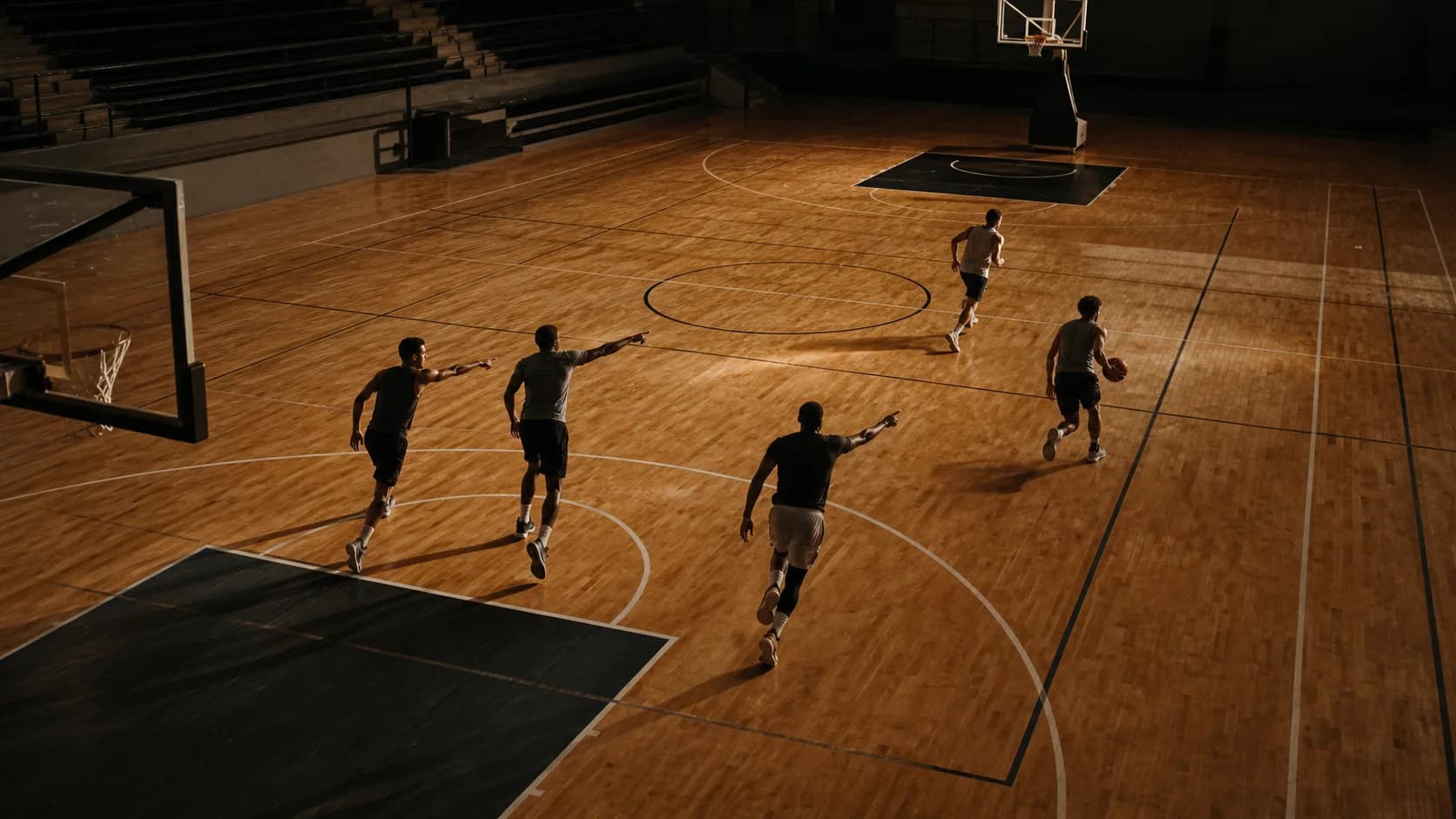
Defensive habits divide cleanly into two groups: the ones that translate from high school to college to NBA, and the ones that get exposed when the competition rises. Players who only have the second group end up rebuilding fundamentals at every level transition, slow, expensive, and often unsuccessful. Players who build the first group have a defensive floor that holds at any level.
This is part of the Player Development Hub cluster.
The 6 Habits That Translate
- Lateral mobility from a low base. Foundational; everything else builds on it.
- Closeout discipline. Short-stride high-hand closeouts at speed.
- Defensive communication. Talk every possession.
- Weak-side rotation timing. Move early enough to arrive on time.
- Box-out commitment. Every possession, regardless of matchup.
- Recovery after mistakes. What happens after you get beat.
A player who builds all six has a defensive floor that holds at every level. A player missing two or more usually loses defensive minutes at the next level even if the offensive game compensates.
Habit 1: Lateral Mobility From a Low Base
The non-negotiable foundation. Without it, every other defensive habit collapses.
The technique:
- Hips low, knees over toes, weight on the balls of the feet.
- Slides initiated from the lead foot push, not the trail foot drag.
- Hands active, outside hand high to deter the ball, inside hand low.
- No crossing the feet (crossing produces a beat).
Drill, Lateral slide endurance. 3 sets of 10 down-and-back slides per session, every other day. 6-8 weeks to build the legs that survive a full possession of guard containment.
Habit 2: Closeout Discipline
The skill that separates fly-by defenders from contestable defenders.
The technique:
- Sprint the first 80% of the closeout, decelerate the last 20%.
- Short, choppy steps in the deceleration phase.
- High hand to contest the shot.
- Eyes on the shooter, body between shooter and basket.
- No swiping at the ball (swipes get beaten on shot fakes).
Drill, 4-spot closeout rotation. Stand at the free throw line. Sprint to a marked perimeter spot, close out high-hand, retreat. Rotate through 4 spots. 3 sets of 4 per session.
Habit 3: Defensive Communication
The cheapest defensive habit to add and the most-undervalued by young players. The categories:
- Screen calls. "Screen left!" before the screen arrives.
- Switch calls. "Switch!" on the fly when the action requires it.
- Help calls. "Help!" when rotating to cover a teammate's rotation.
- Closeout warnings. "Contest!" to a teammate closing on a shooter.
In scrimmage: enforce a personal rule that you must call at least one of these on every defensive possession. Within two weeks, the calls become reflexive.
HoopBrief currently turns basketball and matchup questions into structured reports using public statistical and play-by-play context. It does not accept film uploads or provide possession-level video tagging.
Habit 4: Weak-Side Rotation Timing
The habit that turns athletic defenders into smart defenders. The mechanics:
- Read the offensive intent from body language, eyes, and patterns.
- Start the rotation before the pass, usually 0.3-0.5 seconds before the ball leaves the passer's hand.
- Arrive on time, not early (early arrival lets the offense recognize the cheat).
- Recover to your original assignment without losing the man.
Drill, Pause-and-rotate film study. Watch NBA defensive possessions. Pause at the moment the ball-handler picks up the dribble. Predict the correct help rotation. Press play. Track accuracy across 50 possessions. Two weeks of this builds the anticipation pattern.
Habit 5: Box-Out Commitment
The motor-related defensive habit. Box out on every possession, including the ones where:
- You're not the natural matchup.
- The rebound is unlikely to come your way.
- The shot is heavily contested and probably won't go in.
Coaches and scouts grade box-out commitment specifically because it's the easiest possession-by-possession motor signal to observe. A player who boxes out on 90%+ of possessions is high-motor; a player who boxes out on 60% or less is graded down regardless of skill.
Habit 6: Recovery After Mistakes
What happens in the 4-5 seconds after a defensive breakdown? The translatable habit is:
- Accept the mistake.
- Sprint to recover position or cut off the next angle.
- Communicate to teammates ("my fault, I got it").
- Focus on the next possession, not the last one.
A player who recovers from mistakes maintains the trust of teammates and coaches. A player who argues or sulks loses it, and the trust signal travels.
The 3 Patterns That Get Exposed at Higher Levels
- Athletic-only defense. A defender who relies purely on speed, length, or vertical to compensate for technique gets out-athleted at higher levels.
- Gambling for steals. Smarter offensive players punish gambles with the easy bucket every time.
- Lazy stance. A defender whose hips are too high can be attacked off the dribble by any competent ball-handler.
If you recognize any of these patterns in your current game, the fix is to rebuild the technique-based habits above. Six months of deliberate work usually corrects most pattern issues, but the work has to be deliberate.
HoopBrief currently turns basketball and matchup questions into structured reports using public statistical and play-by-play context. It does not accept film uploads or provide possession-level video tagging.
Where to Go Next
Companion development pieces: How to Improve Basketball Decision-Making, How to Become a Better Off-Ball Player, How to Build a Scouting-Grade Motor, How to Improve Positioning IQ.
Scouting context: How Scouts Grade Defensive Versatility, Why Motor Matters in Scouting Reports.
Hub: Player Development Hub.
Foundation reading: the 12-lens framework, pick-and-roll coverages explained.