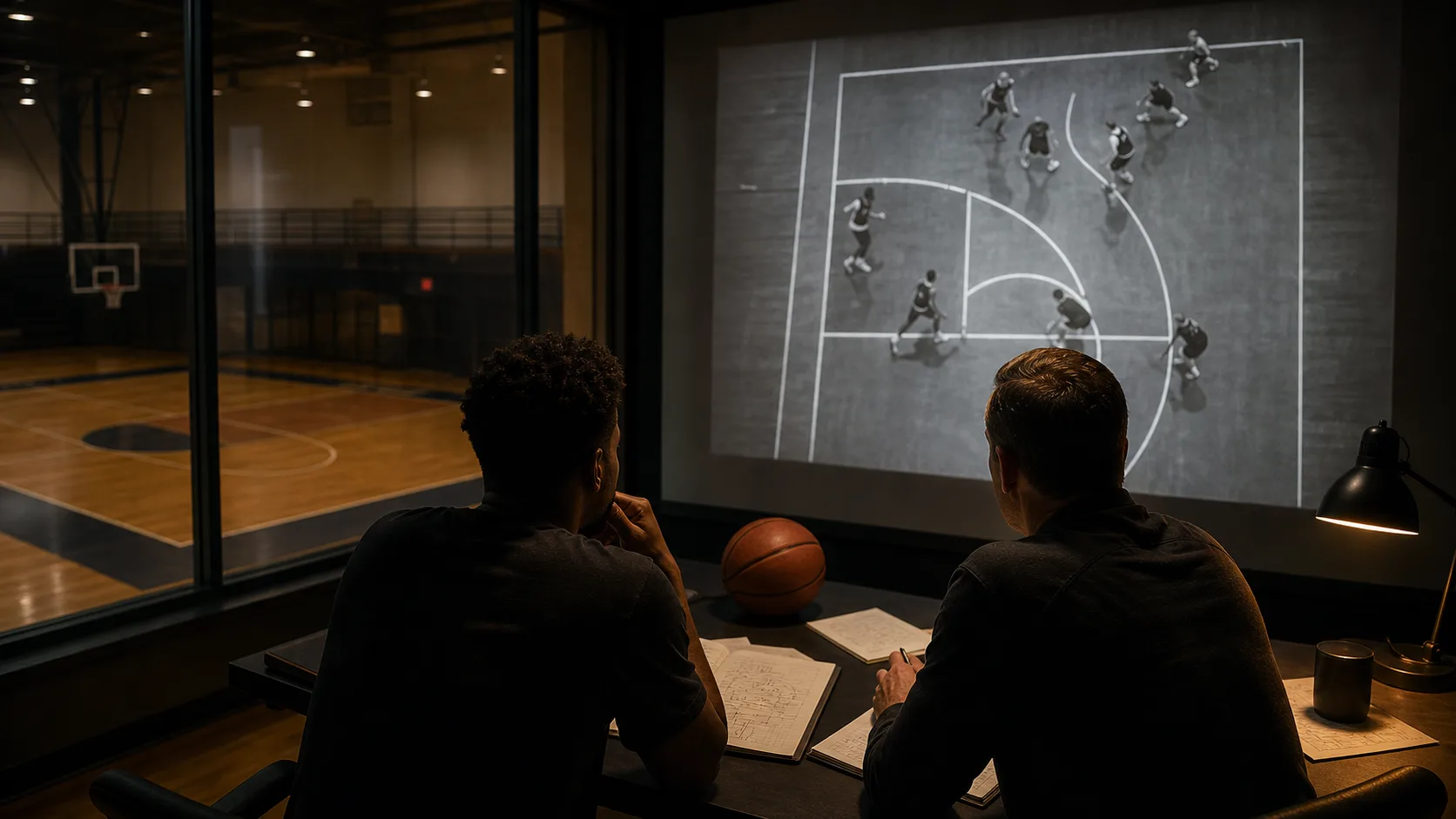
Hand any single basketball possession to twelve different coaches and you'll get twelve different reads. The system coach sees role clarity. The precision coach sees spacing geometry. The defensive coach sees help angles. The analytics coach sees expected value. None of them are wrong. They're all looking at the same possession through a different lens.
HoopBrief currently turns basketball and matchup questions into structured reports using public statistical and play-by-play context. It does not accept film uploads or provide possession-level video tagging.
Why a Single Lens Limits You
Every coach is, by training and temperament, biased toward one or two lenses. The system coach can't help seeing role clarity first. The defensive coach can't help seeing rotation breakdowns. The bias isn't a flaw, it's how a single human brain processes a five-person, fast-moving game in real time.
The flaw is when you stop knowing what you're not seeing. The system coach who never thinks about analytics is leaving expected-value points on the floor. The analytics coach who can't read a film-room cue is missing context the numbers don't carry. The best staffs in the league rotate lenses deliberately, possession by possession.
The Twelve Lenses (Quick Reference)
1. System, role clarity, structure, who fits where (Popovich lineage) 2. Precision, spacing geometry, sequencing, clean reads (Redick lineage) 3. Defensive, coverages, rotations, help angles 4. Analytics, expected value, shot quality, possession-level math 5. Film Room, pre-snap tells, behavioral patterns, opponent tendencies 6. Advance Scout, what the next opponent will do based on this tape 7. Player Development, individual skill execution, what to coach 8. Tactical, set design, ATO craft, playbook architecture 9. Micro-Behaviors, the tiny exploitable details (the Quiet Edges lens) 10. Game Prep, series arithmetic, rotation math, adjustment forecasting 11. Matchups, how a specific assignment plays out across a series 12. Whistle Craft, referee tendencies, contact manipulation, foul math
Different lenses dominate at different stages of the game. Pre-game prep leans on Advance Scout, Film Room, and Game Prep. In-game adjustments lean on Defensive, Matchups, and Micro-Behaviors. Post-game review leans on Analytics and Tactical. Player development leans on the Player Development lens, obviously, but with a Defensive overlay.
Walkthrough: One Possession, Twelve Lenses
Imagine a possession that ends in a corner three: a middle pick-and-roll, the defense ICEs, the handler kicks back to a swung corner shooter who knocks it down.
- System lens: Did everyone hold their role? Did the corner shooter stay in the corner instead of drifting? Did the screener roll on schedule?
- Precision lens: Was the spacing geometry correct? Were the strong-side players one pass apart, no closer?
- Defensive lens: Was the ICE call clean? Did the weak-side help rotate to the shooter on time?
- Analytics lens: Corner three. Highest-value half-court shot. The possession executed expected value correctly.
- Film Room lens: Has this team run this exact action against this defender before? What was the outcome the last time?
- Advance Scout lens: What does this tell the next opponent? They'll watch this possession and adjust their ICE call accordingly.
- Player Development lens: Did the corner shooter use proper footwork on the catch? One-two or hop?
- Tactical lens: What was the ATO entry that led to this? Could the same flow set up a different finish?
- Micro-Behaviors lens: Did the swung defender close out hips-square or hips-open? Was there a tell on the screener's footwork before the slip?
- Game Prep lens: What lineup combinations were on the floor? How does this possession fit the series-arithmetic plan?
- Matchups lens: Who was the worst defender involved? Did the offense hunt them?
- Whistle Craft lens: Was there contact on the closeout the ref let go? What does that tell us about the next 5 minutes?
Twelve reads of the same six seconds. None of them is the "right" one. All of them, together, are how a serious staff views every possession.
Which Lens Should You Default To?
The right default lens depends on your role:
- Player: Player Development + Micro-Behaviors. What can you control next possession?
- Coach: System or Defensive (depending on your team's identity) + Tactical.
- Analyst: Analytics + Advance Scout.
- Fan: Film Room + Micro-Behaviors. The lenses that turn casual viewing into pattern recognition.
The mistake is not having a default. Coaches who try to see everything end up seeing nothing. Pick a default that matches your role, then deliberately add a second lens you're weak at.
Building Multi-Lens Habits
Three exercises to build the multi-lens habit:
1. Watch one quarter through one lens. Pick the lens you're weakest at and force yourself to see only that for 12 minutes. Defensive lens for an offense-first viewer. Analytics for a film-room viewer. 2. Re-watch the same possession through three lenses. Pause after a possession ends, then describe it three times in three different lens-languages. 3. Read one HoopBrief report and identify which lenses are doing the work. Most reports lead with two lenses and use the others for support. Naming them out loud sharpens your own toolkit.
These aren't hard exercises. They take 10 minutes a game. After two weeks, the multi-lens habit is automatic.
Using the Lens System in HoopBrief
Every HoopBrief surface is built to be read through the lens system. The matchup intelligence runs through Matchups + Game Prep. The reports library is structured by lens. The Ask product accepts lens-specific questions ("from the Defensive lens, what happened on this possession?"). The training plans tag drills by lens.
The system isn't there to be cute. It's there because every elite staff in the league operates with multi-lens habits, and the lens system makes the same habit available to a single analyst with a laptop.
The next time you watch a possession, name the lens you defaulted to. Then run the play back and try a second one. That's the entire system, and it's how the staff watching across from you is doing it too.