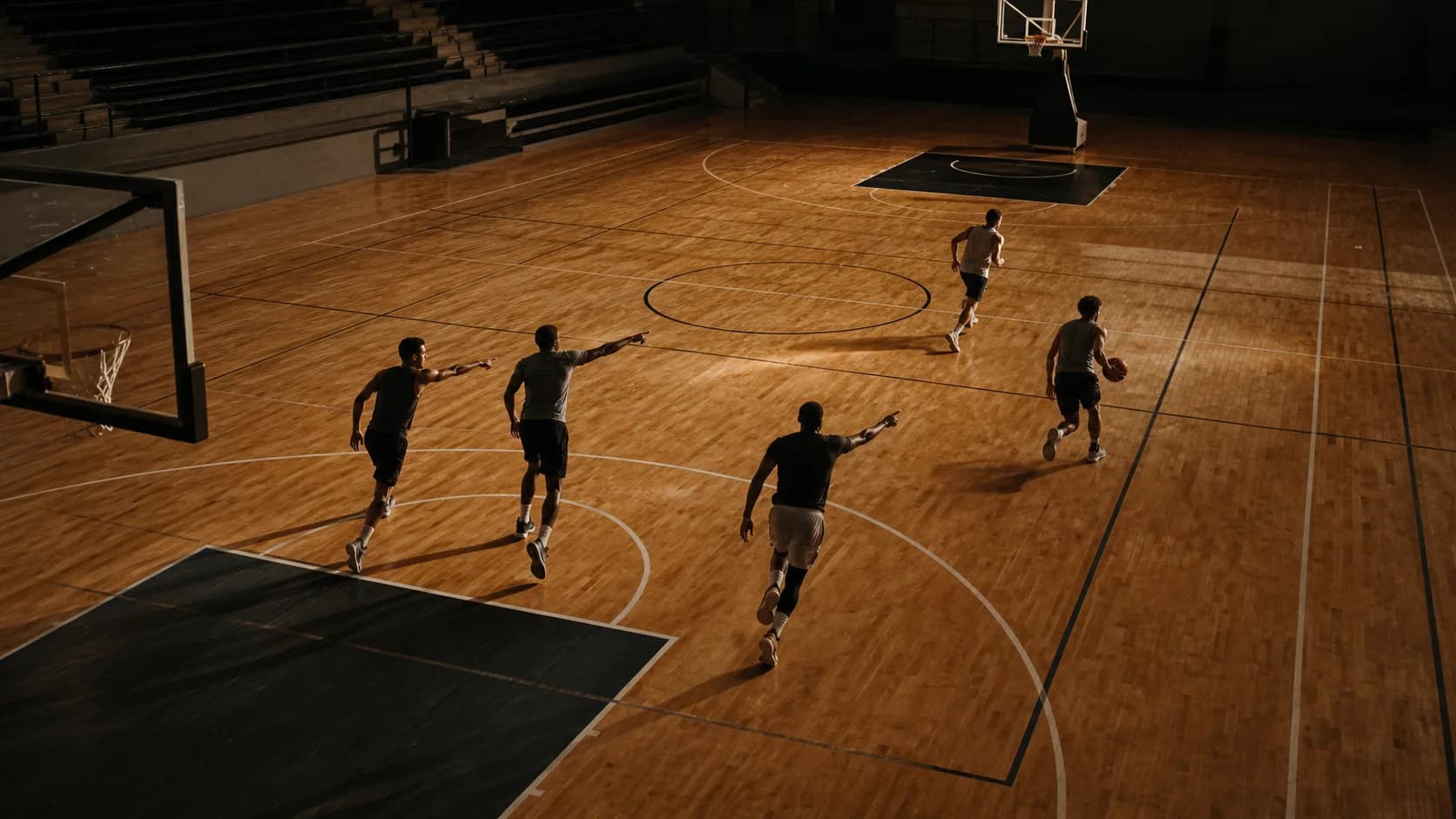
Motor is mostly a choice, not a personality trait. The four motor signals NBA scouts grade, transition defense, closeout effort, recovery after mistakes, and box-out commitment, are all choosable on every possession. This piece is the 90-day plan to build a scouting-grade motor reputation.
This is part of the Player Development Hub cluster.
The 90-Day Build
- Days 1-30: Add the four motor signals one at a time, one per week.
- Days 31-60: Sustain all four across full games and back-to-backs.
- Days 61-90: Build the conditioning that sustains motor without forcing it.
By day 90, the habit is automatic, the reputation is starting to set with teammates and coaches, and the conditioning supports the effort across 30+ games per season.
Days 1-7: Transition Defense
The easiest motor signal to add. The choice: sprint back instead of jog.
The rule: every time your team misses a shot at the offensive end, you sprint back. No exceptions. No "I'll jog this one because we have numbers."
Sprinting back doesn't require skill, decision, or athleticism. It requires the choice. Make it 100% of the time for a week and the habit is set.
By day 7, transition defense is automatic. You don't have to think about it.
Days 8-14: Closeout Effort
Add the second signal. The choice: full-speed closeouts at every point of the possession, including late in possession 75+.
The rule: every closeout is full speed, with a short-stride deceleration at the end, high hand, between the shooter and the basket.
This is harder than transition defense because closeouts happen later in possessions when legs are already tired. The choice still works, it just requires more discipline.
Days 15-21: Recovery After Mistakes
Add the third signal. The choice: accept mistakes, return to the next possession, no arguing.
The rule: when you make a defensive mistake, take one breath, identify the next defensive setup, focus on it. Do not argue with officials, do not sulk, do not let the mistake affect the next two possessions.
This is the hardest signal to add because it requires emotional regulation in real time. Two weeks of deliberate practice usually starts to reshape the pattern.
Want to study NBA players' recovery patterns after defensive mistakes? Start a HoopBrief plan and the micro-behaviors lens tags recovery responses across the 12 lenses.
Days 22-28: Box-Out Commitment
Add the fourth signal. The choice: box out on every possession, including non-natural matchups.
The rule: every shot that goes up, you make contact with the nearest offensive player. Even if you're a guard and your natural matchup is at the perimeter. Even if the shot is heavily contested and probably won't go in. Every possession.
By the end of week 4, all four motor signals run automatically.
Days 29-60: Sustain Across Full Games
The middle 30 days are about sustaining the four signals across full-game and back-to-back fatigue. The test:
- Third quarter of any game, do all four signals hold?
- Second game of a tournament weekend, do all four signals hold?
- Late in a 4-overtime classic, do all four signals hold?
If yes, the behavior is locked in. If not, identify which signal drops first (usually closeouts or box-outs) and add deliberate attention to it.
Days 61-90: Conditioning That Sustains Motor
Motor without conditioning collapses. The 30-day conditioning plan:
- 3 days/week basketball-specific. Defensive slide endurance, sprint intervals, transition speed. 30-40 minutes per session.
- 2 days/week strength. Lower body, upper body push/pull, core anti-rotation. 40-50 minutes per session.
- 2 days/week mobility. Hip openers, ankle work, thoracic rotation, shoulder mobility. 15-20 minutes per session.
By day 90, the four motor signals run automatically, the body has the capacity to sustain them, and the reputation starts to set across teammates, coaches, and the recruiting community.
The Reputation Effect
Motor is a reputation. Once scouts have categorized you as high-motor, the category sticks. Same in reverse.
The reputation builds from observable patterns across multiple games, not from any single game, and not from announcing the motor commitment. Do the work. The recognition follows.
HoopBrief currently turns basketball and matchup questions into structured reports using public statistical and play-by-play context. It does not accept film uploads or provide possession-level video tagging.
Where to Go Next
Companion development pieces: How to Improve Basketball Decision-Making, Defensive Habits That Translate to Higher Levels, How to Become a Better Off-Ball Player.
Scouting context: Why Motor Matters in Scouting Reports.
Hub: Player Development Hub.
Foundation reading: conditioning for basketball, fourth-quarter strength, mental toughness, clutch performers.