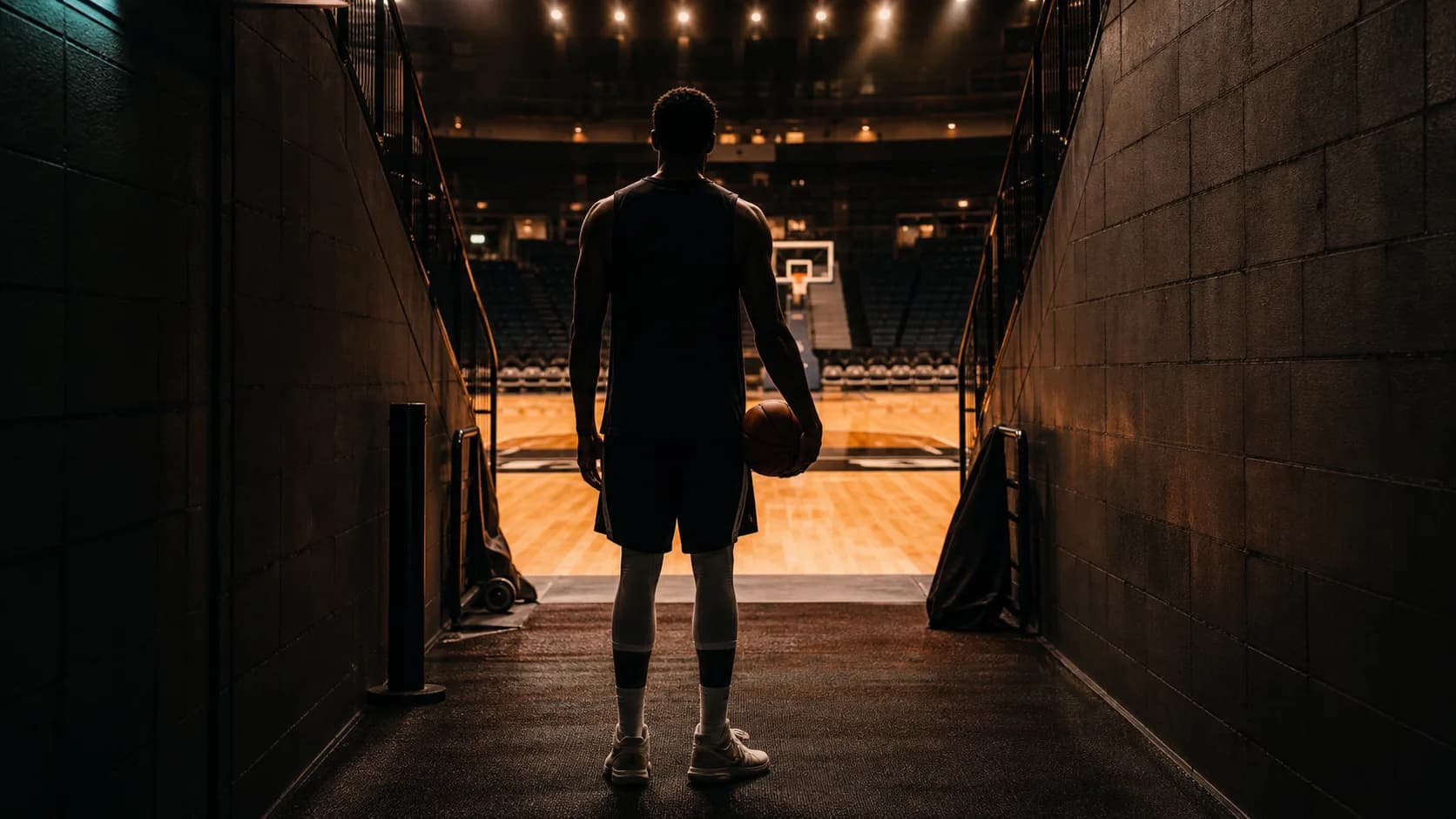
Steph Curry takes a clutch shot the same way he takes a warm-up shot in an empty gym at 11am. Same routine, same release, same breathing. That's not luck. It's training. The mental skill of clutch performance is built, and the players who build it deliberately are the ones still on the court when the game is on the line.
The Myth of "Natural" Clutch
Sportswriters love the idea that some players are born clutch, that there's a gene for being calm under pressure. The research says otherwise. Performance under pressure is a skill, the same as a jump shot. It's trained the same way: through repetition, deliberate practice, and feedback.
The players who succeed in big moments aren't more naturally calm. They've practiced calm more often. They have a specific routine, a specific way of recovering from misses, and a specific mental focus that they've drilled until it's automatic.
Pre-Shot Routine as an Anchor
Every great shooter has a pre-shot routine. It's not superstition. It's an anchor. The routine is identical in pressure and non-pressure situations, which means it imports the calmness of practice into the chaos of the game.
Curry's routine: wipes shoes, two dribbles, one bounce, exhale, shoot. Same every time. In a free-throw down 1 with 0.3 seconds left, same routine. In a half-court shot at the buzzer, same routine. The routine creates the state. Without the routine, the state would be different, and the shot would be different.
If you want to be clutch, build a routine. Use it in every shooting drill. Use it in every game. By the time the big moment arrives, the routine takes you into the same mental state as practice. The shot is then just the shot.
Recovery From a Missed Shot
The hardest mental skill in basketball is missing and forgetting. Most players miss a shot, replay it, get tight, and miss the next one. Then they get scared of the third one. By the fourth quarter they're 2-for-12 and looking for someone to pass to.
Elite players recover in seconds. They have a reset protocol, a physical action that interrupts the mental loop. Some players touch their wrist. Some say a single word. Some look at the clock. The action signals the brain to flush the previous shot and prepare for the next.
The drill: at every practice, miss on purpose. Take a deep breath. Use your reset. Take the next shot. Repeat. By the time you're in a real game, the reset is automatic. The miss doesn't carry forward.
Visualization
Every elite shooter visualizes before games. Not "winning", that's vague. Specific shots: a corner three, a free throw down 2, a step-back from the wing. The brain processes mental rehearsal almost identically to physical rehearsal. The shot you've taken in your mind 1,000 times feels like a familiar shot when it appears in real life.
The protocol: 10 minutes of pre-game visualization. Picture yourself in three specific scenarios. See the catch, the rise, the release, the follow-through. Feel the rhythm. Hear the crowd. Then put your shoes on and go play.
The shots you've visualized show up in the game. You'll feel like you've been there before. You have.
The Pressure-Performance Curve
Performance under pressure is a curve, not a line. Low pressure produces low engagement (warm-up shots get missed). Medium pressure produces optimal performance (this is "the zone"). High pressure produces choking, too much engagement, too much arousal, motor skills break down.
The skill of being clutch is staying in the medium-pressure zone even when objective pressure is high. That's what the routine does. That's what visualization does. That's what the reset does. They keep your nervous system in the optimal performance window even when the situation is screaming at it to leave.
Sleep, Recovery, and Performance
Your nervous system is a battery. Mental toughness is a function of how charged it is. A sleep-deprived player can have all the routines in the world and still choke, because his prefrontal cortex isn't getting enough oxygen to execute them.
The non-negotiable: 8+ hours of sleep, every night. Especially the night before a big game. Players who skimp on sleep make worse decisions, miss shots they normally make, and lose composure faster.
Recovery extends to the whole organism. Hydration. Nutrition. Stress management off the court. Mental toughness in a game is downstream of physical health off the court. The two are inseparable.
Routine Around Games
The 24 hours before a game should be standardized. Same dinner. Same wake-up time. Same morning shootaround. Same pre-game routine. The standardization is the point. It removes uncertainty. By the time the game starts, the only variable is the game itself.
Most players underestimate how much pre-game uncertainty drains their nervous system. A player who eats different food, sleeps in a strange bed, deals with a family issue, and gets to the arena late is already half-cooked before tip-off. The player who controls the controllables arrives fresh.
Champion teams obsess about routine for a reason. It's the mental equivalent of a controlled experiment.
What "Clutch" Actually Looks Like
Watch a clutch moment in slow motion. The body is relaxed. The shoulders are down. The breathing is even. The eyes are focused on a single point.
That's the state the routine, the visualization, and the reset all produce. It's not the absence of pressure, it's the management of it. The player is in the same state he was in during pre-game warm-ups. The shot, when it leaves his hand, is just the shot he's taken 10,000 times before.
The Quiet Edge
The most-clutch players in the league are the ones with the most-boring routines. They eat the same meal, sleep the same hours, warm up the same way, take the same number of shots, do the same breathing. The boring is what produces the brilliant.
The opposite of clutch is chaos. Reduce the chaos in your preparation, and the moment becomes manageable. The routine is the bridge from practice to performance. Build it. Use it. Trust it.
The shot you've made a thousand times in an empty gym is the shot you make at the buzzer. They're the same shot.
Keep reading: playing through a slump, free-throw mechanics, and pre-game routine.