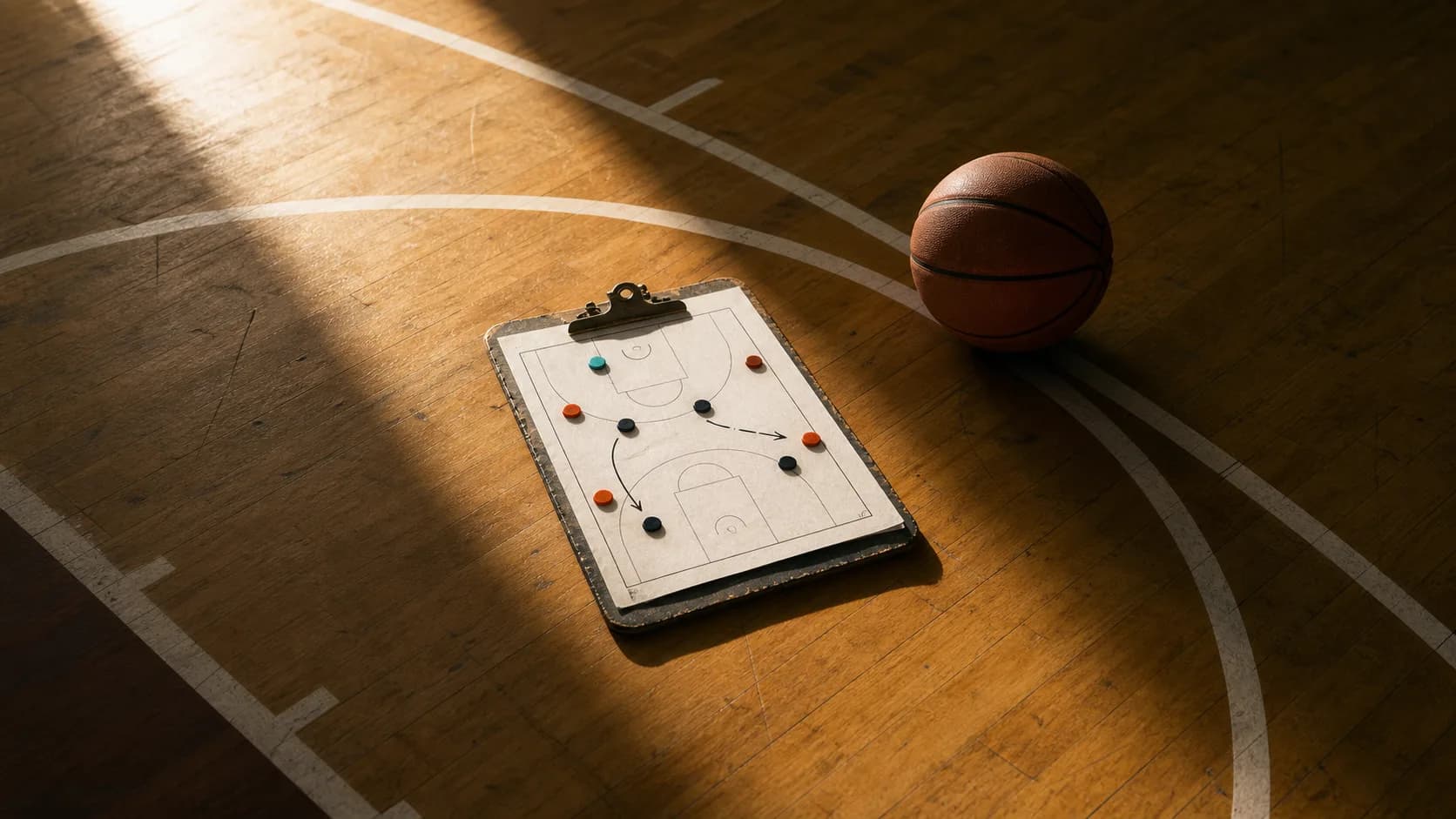
Positioning IQ in a playoff series compounds across 4-7 games until it decides the marginal possessions. Regular-season positioning IQ is necessary for any team that wants to compete; playoff positioning IQ is the higher level, the discipline that survives 7 games of fatigue, scouted adjustments, and high-leverage moments. This piece is what positioning IQ actually means in a playoff series context.
This is part of the Playoff Prep Hub cluster.
The 3 Components of Playoff Positioning IQ
- Defensive help geometry. Where each defender is on every possession.
- Offensive spacing discipline. Where each non-action player is on every possession.
- Late-game positioning under fatigue. Whether both hold in the last 4 minutes of close games.
A team that wins all three components wins close playoff games. A team that loses one component loses close playoff games.
Component 1: Defensive Help Geometry
The first thing scouts evaluate in playoff defensive analysis. The patterns to maintain:
- Ball on the strong wing: weak-side defender at the nail (lane area), helpers a step toward the ball.
- Ball at the top: weak-side defenders even with the ball on each wing.
- Strong-side post-up: weak-side defenders dig and recover.
- Transition: defenders sprint to the paint first, then expand out.
A team that maintains these patterns at 90%+ has elite help geometry. A team that maintains them at 70% loses the geometry math when the opposing star runs 18 pick-and-rolls per game.
The 7-game compounding: each pick-and-roll possession where the help is one step out of position produces 0.05-0.10 PPP for the offense. Across 7 games and 100+ pick-and-rolls, that's 5-15 points of cumulative offensive efficiency for the opponent, usually enough to swing 1-2 games in a series.
Component 2: Offensive Spacing Discipline
The mirror image. The patterns to maintain on offense:
- Pick-and-roll on the right wing: weak-side shooters in left corner + left wing.
- Post-up on the left block: strong-side shooter in left corner, weak-side shooters in right wing + top.
- Drive from the top: corners stretched, wings drifted.
- Iso from the wing: four players symmetric with one in dunker spot.
The teams that maintain these patterns under fatigue create their own open shots. The teams that drift out of position give the defense the rest. Our how to improve positioning IQ piece covers the 6-week training plan.
Component 3: Late-Game Positioning Under Fatigue
The hardest version. In the last 4 minutes of close playoff games, the legs are tired and the focus is challenged. The teams that maintain positioning here win the close ones.
What scouts watch:
- Closeout effort in the last 4 minutes vs the first 4. Did it drop?
- Help rotation timing in late-game vs early-game. Did it slow?
- Off-ball spacing discipline when the offense is searching for a shot. Did it collapse?
- Box-out commitment on the late-game defensive possession. Did it hold?
A team that holds positioning in late game wins close playoff games at a 60%+ rate. A team that drifts loses them at a 60%+ rate. The differential adds up across a series.
HoopBrief currently turns basketball and matchup questions into structured reports using public statistical and play-by-play context. It does not accept film uploads or provide possession-level video tagging.
How Positioning IQ Evolves Across a Series
The opposing scout has watched your patterns from Games 1-3 by the time Game 4 tips. The patterns that produced wins in Games 1-3 will be specifically scouted and countered.
The teams that win 7-game playoff series adapt their positioning patterns to defeat the scout:
- Coverage swaps that change the geometry the offense expects.
- Lineup tweaks that change which positions matter most.
- Spacing variations that produce new angles the defense hasn't scouted.
A team with positioning depth can adapt across a series. A team with one positioning pattern gets scouted out of it.
Our conference finals adjustments piece covers the three universal adjustments NBA staffs make by Game 3, most of them involve positioning changes.
The 7-Game Compounding Effect
The positioning IQ math compounds:
- Game 1: ~5 possessions of positioning differential = 2-3 point swing.
- Game 2: ~7 possessions (each team has scouted the other's tendencies) = 3-4 point swing.
- Game 3: ~10 possessions (adjustments have been installed) = 4-6 point swing.
- Game 4-7: ~12-15 possessions per game = 6-10 point swing per game.
By Games 4-7, the team with higher positioning IQ has a 6-10 point per-game advantage that decides every close game in the series. The team that wins the positioning math wins the series.
HoopBrief currently turns basketball and matchup questions into structured reports using public statistical and play-by-play context. It does not accept film uploads or provide possession-level video tagging.
Where to Go Next
Companion playoff prep pieces: What Coaches Look For in Matchup Prep, How to Break Down Opponent Tendencies, How to Analyze a Team's Offensive Weaknesses.
Tactical reading: conference finals adjustments by Game 3, playoff adjustments, what changes in 7 games, pick-and-roll coverages explained.
Development companion: How to Improve Positioning IQ, Player Development Hub.
Hub: Playoff Prep Hub.
Foundation reading: how NBA coaches prepare for playoffs, the 12-lens framework.