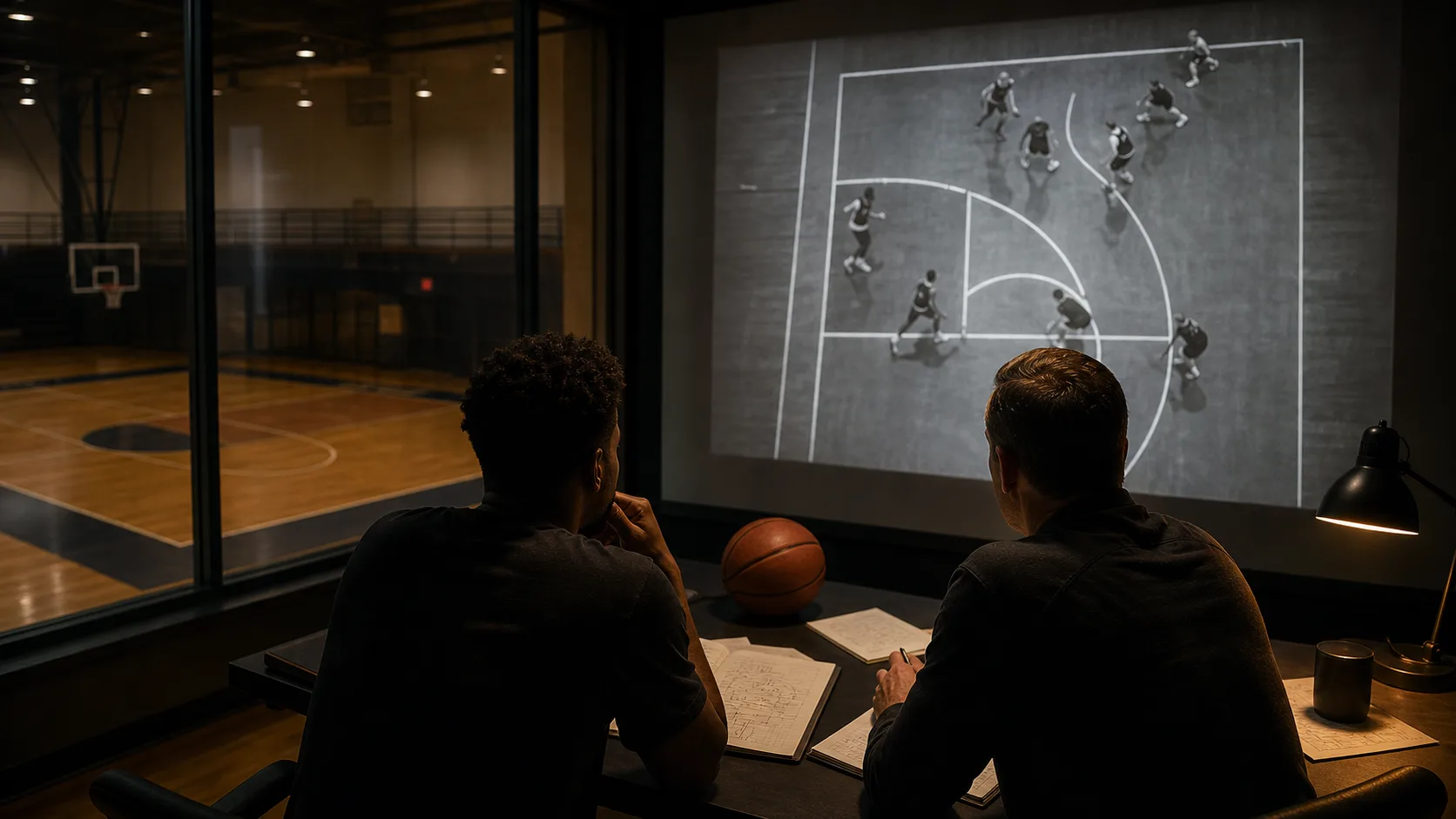
Conference Finals series are decided by Game 3. Not in the box score, in the adjustments staffs commit to once they've seen 96 minutes of tape and have 96 hours to react. By the end of Game 3, every serious staff has made three structural changes. Knowing what they are is the difference between watching the basketball and reading the basketball.
Adjustment #1: Rotation Tightening
The first move every staff makes is rotation tightening, pulling 2-3 minutes from the deepest bench player and giving them to the closer's unit.
In the regular season, an NBA team plays 9-10 players. In the Conference Finals, the floor is 8 and the ceiling is sometimes 7. The 9th and 10th players don't disappear because of bias; they disappear because of a specific calculation:
- The marginal possession the 10th man defends is now worth 3x what it was in November
- Coaches will accept the conditioning cost on the 8 they trust to absorb the lost minutes
- The 10th man's matchup risk (a single bad defensive possession) outweighs his upside
The tell that this adjustment is happening: a player who logged 14 minutes in Game 1 and 12 in Game 2 plays 6 in Game 3, and the 6 is in low-leverage stretches. By Game 4, that player is out of the rotation entirely unless an injury opens a slot.
Adjustment #2: ATO Repertoire Shift
The second change is in the after-timeout play call book. Game 1 ATOs are usually a staff's "public" set, plays the league has seen all year, with one or two new wrinkles. Game 3 ATOs lean heavily on the wrinkles, plus a deliberately new package.
Why? Because by Game 2, the opponent's video staff has watched every Game 1 ATO three times and built a counter for each one. The staff that runs the same ATO library in Game 3 gets every one of them defended. The staff that introduces a new package buys 24-48 hours of confusion.
What "new package" means in practice:
- A different entry for the same action (the ball comes in to a different player but the action is identical)
- A decoy layered on top of an existing set (the action is the same; one extra cut sells the wrong tell)
- An entirely new look from a part of the playbook that's been dormant for months
The new package isn't always good basketball. Sometimes it's mediocre execution that simply isn't on the opponent's tape. That alone is enough to win 4-5 possessions across Games 3-4, see the eight ATO sets winning Conference Finals possessions for current examples.
Adjustment #3: Weak-Side Help Geometry
The third adjustment is the most subtle and the most decisive. It happens on the weak side of every half-court possession.
In the regular season, weak-side help is a system. By Game 3 of a Conference Finals, it's a player-by-player decision. Each weak-side defender is told exactly where to stand and exactly how far to help based on the specific shooter he's guarding and the specific action being run.
The differences are inches and angles, but they're decisive:
- A defender who was 6 feet off his shooter is now 4 feet off, because the staff has seen him hit two corner threes when help arrived late.
- A defender who was tagging the roller is now told not to tag, because the resulting kick-out has been killing the team.
- A defender who was switching every screen now switches only screens involving specific personnel.
The geometry change isn't visible to a casual viewer. It's visible to anyone watching the spacing of the four off-ball defenders on every possession. By Game 3, those four defenders are standing in measurably different spots than they were in Game 1.
What This Looks Like in HoopBrief
HoopBrief currently turns basketball and matchup questions into structured reports using public statistical and play-by-play context. It does not accept film uploads or provide possession-level video tagging.
By Game 3 of any series, the report writes itself: here are the three adjustments your team needs to make, and here are the three the opponent will make. The advantage goes to whichever staff commits to their three first.
The Bottom Line
Game 3 of a Conference Finals isn't a basketball game. It's the first commitment game of a series, the moment when both staffs stop running their regular-season identity and start running what they think will win this specific matchup, against this specific opponent, at this specific time of year.
The three adjustments above are the floor, not the ceiling. Every staff makes some version of all three. The series is decided by which staff makes them sooner, sharper, and with more conviction.
If you're watching Game 3 of a Conference Finals and you can name which player got cut from the rotation, which ATO is new, and how the weak-side help has changed, you're watching the same game the coaches are watching.