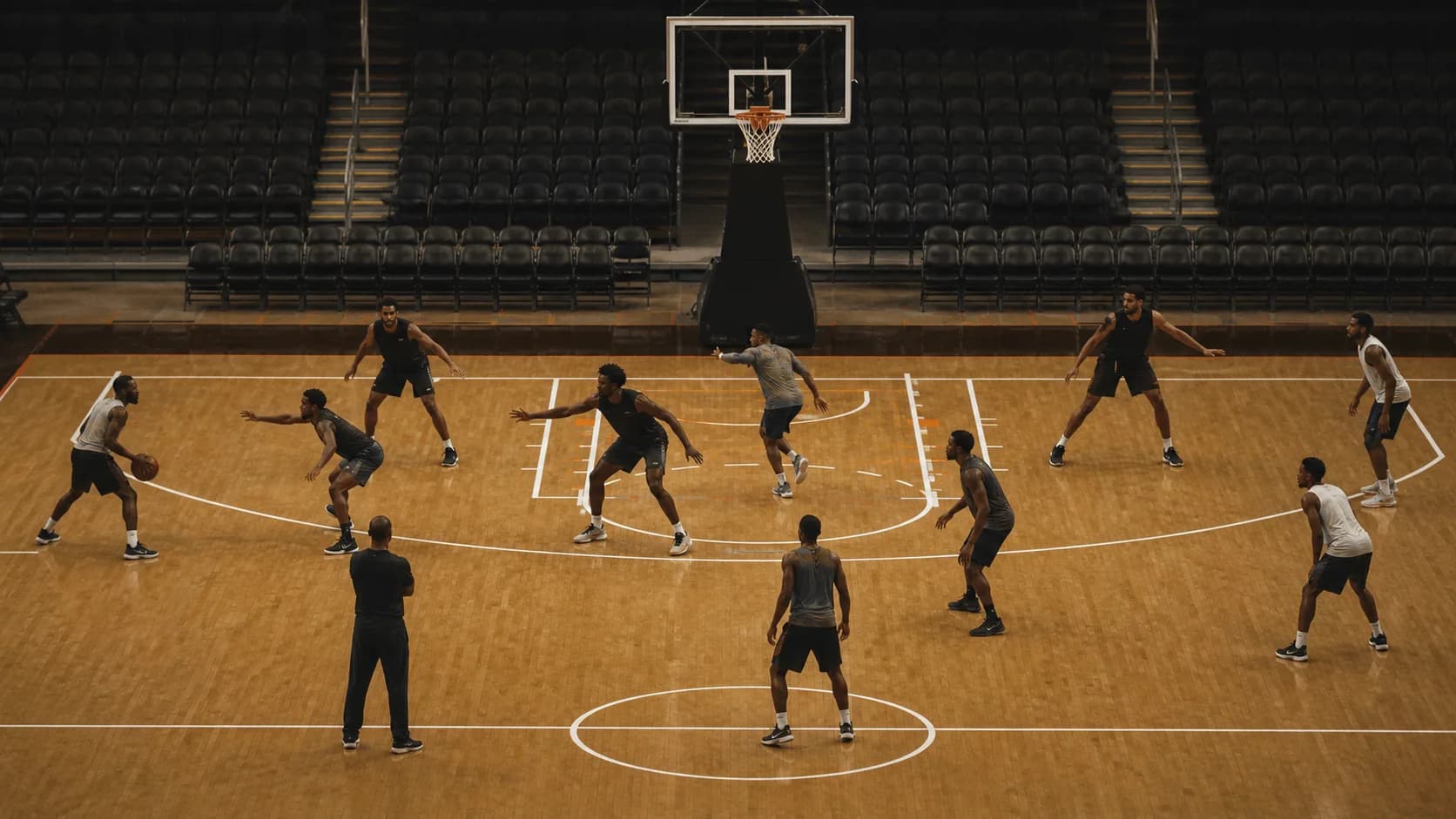
An ATO play is a coach's signature. It's the possession the staff has the most control over, full clock, fresh legs, every player in their preferred spot, and 30 seconds in a huddle to call exactly what they want. Watching playoff ATOs is watching coaches at their cleanest.
Eight families of sets show up over and over in May. Knowing the eight changes how you watch the next 30 minutes of basketball.
Why ATO Sets Are Coach Signatures
Most regular-season possessions are read-and-react. ATOs are scripted. The coach picks the action, the entry, the decoy, and the counter, all in advance. So an ATO tells you what the coach values: where he wants the ball, who he wants to take the shot, and what he expects the defense to do.
That's why ATO tape is the highest-value scouting tape in the playoffs. It's the staff's best thinking, distilled.
#1: The Stagger Pin-Down (a.k.a. the Floppy)
Two screeners line up on opposite blocks. The shooter rubs off both, choosing the side based on the closeout. The closer screen sets a back-pin so the help defender can't tag the shooter on the catch.
Why it works in May: it forces a help-defender decision in a half-second. If the help bumps, the shooter pops free. If the help stays, the shooter gets a clean catch. And there's no clean way to switch it because the screeners are different sizes.
Defense: tag and recover. The strong-side help has to tag the shooter on the cut and recover to the corner before the kickout.
#2: The Inverted Pick-and-Roll
The big handles. The guard screens. The matchup inverts, now the rim-protector's man is the screener (a guard), and the slow-footed wing has to navigate the screen on a quick handler.
Why it works: the natural switch for the defense ends with their slowest player on the ball, miles from the rim. The natural drop ends with the rim-protector chasing a guard around a screen.
Defense: pre-switch. Switch the matchups before the play starts so the inversion never lands.
#3: The Decoy Stack
Three players line up in a stack at the elbow. The decoy player flares, drawing the help. The actual shooter cuts the opposite direction off a hidden screen.
Why it works: defenders are wired to follow movement. The first cut sucks the help one way; the real cut goes the other.
Defense: don't follow movement; follow assignments. A team that's been disciplined all year will defend this. A team that's been help-heavy will give up the open shot.
#4: The Side-Out-of-Bounds Slip
Inbounder is the quarterback. The screener "slips" the screen, fakes setting it, then cuts to the rim. The shooter coming off the would-be screen is the decoy.
Why it works: the slip happens in the moment the defense's eyes are on the shooter. The big diving to the rim is uncovered for a half-second.
Defense: don't switch on slips. The screener's defender stays attached.
#5: The Late-Clock Iso Setup
Ten seconds left. The set is six seconds of decoy movement that resolves into an iso for the team's best scorer at exactly his preferred spot.
Why it works: the decoy movement empties the help side. By the time the iso starts, there's no help to bring.
Defense: switch everything. The iso is unavoidable; the goal is to put the right matchup on the ball.
#6: The Horns Wedge
Two bigs at the elbows, three perimeter players below. The handler enters between the bigs and reads the coverage. If the defense traps, he hits the open big. If they drop, he attacks. If they switch, he attacks the new matchup.
Why it works: it's a read-based set with three valid answers, all of which beat at least one defensive coverage. The defense can't be right against all three.
Defense: stay home and force the long shot. Don't trap, don't drop too deep. The Horns Wedge wins when the defense overcommits.
#7: The Zipper Rip-Through
Shooter starts on the block, runs the lane to the elbow ("zipper"), receives the ball, and immediately rips through into a one-dribble pull-up or attack.
Why it works: the zipper cut is a screen-less catch, there's no screen for the defense to navigate. The defender has to be in perfect position on the catch.
Defense: deny the catch. Top-lock the zipper. If the catch is denied, the entire play breaks.
#8: The Box Floppy with Re-Screen
The classic Floppy gets defended. The shooter, instead of taking the curl shot, dribbles into a re-screen at the wing. Now you have a pick-and-roll with the defense already in rotation.
Why it works: it's two actions glued together. The defense has to defend the first cleanly, then re-organize for the second in three seconds.
Defense: this is where coverage discipline shows up. Switch the first action so you're not in rotation by the second.
What Makes a Great ATO
Three traits separate elite ATOs from regular sets:
1. Two valid answers. The play has to score against at least two defensive coverages. 2. A decoy that pulls real attention. Token movement isn't enough, the decoy has to be a player the defense respects. 3. A clean exit. If the first action fails, there's an immediate flow-into. No standing.
The HoopBrief Tactical lens grades every ATO on these three criteria. By Game 5 of a series, you can see exactly which staff is running their three-trait sets and which staff is still running token movement.
Keep reading: late-game SLOBs, scouting report evolution, and Conference Finals adjustments.