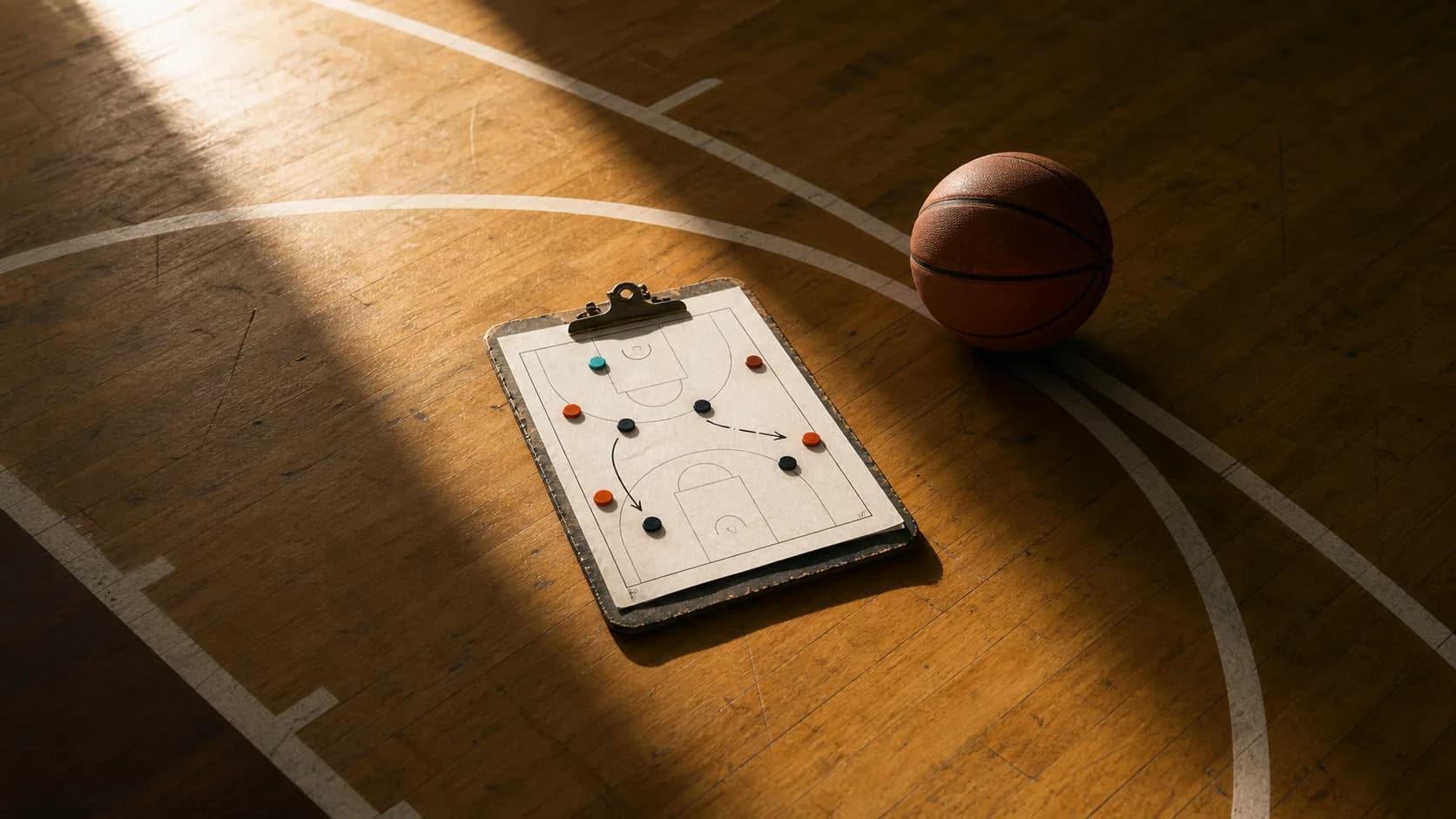
The short answer: A skip pass, a cross-court pass that bypasses the help defender, generates ~1.31 points per possession when it leads to a shot, vs ~1.08 PPP for swing passes. The skill isn't throwing it; it's seeing the rotation a beat before it happens. The best offenses (Boston, Denver, OKC) build their entire weak-side attack around this single pass.
Most amateur offenses never throw a skip pass. They swing the ball, perimeter to perimeter, one defender at a time. The defense rotates one defender at a time. Nothing gets stressed. The shot clock burns. The result is a contested 19-footer with two seconds left.
A skip pass collapses two defensive rotations into one. By the time the defense rotates to the new ball position, they're a beat behind, and the weak-side has a clean look. That's the geometry that produces the 1.31 PPP.
Why Skips Are Higher-EV Than Swings
A swing pass keeps the defense in shape. Each defender shifts one position; the help structure stays intact. Possessions die because each shift gives the defense time to recover.
A skip pass forces a long-distance rotation. Defenders have to cross the lane. Help has to re-anchor. In the 0.6 seconds it takes the ball to travel cross-court, the defense is in chaos. A shooter on the catch can rise without contest. A driver on the catch attacks a closeout from a defender who's still moving.
The math is direct. League-wide tracking data shows possessions ending in a skip-then-shoot generate ~1.31 PPP. Possessions ending in swing-then-shoot generate ~1.08. Possessions ending without any cross-court action: ~0.96. The skip is the single highest-leverage pass in modern basketball.
The Three Skip Windows
Not every possession has a skip available. There are three windows that open it up:
1. After a drive collapses help. The ball-handler drives, two defenders converge, the weak-side help defender steps over. The skip is to the corner that helper just left. Window: ~0.4 seconds.
2. After a strong-side ball reversal forces a rotation. When the ball moves from the wing to the slot, defenders shift. The weak-side wing's defender now has to cover both his man and partial help. Skip to the weak-side corner. Window: ~0.6 seconds.
3. After a strong-side post entry. The digger comes down to the post. The strong-side wing's defender shifts to cover the digger's shooter. The skip is back to the original strong-side wing, who just got freed. Window: ~0.5 seconds.
Recognize the window, throw the skip, generate 1.31 PPP. Miss the window, throw a worse pass.
The Strong-Side Gravity Test
The simplest skip-read: count defenders on the strong side. If three or more defenders are on the strong-side, the weak-side is exposed. Skip.
This sounds basic, but most ball-handlers never count. They watch the ball-handler in front of them. They don't see the rotation behind them. The discipline of looking weak-side before you start your dribble is what generates the skip read.
The best practice: every time you catch the ball, your first eye-glance is the weak-side corner. Then you check strong-side. Then you decide the play. Eye-glance order: weak-side → strong-side → drive lane.
Throwing the Skip
The pass itself is mechanical. Most amateur skips are over-thrown, chest passes from too far away, leading to telegraphed lobs.
The right form: one-handed, on a line. Step toward the receiver. Use the off-hand for a fake (eyes go to the strong-side wing, hand throws to the weak-side corner). Release at chest height; the pass should arrive at chest height.
The pass should travel ~25-30 feet in 0.6 seconds. That's a velocity most guards have but few train. Drill: throw 50 skip passes a day from the wing to the opposite corner, on a line, one hand. Track accuracy. By week three, the pass is a weapon.
The Skip-Back
The skip-back is the move after the skip. Defense rotates to cover the original skip; you swing the ball back to where it came from. The original spot now has a closeout from a recovering defender. Drive the closeout, kick to a new corner.
Watch any Boston playoff possession. Count how many end with a skip-then-skip-back-then-shot. The Celtics live in this geometry. It's the highest-EV three-pass sequence in basketball, generating ~1.42 PPP per possession when it's executed cleanly.
Frequently Asked
Why don't more amateur teams throw skip passes? Because they require seeing the whole floor, and most amateur offensive players are watching the ball or their own defender, not weak-side rotations. It's a vision skill, not a passing skill.
Is the skip pass risky? It can be. League-wide skip-pass turnover rate is ~7% (vs ~3% for swing passes). The 4-point gap is real but worth it given the EV, net of turnovers, the skip is still the higher-EV decision.
When should I NOT skip? When the help defender hasn't committed. If the weak-side defender is still home, the skip is into a closeout, not a clean shot. Patience over volume.
The Quiet Edge
The next time you watch an NBA game, count the skip passes in the first quarter. If a team throws six or more, they probably score 110+. If they throw two or fewer, they probably score under 100. The correlation isn't perfect but it's real, and it tells you everything about what separates modern offenses from old-school motion.
The pass nobody throws is the pass that wins games.
Keep reading: reading help defenders, elite court vision, and off-ball cutting.