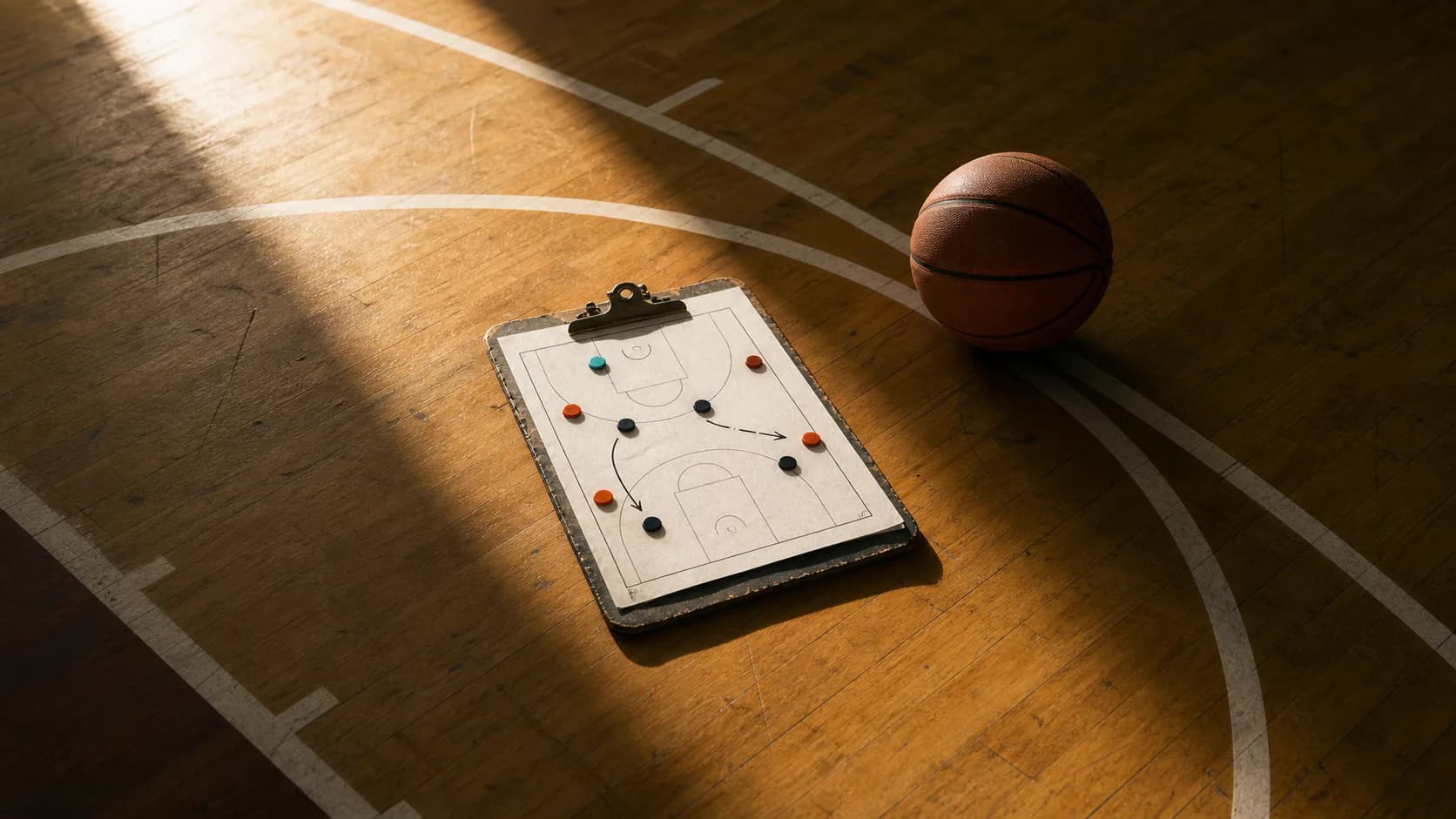
Summer League is the worst basketball you'll see all year. Half-speed offense, no installed coverages, no scouting reports, rookies playing rookies. And yet, every NBA front office sends 4-6 staff to Las Vegas in mid-July because the 5 Summer League games are the first chance to see whether a draft pick's college film actually translates.
This is the coaching-lens watch list for the 2026 NBA Summer League, what to track per pick, what signals predict NBA impact, and what to ignore.
The Summer League Schedule
The 2026 calendar (approximate):
- Salt Lake City Summer League: early July, 4 days, 4 teams.
- California Classic (San Francisco): early July, 4 days, 4 teams.
- Las Vegas Summer League: mid-to-late July at Thomas & Mack Center + Cox Pavilion. All 30 teams play approximately 5 games each.
Most 2026 lottery picks will appear in 2-3 Vegas games before being shut down for load management. The shutdown decision is typically made by the team's development staff after game 2 if the prospect has nothing more to prove, or, less charitably, if the team doesn't want more film of weaknesses circulating.
The 4 Signals That Actually Predict NBA Translation
Forget the Summer League box score. The four signals worth tracking, in priority order:
Signal 1: Shot Mechanics Under Contest
Can the form hold up against NBA-length defenders, or does the elbow drift / release point drop as the contest arrives?
What to watch: the prospect's pull-up jumper specifically. Catch-and-shoot in Summer League is mostly wide-open looks; pull-ups against an actual defender are the closest Summer League gets to NBA difficulty.
Why it matters: mechanics that break under Summer League contest will break worse against NBA defenders. The college film often disguises this because college defenders are 2-4 inches shorter than NBA wings.
Signal 2: Decision Speed in Pick-and-Roll
NBA-level handlers make the read in 0.4-0.5 seconds. Summer League rookies who take 0.7-0.9 seconds will get scouted-out by the regular season.
What to watch: the prospect's first 5-10 pick-and-roll possessions. Time from the screen contact to the offensive action (drive, kick, pull-up). If the read consistently takes 0.7+ seconds, the NBA path narrows quickly.
For the full pick-and-roll read framework, see pick-and-roll coverage breakdown for players.
Signal 3: Defensive Rotation Timing
Is the prospect rotating to weak-side help on time, early, or late?
What to watch: specifically the second action of any Summer League pick-and-roll. The first action is usually clean; the second action exposes rotation timing. Late rotators get punished in NBA halfcourt offense.
Signal 4: Motor Under Fatigue
Summer League back-to-back games are the cleanest motor test you'll see all year. The first game everyone tries hard. The second game, the prospects with NBA motor still sprint back on defense and box out; the prospects without it coast.
What to watch: transition defense in game 2 of any back-to-back. Sprint vs jog.
HoopBrief currently turns basketball and matchup questions into structured reports using public statistical and play-by-play context. It does not accept film uploads or provide possession-level video tagging.
What to Ignore
Summer League over-rewards three things that don't translate:
- Isolation scoring against rookie defenders. A draftee dropping 25 points in iso looks great; in the NBA the same iso against a starting wing produces 0.85 PPP.
- On-ball usage volume. Rookies who hog the ball in Summer League often did the same in college. NBA usage gets enforced by scheme and veterans; college usage rarely translates.
- Counting stats per game. Points, rebounds, assists in Summer League correlate roughly 0.3 with NBA year-1 production. The four signals above correlate 0.65+.
How to Watch the 2026 Lottery Class Specifically
Without naming exact picks (the 2026 lottery results just dropped and most projections are speculative this early), the per-team archetypes to track:
- The top-3 picks: all expected to be star-projection prospects. Watch the 4 signals; ignore the counting stats. The decision-speed lens is the most-predictive single thing.
- Picks 4-7: the biggest variance in this range. Combine measurables already differentiated them; Summer League tells you whether the skill stack matches the body.
- Picks 8-14: role-player projections. Watch the off-ball value specifically, cuts, screens, relocations. The lottery picks who become starters from this range usually had elite off-ball signals in Summer League.
For the broader draft-evaluation framework, see NBA Draft 2026 final mock + team fits and NBA Draft 2026 preview: coaching-lens prospect guide.
What Summer League Doesn't Show
Three things you literally cannot evaluate in Summer League because the scheme doesn't exist:
- Defensive matchup work, Summer League defenses don't switch, don't hedge, don't blitz. The defensive scheme is mostly "guard your man." So defensive lens evaluation is severely limited.
- Off-ball value at NBA spacing, Summer League spacing is amateur, which makes Summer League cuts and screens look more impactful than they would be at NBA spacing.
- Late-game decision-making, most Summer League games are decided by 4th-quarter benches (the actual prospects get pulled). So clutch reads can't be evaluated.
HoopBrief currently turns basketball and matchup questions into structured reports using public statistical and play-by-play context. It does not accept film uploads or provide possession-level video tagging.
Where to Go Next
Draft context: NBA Draft 2026 final mock + team fits, NBA Draft 2026 preview: coaching-lens prospect guide.
Scouting framework: how NBA scouts evaluate size, length, and athletic translation, how NBA scouts evaluate playmaking and passing, what NBA scouts look for in middle school and high school players.
Hub: NBA Scouting Hub.