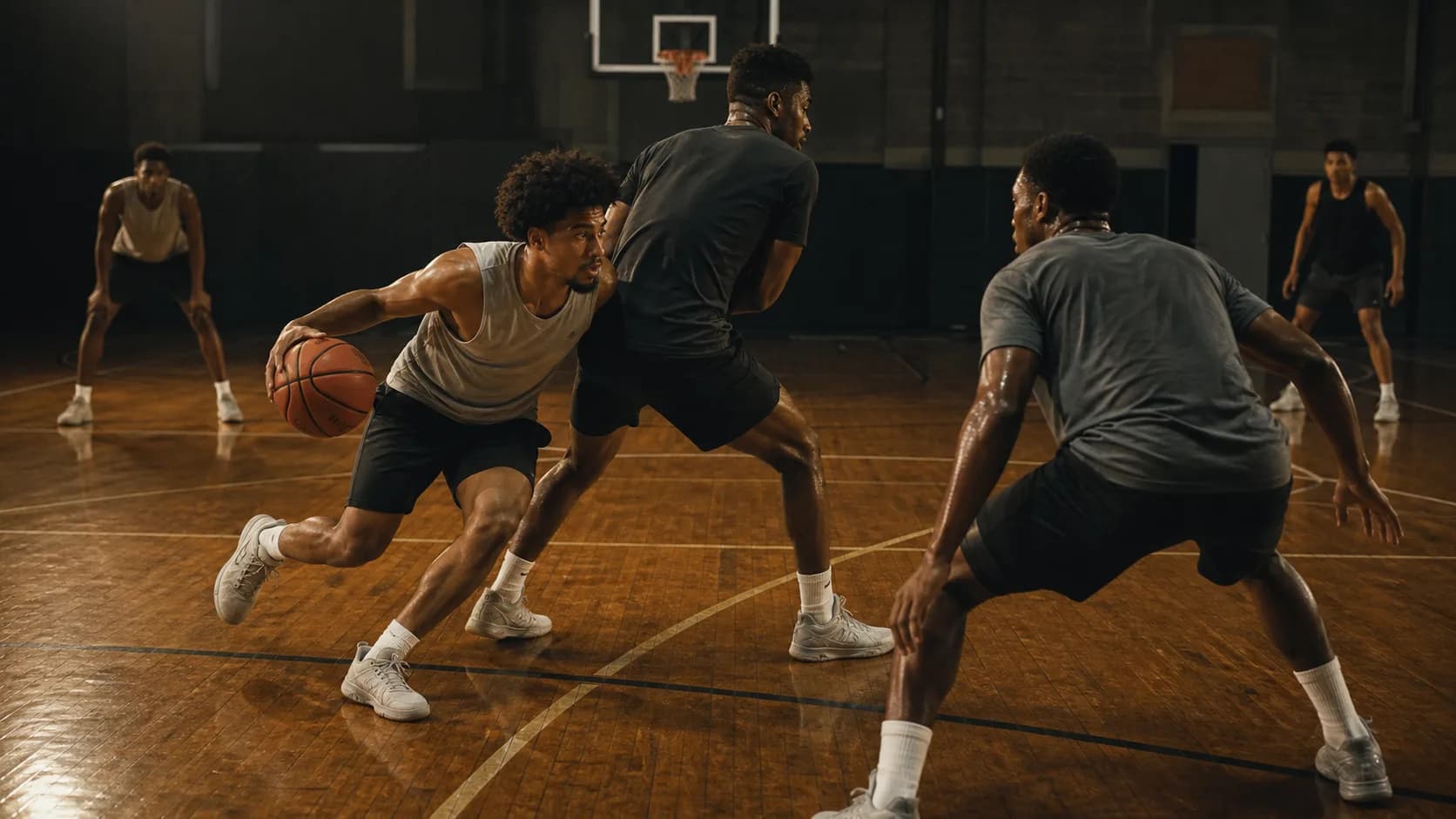
You have 0.4 seconds. That's the window between when a ball screen lands and when the on-ball defender commits to either fighting over or going under. In that window, you have to identify the coverage, pick the counter, and start the move. NBA-level guards make the read inside the 0.4. College guards take 0.6. High school guards take a full second, and lose the window.
This piece is the read-first breakdown of the four common coverages, drop, switch, blitz, ICE, built for the player making the decision, not the coach drawing it up.
The Pre-Screen Tell: Look at the Screener's Defender's Feet
The single most useful read in pick-and-roll happens before the screen even arrives.
Watch the screener's defender (usually the center). Their feet position telegraphs the coverage:
- Feet sunk deep toward the rim = drop. They're protecting the paint; you'll get a clean pull-up.
- Feet ready to step out at screen level = hedge or blitz. They're going to step out; expect a trap or a hard show.
- Feet flat at the level of the screen, body squared to you = switch. They're going to switch onto you.
- Feet shaded to one side = ICE. They're going to force you toward the sideline.
The on-ball defender's body angle is the secondary tell. But the screener's defender's feet are the tell that arrives first, before the screen even contacts the on-ball defender.
If you train yourself to look at the screener's defender's feet during the dribble approach, you'll have the coverage read 0.5-1.0 seconds before the screen arrives. That's the entire game.
Coverage 1: Drop
What the defense gives up: the mid-range pull-up between the elbows. What the defense protects: the rim and the corners.
Your primary read: pull up at the elbow. Don't drive into the drop; the big is waiting. Don't kick to the corner; the defender is positioned to recover.
Your secondary read (if your pull-up isn't ready): the snake dribble + kick. Reject the screen, snake through the lane, the weak-side help defender will tag the roller, kick to the corner where they vacated.
Common mistake: trying to drive at the big. Drop coverage exists specifically to make rim drives inefficient. Take the shot the defense gave you.
Drill: chair at the elbow as the screen, partner standing in the paint as the dropping big. Attack the screen, pull-up between the elbow and foul line. 25 reps each side until the pull-up arrives automatically without testing the drive.
Coverage 2: Switch
What the defense gives up: mismatches, a big on you, a small on the roller. What the defense protects: rim attacks against an in-position defender.
Your primary read: attack the mismatch in your favor. If you're a 6'4" guard who got switched onto by a 6'10" center, drive to your dominant hand, use your speed advantage. If your screener got switched onto by a 5'11" guard, throw the lob or hit them on a quick post-up entry.
Your secondary read: if neither mismatch is exploitable in 3 seconds, swing the ball and re-attack on the next action.
Common mistake: holding the ball too long. Switch coverage gives you a fresh shot clock and a mismatch, but the mismatch only lasts 4-6 seconds before help defenders rotate. Attack early.
Drill: scrimmage with the rule that every pick-and-roll must be defended with a switch. Train the read pattern in a controlled environment before applying in unstructured scrimmage.
HoopBrief currently turns basketball and matchup questions into structured reports using public statistical and play-by-play context. It does not accept film uploads or provide possession-level video tagging.
Coverage 3: Blitz (Hedge / Trap)
What the defense gives up: the short-roll 4-on-3. What the defense protects: the on-ball scorer.
Your primary read: pass to the rolling big in the short-roll area (between the rim and the 3-point line). Don't try to split the blitz. Don't try to shoot through it. The blitz is double-commit defense; the math is in the 4-on-3 on the other side of the floor.
Your secondary read: if the short-roll big isn't available (covered by a tagger), skip to the weak-side corner. The corner shooter will be open because the tagger has rotated.
Common mistake: trying to split the two defenders. Splitting produces a turnover 60% of the time at the high school level. The blitz exists to bait you into the split.
Drill: ball-screen drill with two defenders blitzing. Your only allowed action is the pass, no shots, no drives. 30 reps. Builds the reflex to find the open man immediately.
Coverage 4: ICE (Force to Sideline)
What the defense gives up: the long mid-range from the sideline. What the defense protects: the strong-side three and the strong-side rim attack.
Your primary read: if your shot is ready, take the long two from the sideline area. ICE exists to live with that shot.
Your secondary read: if the shot isn't there, attack the gap between the on-ball defender and the wing-side help. ICE creates a small driving lane along the sideline; use it for a contact-finish drive.
Tertiary read: reset and re-attack from the other side. ICE only works on side ball screens; if you swing the ball to the top and re-screen, you can force the defense to choose a different coverage.
Common mistake: trying to drive middle against ICE. The defense is specifically designed to take that away. Use the side; or reset.
The Read Pattern in Game Speed
In a real possession, your read sequence runs:
- Dribble approach (1-2 seconds before the screen): scan the screener's defender's feet. Identify the coverage.
- Screen contact (0.4-second window): confirm the coverage from the on-ball defender's response. Pick the counter.
- Counter execution (1-2 seconds): execute the move associated with the counter.
- Decision point (0.4 seconds after the counter): shoot, pass, or re-attack based on what the defense did.
The whole sequence takes 3-5 seconds. NBA elite handlers run it on every possession without conscious thought. The path from "thinking about each step" to "automatic" is 6-12 months of deliberate reps.
Why This Is the Highest-Leverage Skill for a Modern Guard
The pick-and-roll is roughly 25-35% of every NBA possession. If you're a primary handler, you'll run 30-50 PnRs per game. The gap between elite reads and average reads on those possessions is 0.10-0.15 PPP, across 40 possessions, that's 4-6 points of offensive efficiency per game.
A guard who upgrades from average reads to elite reads improves their team's offensive rating by 4-6 points without changing a single physical skill. It's the single highest-leverage skill development available to a primary handler.
HoopBrief currently turns basketball and matchup questions into structured reports using public statistical and play-by-play context. It does not accept film uploads or provide possession-level video tagging.
Where to Go Next
The pillar coach-side breakdown: pick-and-roll coverages explained, drop, switch, blitz, ICE, which now carries the counter library for beating each one.
Sibling player-side reading pieces: how to read NBA defensive coverages on film.
Next step, apply the reads against an opponent: how to break down opponent tendencies.
Hub: Playoff Prep Hub.