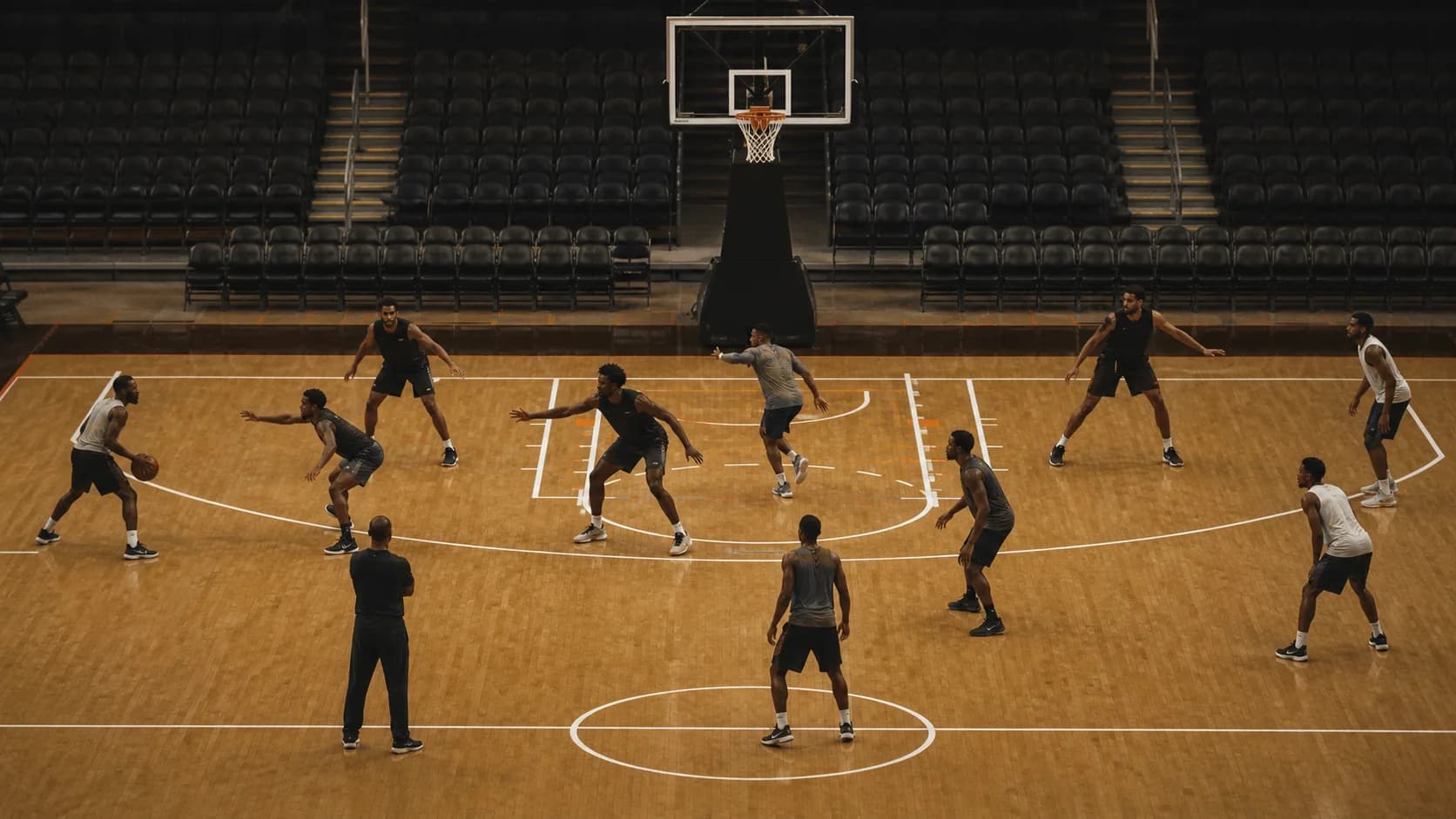
To a casual viewer, an NBA defensive possession looks like five athletic players scrambling. To a coach, it's a small set of recognizable patterns drawn from a coverage playbook with maybe 15 unique configurations. Once you know the patterns, the chaos becomes legible, and the read happens before the action even develops.
This piece is the coverage recognition guide for any serious film student.
The First Rule: Watch the Screener's Defender
Most viewers watch the ball-handler. Most coaches watch the screener's defender.
The screener's defender's body position reveals the coverage 0.5-1.0 seconds before the screen even arrives. By the time the on-ball defender responds to the screen, the coverage is already legible from the screener's defender's pre-screen posture.
Train your eye to scan the screener's defender during the dribble approach. The pre-screen tell beats every other read on the floor.
The 6 Common Coverages
In modern NBA basketball, six coverages cover roughly 95% of pick-and-roll defense:
- Drop. Big sags to the paint to protect the rim.
- Hedge (Show / Blitz). Big steps out to slow the ball-handler.
- Switch. Big and on-ball defender trade matchups.
- ICE (Down / Blue). On-ball defender forces ball-handler to the sideline.
- Zone-up. Switch + weak-side tag (hybrid).
- Conservative. On-ball defender chases over; big stays at screen level (no drop, no hedge).
Each has a distinct pre-screen tell.
Coverage 1: Drop
The tell: screener's defender's feet are deep (at or below the foul line) before the screen arrives. Body is squared to the rim, not the ball.
On-ball defender: chases over the top of the screen.
What the defense gives up: the mid-range pull-up between the elbows.
Who runs it: teams with elite drop-coverage bigs (Brook Lopez, Rudy Gobert historically, Walker Kessler). Drop requires a 7-footer with reach and verticality.
Film recognition: when you see the big's heels at or below the foul line as the action starts, the coverage is drop. The pull-up is coming.
Coverage 2: Hedge / Blitz
The tell: screener's defender's feet are at or above the level of the screen, ready to step out. Body angled toward the ball.
On-ball defender: chases over the top, prepares to trap with the big.
What the defense gives up: the short-roll 4-on-3.
Who runs it: teams with mobile bigs (Bam Adebayo, Draymond Green historically, Al Horford). Hedge requires lateral quickness from the big.
Film recognition: when you see the big lifted to screen level pre-action, the coverage is hedge or blitz. Watch for the second defender's commit, if both go to the ball, it's a blitz; if the big returns to the roller, it's a hedge.
Coverage 3: Switch
The tell: screener's defender's feet are flat, body squared to the ball-handler, not the rim. The defender is essentially in a defensive stance against the ball-handler before the switch even happens.
On-ball defender: stays with their original man as the new defender takes the ball-handler.
What the defense gives up: mismatches.
Who runs it: teams with switchable rosters across positions 2-5 (Boston, Miami, OKC). Switch requires every defender to be able to defend multiple positions.
Film recognition: when you see the big set up in a low defensive stance pre-screen, with their eyes on the ball-handler instead of the rim, the coverage is switch.
Coverage 4: ICE
The tell: on-ball defender's body is angled to deny the screen, usually one shoulder turned toward the sideline. Big's feet are shaded to the strong side.
On-ball defender: forces the ball-handler away from the screen, toward the sideline.
What the defense gives up: the long mid-range from the sideline.
Who runs it: any team can run ICE on side ball screens. It's the most common side-screen coverage in modern NBA basketball.
Film recognition: when you see the on-ball defender turn their shoulder to deny the screen, the coverage is ICE. The big position confirms it, shaded to the strong side rather than centered.
HoopBrief currently turns basketball and matchup questions into structured reports using public statistical and play-by-play context. It does not accept film uploads or provide possession-level video tagging.
Coverage 5: Zone-Up
The tell: the same as switch (big in low stance, squared to ball) but with the weak-side defender pre-positioned to tag the roller. The weak-side defender is typically a step closer to the lane than they would be in a standard switch.
On-ball defender: switches as in standard switch.
What the defense gives up: the weak-side corner (because the tagger leaves their man).
Who runs it: elite defensive teams that can execute the post-switch rotation cleanly. Boston is the modern prototype.
Film recognition: watch the weak-side defender during the dribble approach. If they're one step closer to the lane than standard help positioning, zone-up is coming.
Coverage 6: Conservative
The tell: big stays at screen level (not deep like drop, not above like hedge). Body squared to the ball but with feet planted, not ready to step.
On-ball defender: chases over without trapping.
What the defense gives up: the pull-up between elbow and free throw line (less open than drop's pull-up).
Who runs it: teams that want flexibility, conservative coverage can adjust to switch or drop on the fly. Common against weaker scoring threats.
Film recognition: when the big is at screen level but not stepping out, the coverage is conservative. It's the least-aggressive option.
How to Train Coverage Recognition
The pause-and-identify drill:
- Pick an NBA defensive possession.
- Watch until the dribble approach begins.
- Pause.
- Identify the screener's defender's pre-screen posture and predict the coverage.
- Press play and check.
50 reps per session, 3-4 sessions per week. By week 3, coverage recognition becomes near-automatic at film speed. By month 3, recognition arrives at game speed during your own possessions.
What This Enables
Coverage recognition is the foundation skill for three more advanced reads:
- Picking the right counter. Knowing the coverage in advance lets you select the right offensive read (see pick-and-roll coverage breakdown for players).
- Scouting opponent tendencies. Knowing which coverage a team prefers lets you predict their next-possession coverage in real time (see how to break down opponent tendencies).
- Finding defensive weaknesses. Knowing what each coverage gives up lets you identify which actions to call against which defenses (see how to find defensive weaknesses to attack).
Coverage recognition is the gateway skill. Build it first; the advanced reads compound on top.
Want NBA-staff-grade coverage tagging on every possession across the league? HoopBrief plans include the defensive lens for the full NBA library.
Where to Go Next
Companion reading: pick-and-roll coverages explained (the coach-side), pick-and-roll coverage breakdown for players (the player-side).
Next step, apply coverage reads in opponent prep: how to break down opponent tendencies, how to find defensive weaknesses to attack.
Hub: Playoff Prep Hub.