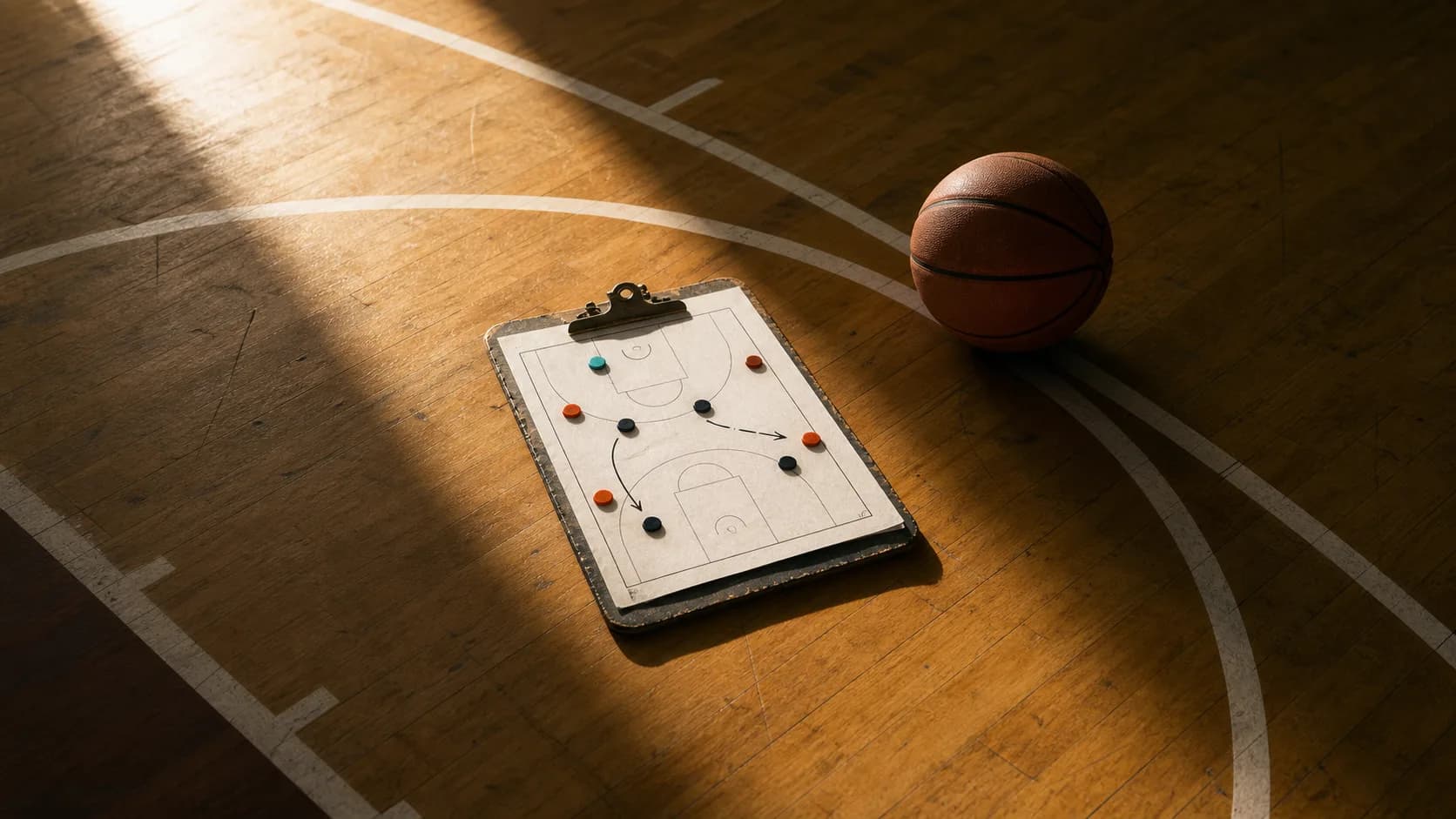
Breaking down opponent tendencies is the work that turns 30 days of game film into 6-10 specific exploitable patterns. It's the highest-leverage advance-scout work and the foundation of every playoff game plan. This piece is the 5-step method NBA scouts use, and the method you can apply to your own scouting if you have access to opponent film.
This is part of the Playoff Prep Hub cluster.
The 5-Step Method
- Step 1: Sample the last 30 days of game film.
- Step 2: Tag possessions by action, personnel, and outcome.
- Step 3: Identify primary patterns and frequencies.
- Step 4: Filter for exploitable patterns relevant to your plan.
- Step 5: Deliver as a personnel-page-plus-game-plan package.
A complete tendency breakdown takes 40-65 hours of work for a playoff opponent. The output is the foundation of the game plan.
Step 1: Sample the Last 30 Days
The recency window matters. A team's tendencies 60 days ago aren't reliably indicative of their tendencies today, rotations have changed, sets have been added, defensive coverages have evolved.
The sampling target: every game from the last 30 days, including playoff games if applicable. For a 30-day window, that's typically 12-15 NBA games at 200+ possessions each = 2,400-3,000 possessions of raw tendency data.
Don't try to sample older film. The data is less actionable and dilutes the recency signal.
Step 2: Tag Possessions
Each possession gets tagged across multiple dimensions:
- Action type: PnR, post-up, iso, transition, off-ball cut, DHO, etc.
- Personnel involved: which player handled, which screened, which received the kick.
- Coverage faced: what defense did the opponent see, and how did they respond?
- Outcome: PPP, made/missed shot, turnover, foul.
- Score state: lead/trail/tied, with how much time remaining.
- Lineup context: which 5-man unit was on the floor.
A complete tagging produces a possession database that supports cross-cutting queries, e.g., "what's the PPP when the opposing star runs side pick-and-roll vs drop coverage in the last 4 minutes of close games?"
HoopBrief currently turns basketball and matchup questions into structured reports using public statistical and play-by-play context. It does not accept film uploads or provide possession-level video tagging.
Step 3: Identify Primary Patterns and Frequencies
From the tagged database, surface the patterns that repeat:
- Top 5 offensive actions by frequency.
- Top 5 defensive coverages by frequency.
- Top 5 ATO and SLOB sets by frequency.
- Top 5 late-game tendencies by frequency.
For each pattern, calculate:
- Frequency (% of possessions).
- PPP (offensive efficiency or defensive efficiency allowed).
- Personnel-specific variations (does the pattern hold across all rotation players or just specific ones?).
The output is a pattern frequency table, typically 1-2 pages of structured data per opponent.
Step 4: Filter for Exploitable Patterns
The frequency table is descriptive. The exploit analysis is prescriptive. Filter the patterns for the ones relevant to your strategic plan:
- Patterns that match your defensive strengths. If your team is good against drop coverage, identify the opposing players who shoot pull-ups against drop at low efficiency.
- Patterns that match your offensive strengths. If your team is good at attacking switches, identify the opposing coverages that produce switches.
- Patterns that exploit personnel weaknesses. If you have a guard who attacks left, identify the opposing guard who defends drives to their right weakly.
- Patterns that match your tempo. If you push pace, identify the opposing transition defense weaknesses.
The output is the 6-10 exploitable patterns that will drive the game plan.
Step 5: Deliver as a Game Plan Package
The deliverable is typically a 4-6 page package:
- Cover page: strategic plan summary.
- Personnel pages: 1-2 pages per rotation player.
- Coverage recommendations: which defense to run on each opposing scorer.
- ATO/SLOB recommendations: which of your sets to call against this opponent's coverage.
- Lineup engineering: which 5-man units to play together and against which opposing lineups.
- Late-game packages: the 2-3 sets / coverages ready for the last 4 minutes.
The package is read by the head coach and the staff. It's the bridge between the advance-scout's analysis and the game-day decisions.
The Tendency-Analysis Compounding Effect
Tendency analysis compounds across a season. The work you do on Boston in October provides the foundation for the Boston analysis in March. The personnel pages persist. The coverage patterns evolve, but the framework stays.
A team with consistent tendency-analysis work has a real edge across an 82-game season. A team that rebuilds the analysis from scratch each opponent loses 5-10% of the analytical depth that compounding would provide.
Want to build a tendency-analysis library across NBA opponents? HoopBrief plans include a multi-opponent tagging system that compounds across the season.
Where to Go Next
Companion playoff prep pieces: What Coaches Look For in Matchup Prep, What Positioning IQ Means in a Playoff Series, How to Analyze a Team's Offensive Weaknesses.
Tactical reading: pick-and-roll coverages explained, ATO playbook, conference finals adjustments by Game 3.
Hub: Playoff Prep Hub.
Foundation reading: how NBA coaches prepare for playoffs, the basketball film study guide, the 12-lens framework.