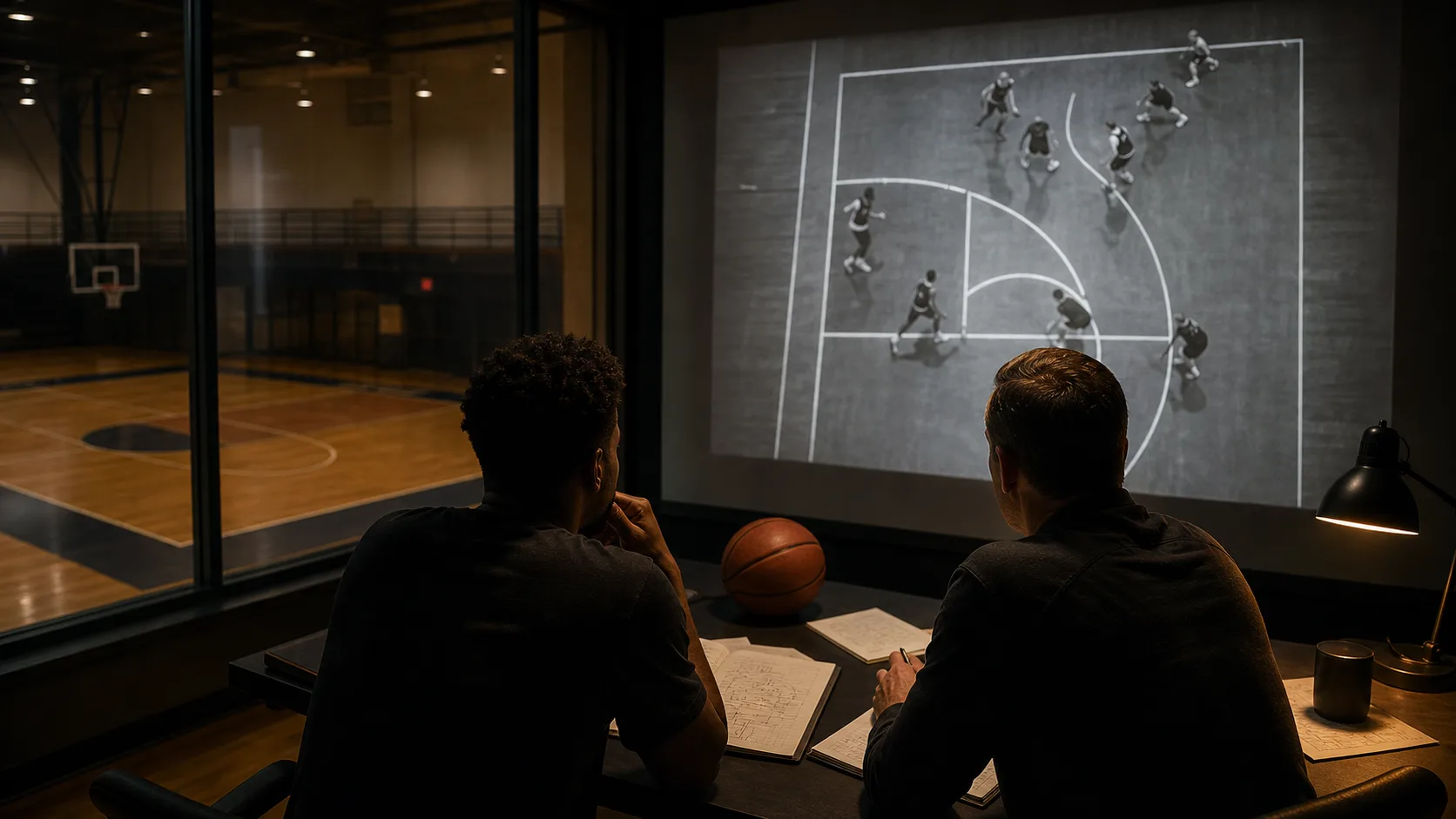
Matchup prep isn't a tendency list. It's the assembly of 6-10 specific exploitable patterns from the opponent's last 30 days, drawn from six analysis components, and packaged into a game plan that fits the coach's strategic preferences. This piece walks through the actual framework NBA staffs use.
This is part of the Playoff Prep Hub cluster.
The 6 Components of NBA Matchup Prep
- Opposing primary actions and frequencies. What does the opponent run, and how often?
- Personnel-specific tendencies. What does each player do, and what are their patterns?
- Defensive coverage patterns. What coverages do they run on the pick-and-roll, and which to anticipate?
- ATO and SLOB packages. What sets do they run out of timeouts and inbounds?
- Lineup combinations and net ratings. Which lineups are exploitable, which aren't?
- End-of-quarter / late-game tendencies. What patterns hold in high-leverage moments?
A complete matchup prep covers all six. A weak one covers two or three. The gap between complete and weak prep often decides games against well-coached teams.
Component 1: Opposing Primary Actions and Frequencies
The foundation. Every team has 4-6 core offensive actions they run on 50%+ of possessions. Identifying them is the first work of matchup prep.
Typical NBA offensive frequencies:
- Side pick-and-roll: 25-35% of possessions.
- Top pick-and-roll: 15-20%.
- Post-up: 5-10% (down from 15-20% in 2015).
- Iso: 8-12%.
- DHO and handoff actions: 8-15%.
- Off-ball screen + cut sequences: 10-15%.
Scouts cross-check the frequency with the per-action PPP. A team that runs side pick-and-roll on 30% of possessions at 1.10 PPP is doing it correctly. A team that runs it on 30% at 0.95 PPP has a problem that the matchup prep should exploit.
Component 2: Personnel-Specific Tendencies
The hardest component to build and the most-valuable in execution. Every rotation player gets a personnel page with:
- Strong hand and weak hand.
- Preferred spots (3-5 spots on the floor where they shoot or attack from).
- Coverage preferences (what coverage they exploit best).
- Foul-rate tendencies (do they draw fouls reliably?).
- Micro-behaviors (hip-opening, pull-up settling, etc., see our micro-behaviors piece).
- Late-game role (do they take the last shot, or do they screen for someone else?).
A complete personnel page is roughly 1-2 pages per rotation player, built from 20-30 hours of analyst work per page. For a playoff opponent, that's 60-100 hours of work just on personnel.
Component 3: Defensive Coverage Patterns
What does the opponent run on defense? Specifically:
- Pick-and-roll coverage on each lead handler. Drop, hedge, switch, blitz, and at what frequencies?
- Help geometry. Where does the weak-side help come from?
- Closeout patterns. Short closeouts, fly-by closeouts, no-closeouts?
- Switch rules. Switch 1-4, switch 1-5, switch only on cross-matches?
- Late-game adjustments. What changes in the last 4 minutes?
Knowing the coverage patterns determines which offensive actions you call. Our pick-and-roll coverages explained piece covers the four coverages in detail, plus the counter library covering the attack patterns that beat them.
Component 4: ATO and SLOB Packages
After-timeout (ATO) and sideline-out-of-bounds (SLOB) sets are the highest-prep possessions in basketball, they're the only sets where the coach has full control of what gets called.
For matchup prep, you need to know:
- The opponent's most-run ATO sets and their PPP.
- The opponent's most-run SLOB sets and their PPP.
- The personnel involved in each (who screens, who cuts, who shoots).
- The coverage that defeats each set most reliably.
Our ATO playbook piece covers ATO design and counter-ATO defense.
HoopBrief currently turns basketball and matchup questions into structured reports using public statistical and play-by-play context. It does not accept film uploads or provide possession-level video tagging.
Component 5: Lineup Combinations and Net Ratings
The least-watched component by fans and the most-exploited by coaches. Every lineup combination has a net rating; the matchup prep identifies which combinations are exploitable.
- Bench lineups. What's the net rating when the opponent's bench unit is on the floor? Often a 6-10 point exploit window per 36.
- Star + bench lineups. What's the net rating when one star sits and the four-out unit is on the floor with the remaining star?
- Specific player combinations. Some combinations (e.g., two non-shooters together) cripple the spacing of the offense and create defensive exploits.
The matchup prep should identify 2-3 specific lineup windows where the score swing happens. The game plan then engineers playing time to maximize exposure to those windows.
Component 6: End-of-Quarter and Late-Game Tendencies
Patterns that hold in high-leverage moments:
- Last-shot sets (the 2-for-1 possession at end of quarter).
- Late-clock attack patterns when the offense fails to find an open look.
- Late-game ATOs (the sets called with under 1 minute left).
- Foul-trouble management patterns (does the opponent ride out a star with 3 fouls or pull them?).
Scouts watch the last 2 minutes of every game specifically to build the late-game pattern library. The patterns are the most-prepared possessions in any game and the most-decisive in playoff series.
How the 6 Components Become a Game Plan
The matchup prep delivers 6-10 specific exploitable patterns. The game plan packages them into:
- Coverage decisions on the opposing star (1-2 coverages selected based on PPP math).
- ATO and SLOB calls (5-8 selected from the playbook based on personnel exploit windows).
- Lineup engineering (specific minutes assignments to exploit the lineup windows identified).
- Defensive matchup assignments (which defender on which scorer, based on personnel pages).
- Late-game adjustments (the 2-3 changes ready to deploy in the last 4 minutes).
The game plan is the output of the matchup prep. A complete prep produces a tight game plan; a weak prep produces a generic one. The gap shows up in close games.
Want NBA-staff-grade matchup prep applied to every game? Subscribe to HoopBrief and the 12-lens framework gives you a matchup prep deliverable across all six components.
Where to Go Next
Companion playoff prep pieces: How to Break Down Opponent Tendencies, What Positioning IQ Means in a Playoff Series, How to Analyze a Team's Offensive Weaknesses.
Tactical reading: pick-and-roll coverages explained, conference finals adjustments by Game 3, playoff adjustments, what changes in 7 games.
Hub: Playoff Prep Hub.
Foundation reading: how NBA coaches prepare for playoffs, the 12-lens framework.