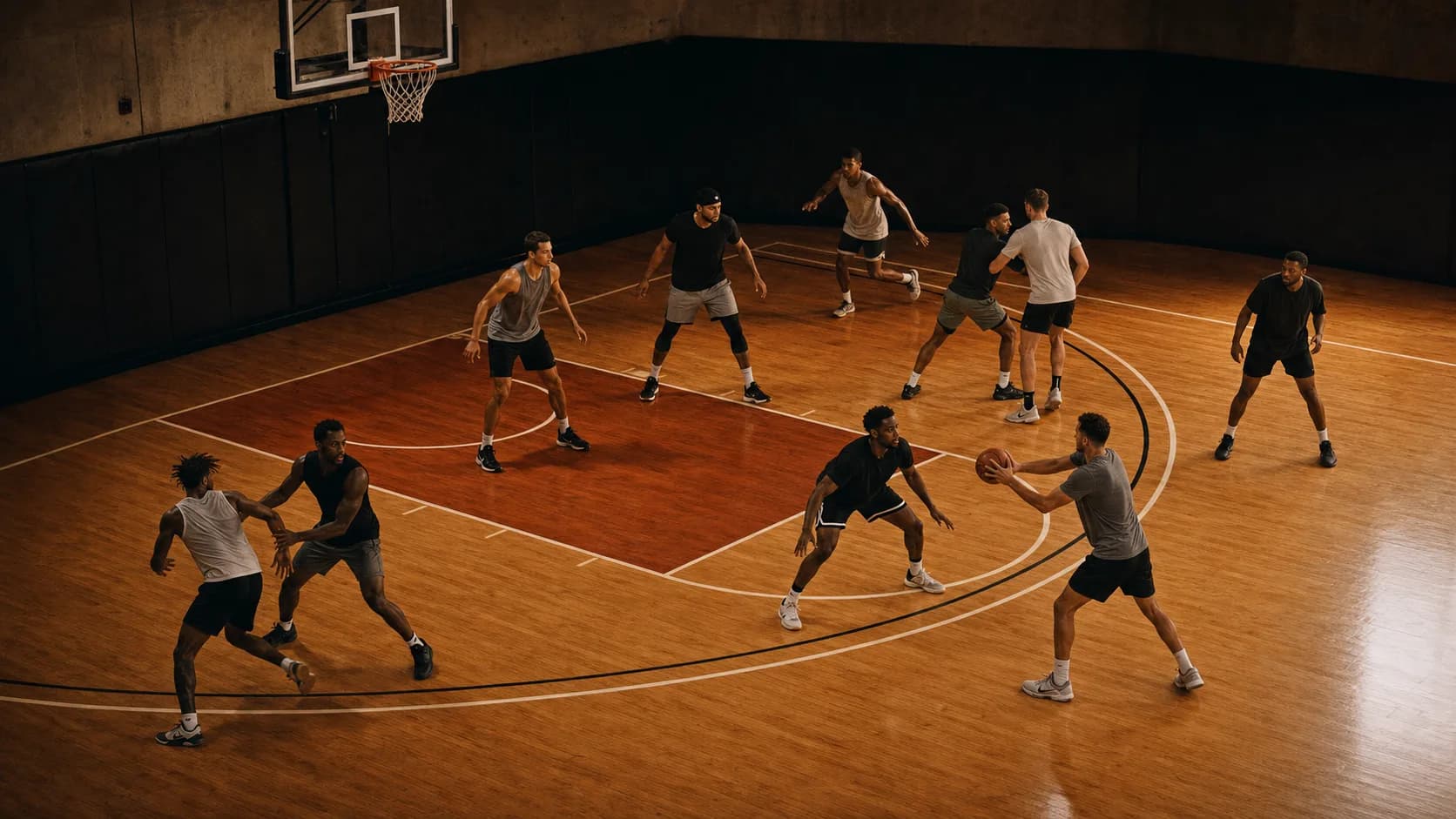
Off-ball value is the basketball trait fans can't see and scouts grade first. Highlight reels show what happens when a player has the ball. Off-ball value happens on the 60-70% of possessions they don't touch it, the cuts, screens, relocations, and spacing that affect the outcome without statistical credit. This piece is why scouts care, how they measure it, and the four habits any young player can build to add off-ball value to their scouting profile.
This is part of the NBA Scouting Hub cluster, trait deep-dives that explain each of the eight traits scouts grade.
Why Off-Ball Value Matters More Than Fans Realize
Three structural reasons:
- NBA possession math. Even ball-dominant stars touch the ball on only 30-40% of possessions. The other 60-70% are where lineups get their value.
- Roster construction. You can only have one or two ball-dominant players on the floor at a time. The other three need off-ball value, or the offense stalls.
- Switching defenses. Modern defense switches and tags constantly. The off-ball player who relocates intelligently breaks the defense's geometry; the off-ball player who stands lets the defense rest.
The headline math: a player who adds 0.05 PPP to their team through off-ball actions across 50 possessions per game is worth 2.5 points of offensive efficiency. Across an 82-game season, that's 200+ points of expected scoring difference, comparable to adding a full-time bench scorer.
The 4 Off-Ball Habits
- Cuts. Baseline cuts, 45-cuts, backdoor cuts. Movement that creates open shots for yourself or pulls help defenders out of position.
- Screens. Pin-downs, flares, ball screens for teammates. The screen is the most-undercredited off-ball action in basketball.
- Relocation. After a pass, moving to a new spot. Either creates a new shooting angle or drags the defender out of help.
- Spacing. Standing in the right spot, far enough from the action to stretch the defense, close enough to be a real threat. Boring but essential.
A player who does at least one of these on 60%+ of possessions they don't touch the ball is high-off-ball-value. Under 30% is low. Most young guards are at 20-30%; most NBA wings are at 60-75%.
Habit 1: Cuts
Three types worth mastering:
- Baseline cut. When the help defender's head turns, sprint to the rim along the baseline. The most-open shot in basketball.
- 45-cut. Cut at a 45-degree angle from the wing to the rim. Works against defenders who play in passing lanes.
- Backdoor cut. When the defender denies the pass to the wing, cut behind them to the rim.
The trigger for each is a defensive cue. Watch the help defender's eyes, when they turn toward the ball, that's your cut window. Two weeks of cut-watching film study and the triggers become automatic.
Habit 2: Screens
Most young players underrate screen-setting because they don't see the result. The screen sets up the shot; the screener doesn't get the credit.
The four screen types worth mastering:
- Pin-down. Down-screen at the elbow for a wing coming up.
- Flare. Up-screen for a shooter relocating away from the ball.
- Ball screen. On-ball screen for the handler in pick-and-roll.
- Off-ball back screen. Surprise screen behind the defender's head for a cutter.
A great screen produces 0.10+ PPP more than an average screen on the resulting possession. Across 8-12 screens per game, that's 1+ points of offensive efficiency that doesn't show up in your stat line.
HoopBrief currently turns basketball and matchup questions into structured reports using public statistical and play-by-play context. It does not accept film uploads or provide possession-level video tagging.
Habit 3: Relocation
The most under-trained habit. Most young players pass the ball and stand. Elite off-ball players pass and immediately move to a new spot.
The two relocation patterns:
- Lift. Move from the corner to the wing (or the wing to the top). Creates a new shooting angle and shortens the pass for the next possession.
- Drift. Move from the wing to the corner. Drags the defender out of help and opens the strong-side drive.
A player who relocates on 70%+ of their passes adds measurable offensive value. A player who stands after the pass adds zero off-ball value and lets the defense rest.
The training: enforce a personal rule that every pass triggers a movement. For two weeks, don't allow yourself to stand after passing. The habit becomes automatic.
Habit 4: Spacing
The boring habit. Stand in the right spot, far enough from the action to stretch the defense, close enough to be a real threat.
What "right spot" means depends on the action:
- In a pick-and-roll on the right wing: weak-side shooters in the left corner and left wing.
- In a post-up on the left block: strong-side shooter in the left corner, weak-side shooters in the right wing and top.
- In transition: trailer at the top of the key, fillers on each wing.
- In an iso: four players spaced symmetrically with one of them in the dunker spot.
A player who stands in the right spot makes everyone else's offense more efficient. A player who clogs the spacing reduces every other player's PPP.
HoopBrief currently turns basketball and matchup questions into structured reports using public statistical and play-by-play context. It does not accept film uploads or provide possession-level video tagging.
How to Build the Off-Ball Reputation in 60 Days
If you want scouts to grade you as high-off-ball-value, the plan:
- Weeks 1-2: Pick the cuts habit. Commit to cutting on 100% of possessions where the help defender's head turns.
- Weeks 3-4: Add screens. Set at least 3 screens per quarter, of any type.
- Weeks 5-6: Add relocation. No standing after a pass.
- Weeks 7-8: Add spacing discipline. Always in the right spot.
A player who builds all four habits over 60 days shifts their off-ball value rating from 20-30% to 60-70%, the difference between college role player and NBA prospect on this specific trait.
Where to Go Next
Companion trait deep-dives: How Scouts Evaluate Decision-Making, How Scouts Grade Defensive Versatility, Why Motor Matters in Scouting Reports.
Position scouting pieces: What NBA Scouts Look For in Guards, What NBA Scouts Look For in Wings, What NBA Scouts Look For in Bigs.
Hub: NBA Scouting Hub.
Development companion: How to Become a Better Off-Ball Player, Player Development Hub.