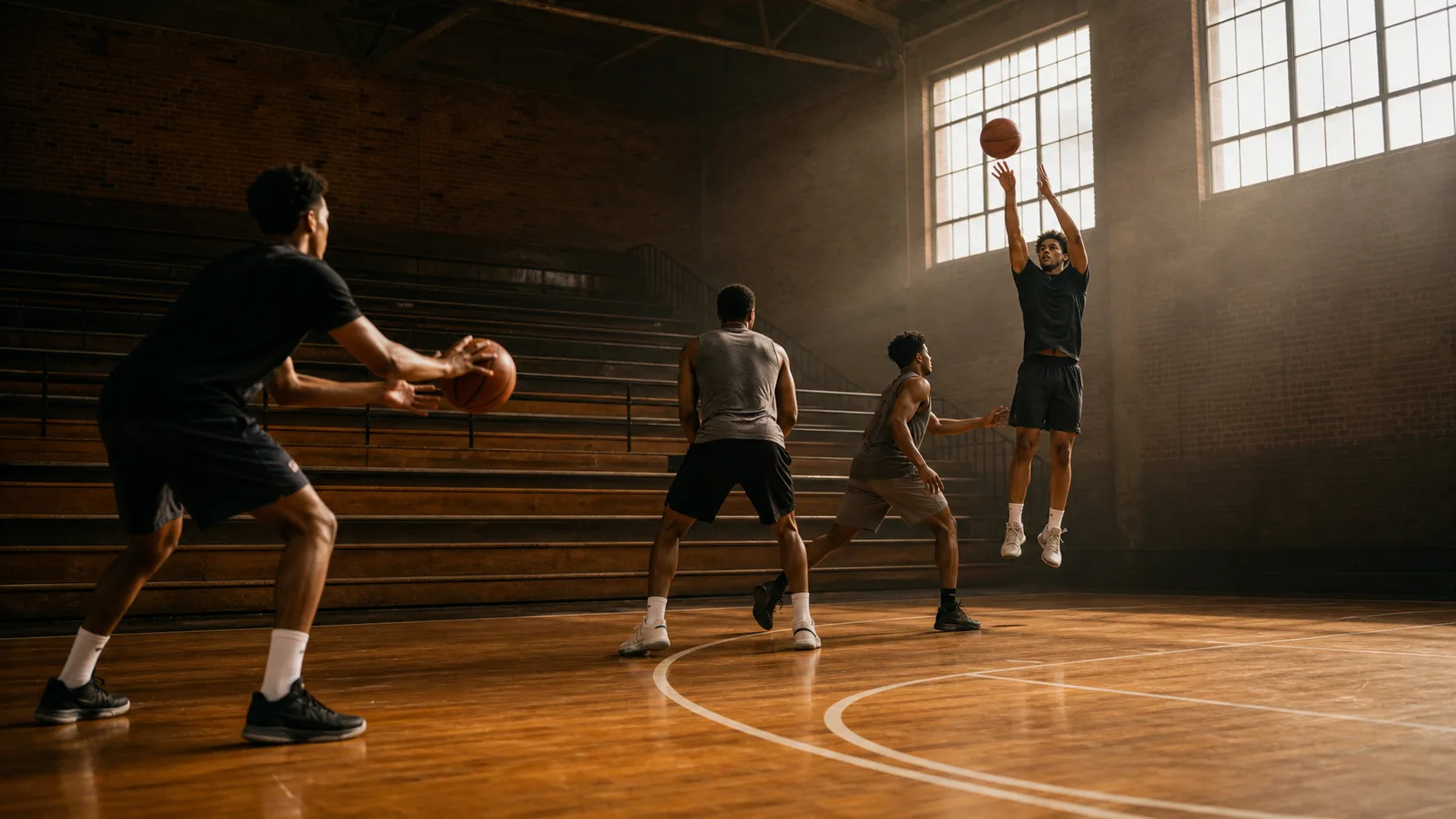
The 2026 NBA big is a completely different position than the 2010 NBA big. Switchability, three-point range, short-roll passing, and perimeter touch matter more than ever. Pure post-up offense matters less. The seven traits scouts now grade in big prospects reflect this shift, and the bigs who hit the modern stack have the clearest NBA path of any position because the league is starved for them.
This piece is the big-specific companion to our broader what NBA scouts look for in middle school and high school players piece. For guards, see what NBA scouts look for in guards. For wings, see what NBA scouts look for in wings.
The 7 Big-Specific Traits
- Switchability onto guards in pick-and-roll.
- Three-point range OR elite skill at every other big-man trait.
- Short-roll decision-making.
- Screen-setting quality.
- Rim protection at the second jump.
- Offensive rebounding instincts.
- Mobility + late-career durability signals.
Trait 1: Switchability Onto Guards
The single most-valued big-man trait in 2026. When a big can switch onto a guard in pick-and-roll and contain them for at least one possession without fouling, the defensive scheme opens up completely. When they can't, the offense exploits the switch every possession.
What scouts grade:
- Lateral mobility from a lower hip position.
- Wall-up technique to contain drives without fouling.
- Closeout speed on a switch to a perimeter shooter.
- Recovery when the guard does get past, sprinting to cut off the next angle.
The training principle is hip-mobility work + endless lateral-slide reps. Most young bigs are stuck in upright defensive posture; the bigs who project to NBA switchability train low-hip stances from age 13.
Trait 2: Three-Point Range (or Elite Everything Else)
The modern NBA big is one of two archetypes:
- The stretch big. Shoots 35%+ from three at meaningful volume. Examples: KAT, Brook Lopez, Myles Turner, Naz Reid.
- The elite-everything-else big. Doesn't need to shoot threes because every other skill is elite. Examples: Jokić, Sabonis, Bam Adebayo, Joel Embiid (who also shoots).
The middle-ground big, average shooting, average rebounding, average defense, is mostly out of the league. If you're a young big, pick one path and commit. The stretch path requires daily three-point reps from age 12; the elite-everything-else path requires elite rebounding, screening, passing, and rim protection without the shooting.
Trait 3: Short-Roll Decision-Making
The short-roll skill: after rolling off a ball-screen, the big arrives in the foul-line area. The ball comes to them. They have one of three decisions, shoot, pass to the cutter, or attack the recovering defender.
A big who can make all three reads consistently is a primary pick-and-roll partner. A big who can only make one or two has a lower offensive ceiling.
The training method: short-roll read drill. Teammate handles at the top of the key. You set the screen, roll, and receive the pass in the short-roll area. Make the right read based on the defense. 30 reps per session, 10 shoot situations, 10 pass situations, 10 attack situations.
Want to study how Jokić, Sabonis, or AD read the short-roll? Start a HoopBrief plan and pull every short-roll possession of any modern big tagged across the 12 lenses.
Trait 4: Screen-Setting Quality
Hidden in plain sight. The gap between a great screen and an average screen produces roughly 0.10 PPP on the resulting possession, across 30+ pick-and-rolls per game, that's 3 points of offensive efficiency.
What scouts grade:
- Solid base, wide stance, low hips, no leaning.
- Correct angle, screen aimed at the off-shoulder of the defender.
- Legal-but-firm contact, knees of the on-ball defender, but no moving screen.
- Timing, screen arrives when the handler is at full speed, not before or after.
This is a learnable skill. Most young bigs set lazy screens because the work isn't visible. Bigs who commit to elite screens make their guards better, and that compounds across a career.
Trait 5: Rim Protection at the Second Jump
Anyone can block one shot. NBA rim protection requires a second jump within 1.5 seconds of the first, the put-back contest, the second-effort block on the offensive rebound.
What scouts grade:
- Vertical recovery, how high can you jump the second time?
- Hand discipline, wall up instead of swinging at the ball.
- Verticality habit, going straight up to avoid the foul.
- Body-on-body, using the body to contest, not just the arms.
Rim protection at the first jump is genetic. Rim protection at the second jump is mostly trained. The trained version is what separates NBA rim protectors from prospects who fade at higher levels.
Trait 6: Offensive Rebounding Instincts
The trait most fans miss. Offensive rebounding produces second-chance points worth roughly 1.0-1.2 PPP, the highest-efficiency possession type in basketball.
What scouts grade:
- Anticipation, reading where the shot is going to miss before it's released.
- Positioning, getting to the rebounding spot before the box-out.
- Hands, securing the rebound through contact.
- Put-back ability, finishing the second chance without a second possession reset.
An elite offensive rebounder is worth 3-5 points of net rating just from second-chance points. It's also the cheapest big-man skill to add because it requires effort and instinct more than physical ability.
Trait 7: Mobility + Late-Career Durability Signals
Bigs have historically had short careers because their joints get hammered. Scouts in 2026 explicitly grade durability signals to project career length.
What they look for:
- Daily mobility work, hip openers, ankle dorsiflexion, thoracic rotation.
- Stability training, single-leg balance, glute-medial activation.
- Movement quality, clean cuts, no labored running, recovery between sprints.
- History of injury management, proactive rehab habits, no recurring soft-tissue issues.
A 19-year-old big who already has the durability habit pattern projects to a 12-15 year career. A 19-year-old big without it projects to 6-8 years before injury attrition. The difference matters for draft positioning.
Want to track durability signals across NBA bigs and apply the same to your own development? HoopBrief plans include the mobility and durability lens as part of the 12-lens framework.
How Bigs Should Structure Their Development
If you're a young big (or projecting to 6'8"+), here is the priority order:
- Today's choice: motor, effort screens, defensive intensity.
- Year-1 build: three-point shooting (start from form distance, build to NBA range over 18-24 months), lateral mobility for switch defense.
- Year-2 build: short-roll decision-making, rim protection second-jump habit, screen-setting craft.
- Career-long earn: durability through daily mobility work.
The big position is the rarest archetype in the NBA. The league is desperate for switchable bigs who can shoot. Master the modern skill stack and the recruiting and draft path opens up almost immediately.
Where to Go Next
Companion scouting pieces by position: What NBA Scouts Look For in Guards, What NBA Scouts Look For in Wings.
Trait deep-dives: How Scouts Evaluate Decision-Making, How Scouts Grade Defensive Versatility, Why Motor Matters in Scouting Reports, Off-Ball Value: The Trait Most Fans Miss.
Hub: NBA Scouting Hub.
Archetype guides: Play Like Victor Wembanyama, Power Forward Drills for Stretch-4 Skills.