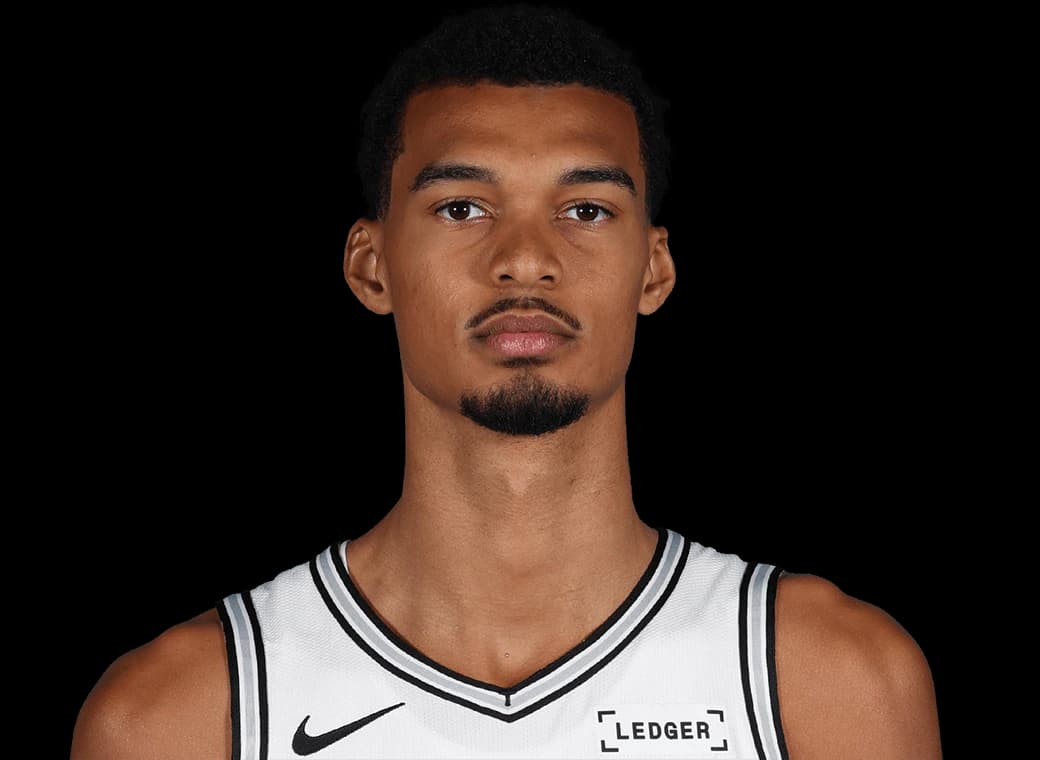
You can't be 7'4". But you can train like Victor Wembanyama trained at 14. Most kids watching Wemby want the dunks and the blocks, the things that depend on his height. The things that actually made him Wemby are different: a daily film routine he started before his growth spurt, perimeter-first skill training that ignored what his height "should" make him, and a habit set that compounds across years. Those are the parts you can steal.
This guide breaks Wembanyama's development into seven copyable pieces. None of them require you to be tall. All of them require you to be patient.
The Wembanyama Profile in Three Numbers
- 7'4", 8' wingspan, 9'7" standing reach. Genetic outliers; not copyable.
- Age 12. The age he started a daily perimeter skill routine, before his second growth spurt, before any coach told him he was a center.
- 90 minutes/day. The publicly described length of his skill work session in adolescence. Less than fans assume; more deliberate than most kids' practice.
The Wemby case study isn't about copying his game. It's about copying the development plan that produced his game. Those two things are very different.
Skill / Habit 1: Perimeter-First Training (Regardless of Height)
The single most important Wembanyama decision happened when he was 12: his coaches kept training him as a guard even as he became the tallest player on the floor. Every time he wanted to camp under the basket, they sent him back to the perimeter. Every time he wanted to take a hook shot, they made him take a pull-up jumper.
This is the opposite of what happens to most tall kids. Most coaches see a 6'2" 12-year-old and immediately make them a post player. The kid stops handling the ball, stops practicing pull-ups, stops developing decision-making, and by the time they're 16 and 6'8", they're a one-dimensional finisher whose skill ceiling is lower than their height ceiling.
If you're a tall kid (or a coach of one): keep training perimeter skills. Handle every day. Shoot pull-ups every day. The body will catch up; the skill stack can't be added later if it isn't there first.
Skill / Habit 2: The Two-Foot Stop and Pivot
The most-used Wembanyama move in his second NBA season is the two-foot stop into a pivot. He attacks, stops on two feet, surveys, pivots into a shot, a kick, or a step-through.
Two-foot stops do four things at once:
- Let you pivot in either direction (one-foot stops commit you).
- Give you a half-second to read the defense.
- Draw more fouls (officials reward stopping, not flying).
- Build the foot stability that protects ankles and knees.
This is the most underrated habit a young player can build. It's the habit Wembanyama is best at among NBA bigs, and it scales perfectly to your level.
Drill, Two-foot Mikan + pivot. Stand on the left block. Two-foot stop layup off the backboard. Catch the rebound on two feet. Pivot toward the middle. Step-through layup. 30 reps each side. Add 30 seconds to a standard Mikan and reshape the habit.
Skill / Habit 3: Daily Film Study (Started at 14)
Wembanyama started a daily film routine at 14. Not highlight reels, full-game film, with a notebook, with specific things to look for. By 17 he was watching one full NBA game per day and tagging the possessions where the bigs did something he wanted to copy.
This is the highest-leverage habit on this list because it compounds faster than any physical skill. A 14-year-old who watches one full game per day with a notebook for four years has 1,460 games of structured film study by 18, more than most college coaches accumulate in a decade.
How to start: pick one player to study for a full month. Watch one full game per day. In a notebook, write down: (a) one move they did that you want to steal, (b) one defensive read they made that you didn't expect, (c) one possession where they failed and what they should have done. Twenty days of this per player and the player's habits become yours.
Our film study guide walks through the full study framework with examples.
Want to study film with NBA-staff tagging? Start a HoopBrief plan and every Wembanyama possession of the 2026 season is tagged across all 12 lenses, defensive, system, precision, micro-behaviors, ready for the kind of structured study habit Wemby built at 14.
Skill / Habit 4: Ambidexterity Training
Wembanyama can finish, dribble, and pass with both hands. This is more rare than fans realize, most NBA bigs are 70/30 dominant-hand players. Wemby is closer to 55/45, which means defenders can't shade him to his weak side because he doesn't have one.
The training principle: deliberately use the non-dominant hand in low-stakes situations until it stops being non-dominant. Brush your teeth with the off hand. Open doors with the off hand. Eat with the off hand twice a week. The transfer to basketball happens because the off-hand neural pathways get used to firing.
Drill, One-week off-hand challenge. For one week, do every layup in your warmup with your off hand. Every catch goes to the off hand first. Every dribble starts with the off hand. The first week is ugly; by week three the off hand feels almost as natural as the dominant hand.
Skill / Habit 5: Mobility and Stability Work (Daily, Not Weekly)
Tall players historically have short careers because their joints get hammered. Wembanyama's training breaks this pattern by emphasizing daily mobility (hip openers, ankle dorsiflexion, thoracic rotation) and stability (single-leg balance, glute-medial activation, core anti-rotation).
The math: 15 minutes of mobility a day is 90 hours per year. Most tall players do 30 minutes a week, which is 26 hours per year. The difference is a 3.5x volume gap, and it shows up at age 28 when one player is healthy and the other isn't.
This habit isn't height-specific. If you're a young player who wants a long career, build the mobility habit early. It's the closest thing to a free skill in basketball.
Skill / Habit 6: Perimeter Shot Process (Not Just Shot Mechanics)
Wembanyama's three-point shot is mechanically clean, but the more important thing is the process: feet first, hands second, eyes on the rim through the release. He doesn't fade unless he has to. He doesn't lean. He doesn't shoot off his back foot. Every shot has the same setup.
Young shooters work on mechanics; great shooters work on process. The difference: mechanics is what your shot looks like; process is what happens before your shot. A process-based shooter has a higher floor on bad days because the setup doesn't change with confidence.
Drill, 50-shot process check. Set up at the right wing. Take 50 shots. For each shot, before you release, mentally check: feet aligned with rim, balance on both feet, hands on the ball, eyes on the rim. If any check fails, don't shoot, reset. Builds the habit of refusing to shoot a bad-process shot.
Skill / Habit 7: Defensive Anticipation Reads
Wembanyama's defensive reputation is built on blocks, but the more important skill is the anticipation read, the moment he reads the offense's intent and rotates before the offense commits. He doesn't react to the pass; he rotates to where the pass is going to go before it gets thrown.
This is a learnable skill at any height. The training method is film-based: watch a possession, pause it at the moment the ballhandler picks up the dribble, predict the pass, then watch the result. After 200 reps your anticipation patterns shift from reactive to predictive.
Drill, Pause-and-predict film study. Pick any NBA possession. Pause at the moment the ballhandler picks up the ball. Predict the pass destination. Press play. Track your accuracy across 50 possessions. Goal: 70%+ correct by week four.
The Wembanyama Habit Stack vs. the Wembanyama Genetic Stack
Here's the honest framing: Wembanyama's NBA outcome is roughly 60% genetic (height, length, athleticism, hand size) and 40% trained (skill stack, habits, film work). You can't get the 60%. You can absolutely get the 40%.
And the 40% is what separates Wemby from the other tall, athletic prospects who came before him. There are 7'+ NBA players whose habits never caught up with their physical gifts. Wemby is different because the habit stack is real. A young player who builds the same habits without the same gifts ends up as a high-skill, high-IQ rotation player at whatever level their genetics allow, which is the best version of the basketball career available to them.
HoopBrief currently turns basketball and matchup questions into structured reports using public statistical and play-by-play context. It does not accept film uploads or provide possession-level video tagging.
Where to Go Next
If you're a tall, perimeter-skilled player, pair this with Play Like Anthony Edwards for the explosion-wing translation. If you're a guard, Play Like Jalen Brunson is the craft-first archetype.
For the broader career path: how to make it to the NBA and what NBA scouts actually look for in middle school and high school players.
Framework reading: 12-lens framework, film study guide.