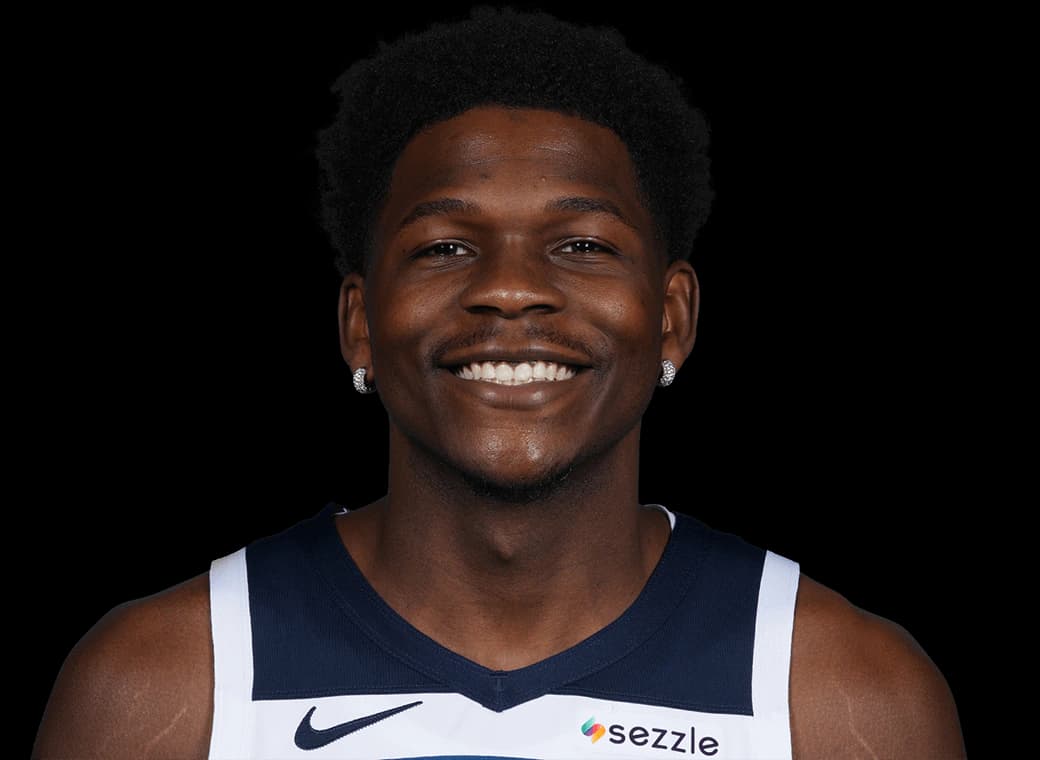
Anthony Edwards is the most athletic shooting guard in the NBA, and the most copyable one. He's 6'4". His wingspan is good but not elite. He doesn't have outlier hand size. What makes him special is the combination of vertical explosion with old-school footwork: he uses his athleticism to set up the shot, then takes the shot the same way Kobe took it. That sequence is teachable. The vertical isn't, but the footwork that uses the vertical is.
This guide breaks Edwards's game into five copyable skills. Three are skill-only (footwork, pull-up mechanics, defensive positioning). Two are skill plus athleticism (first-step burst, contact finishing). Build the first three and you've got an NBA-ready skill stack regardless of your vertical.
The Edwards Profile in Three Numbers
- 6'4", 6'9" wingspan. Above average for an NBA shooting guard but not outlier.
- 43-inch reported running vertical. Top-1% NBA athlete.
- 0.95 seconds. Average time between Edwards's first dribble and his pull-up release on a side ball-screen, fast enough that the screen-defender almost never recovers.
The Edwards archetype is the explosive guard. If you project to 6'3"+ with above-average burst, this is your case study. If you project shorter or less explosive, pair this with Play Like Jalen Brunson for the craft template.
Skill 1: The Two-Dribble Pull-Up (the signature move)
The most-used Edwards scoring possession is the two-dribble pull-up off a side ball-screen. The sequence:
- He calls for a side screen with his preferred screener.
- He attacks the screen with one hard dribble to set up the angle.
- He takes a second hard dribble to gain downhill momentum.
- He plants on two feet between the elbow and the foul line.
- He releases the shot at the peak of his jump.
The mechanical detail most kids miss: the second dribble is harder than the first. Most young guards take the first dribble hard (the explode) and the second dribble soft (the pull-up setup). Edwards reverses it, soft first, hard second, because the soft first dribble disguises his intent, and the hard second dribble creates the separation he needs from the on-ball defender.
Drill, Side-screen two-dribble pull-up. Set a chair at the right wing as the screen. Attack the screen with the right hand: dribble 1 controlled, dribble 2 explosive, plant on two feet at the elbow, pull-up release. 25 reps right side, 25 left side, daily for two weeks.
Skill 2: First-Step Burst (the athleticism-dependent unlock)
Edwards's first step is in the 95th percentile of NBA guards. He covers about 4 feet on his first step from a triple-threat position, which is enough to beat almost any defender's reaction time.
The training principle: first-step burst is partially trainable. The trainable components:
- Hip stiffness reduction (mobility work, dynamic hip flexor stretches, lateral lunge variations).
- Single-leg power (Bulgarian split squats, single-leg box jumps).
- Reaction time (light-based reaction drills, partner-cue starts).
- First-step technique (low first step, push off the back foot, no false move).
What's not trainable: the genetic ceiling on fast-twitch fiber recruitment. You can move from "below average" to "above average" with hard work, but you probably can't move from "average" to "elite" without a genetic lottery ticket.
Drill, Reactive first-step. Partner stands 6 feet away holding two cones (one in each hand). Partner drops one cone. You sprint to that cone with a first-step start. 10 reps. Build reaction time and first-step quickness simultaneously.
HoopBrief currently turns basketball and matchup questions into structured reports using public statistical and play-by-play context. It does not accept film uploads or provide possession-level video tagging.
Skill 3: Contact Finishing Through NBA Bigs
Edwards finishes through contact at the rim at one of the highest rates of any guard in the NBA. The technique: he leads with his inside shoulder and uses his free arm to bar the defender, both legal, both effective.
The progression for a young player:
- Start with a pad. Coach or partner holds a Pop-It pad in the lane. Attack, two-foot stop, finish through the pad.
- Add a chair. Same drill but the chair is the immobile defender. You learn to finish through a solid obstacle.
- Add a real defender at 50% intensity. Practice partner stands in the lane, semi-active. You finish with real but predictable contact.
- Game speed. Real defenders at full speed. By this point your contact-finishing mechanics should be automatic.
The number one mistake young players make: they avoid contact instead of seeking it. NBA guards know that contact at the rim either produces a finish or a free throw, both of which are good outcomes. Avoiding contact produces neither.
Drill, Pad-to-real progression. Two weeks pad. Two weeks chair. Two weeks partner. Two weeks full speed. Total 8-week progression to NBA-ready contact finishing.
Skill 4: Defensive Burst (the underrated Edwards skill)
Edwards has elite recovery quickness on defense, the ability to close out at full speed from far away and arrive without overrunning the shooter. This is a learnable skill that most young guards skip because it's not glamorous.
The technique:
- Sprint the first 80% of the closeout. Full speed, eyes on the shooter.
- Decelerate the last 20% with short, choppy steps (basketball term: "stutter step").
- Arrive with a high hand, not a swipe at the ball. Swipes get you on highlights and beaten on shot fakes.
- Stay between the shooter and the basket through the closeout. Never overrun.
This is the single skill that turns "athletic guard" into "two-way NBA guard." Edwards added defensive intensity in his second NBA season and his rotation defender ratings jumped 8 percentile points. Same player, different effort.
Drill, 4-spot closeout. Stand at the free throw line. Sprint to a marked spot on the perimeter (top of the key), close out high-hand, retreat to free throw line, sprint to the next spot (right wing), close out, retreat. Four spots, three sets of four. Builds the legs and the technique together.
Skill 5: The Mid-Range Pull-Up From Both Hips
Edwards is one of the best mid-range pull-up shooters in the NBA from both hips, the right elbow and the left elbow. Most guards have a dominant hip; Edwards has neither.
The training: identical reps from both spots. Most young guards take 70% of their mid-range pull-ups from one hip. To become a Edwards-style symmetric scorer, force yourself to take 50% from each hip in practice. Track make rate over 100 reps each side every week. When the make rates converge (within 5 percentage points), the symmetry is real.
Drill, Symmetric pull-up. Right elbow: 25 pull-ups off the dribble. Left elbow: 25 pull-ups off the dribble. Track make rate weekly. When right and left rates are within 5%, you're symmetric. When they're within 2%, you're elite.
Want to track your shot data the way an NBA front office does? HoopBrief plans include a shot-quality framework that maps every shot to one of 12 spots and tracks PPP across all of them, the same shot-zone framework NBA analytics staffs use.
The Edwards Skill Stack Compared to the Brunson Skill Stack
Both Brunson and Edwards are sub-6'5" guards who score 25+ PPG in the NBA. But the skill stacks are different, and the right one depends on your athletic profile.
- If you're explosive (top 20% vertical, fast first step): Edwards is your model. The two-dribble pull-up, the rim attacks, the defensive recovery.
- If you're not explosive (average vertical, average first step): Brunson is your model. Pace control, pivots, two-foot stops, contact finishes off two feet.
- If you're both explosive and craft-skilled: That's the SGA/Edwards hybrid archetype. Both case studies apply.
Be honest about your athletic profile. Picking the wrong archetype is the single most common reason young players fail to develop, they build the wrong skill stack for their body. Our how to make it to the NBA guide covers archetype selection in more detail.
Where to Go Next
If the Edwards archetype fits, the natural follow-ups are Play Like Shai Gilgeous-Alexander for pull-up mastery and Play Like Victor Wembanyama for the perimeter-skill-in-a-big-body template.
Foundation reading: how to make it to the NBA, what NBA scouts look for in middle/high school players, the 12-lens framework.