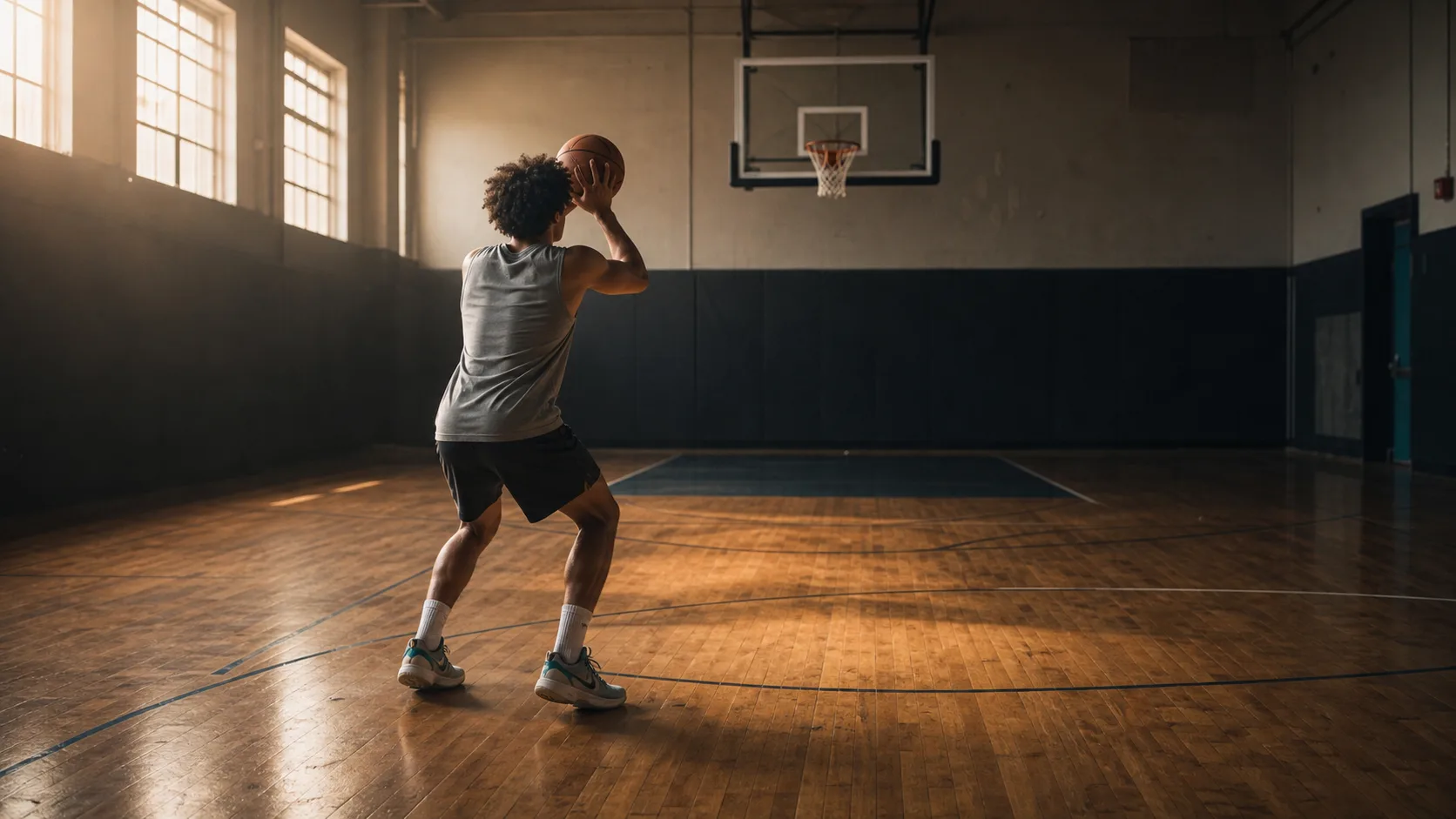
The 2026 NBA power forward is the most evolved position in basketball. They shoot threes, defend smaller guards on switches, handle the ball in transition, finish through contact, and make short-roll decisions like a point guard. The "back-to-the-basket bruiser" position barely exists anymore. If you're a young big (6'6"+ projecting to 6'8"+ as an adult), the skill stack you build needs to look almost nothing like the PF skill stack of 2010.
This piece is the 10-drill workout that builds the modern stretch-4 skill stack, broken into the five priorities of the position. Every drill has been used by an NBA-trained development coach we work with.
The Modern Stretch-4 Skill Stack
Five priorities, in order:
- Three-point shooting. 35%+ from college/NBA range on catch-and-shoot.
- Switchable defense. Defend 1-through-5 in pick-and-roll switches.
- Transition ball-handling. Handle from rim-to-rim without turnovers.
- Contact finishing. Score at the rim through bigger defenders.
- Short-roll decision-making. Pass, score, or kick from the foul-line area after a roll.
A PF without one of these has a ceiling. A PF with all five has an NBA path. The drills below build each in order of priority.
Priority 1: Three-Point Shooting (4 drills)
Drill 1: Spot Shooting With Make Targets
Standard 5-spot three-point routine, but with a make target per spot: 15 makes (not attempts) before moving. This forces you to take quality shots, you can't rush.
The 5 spots: left corner, left wing, top of the key, right wing, right corner. Total target: 75 makes. Daily.
Track make rate at each spot weekly. Find your weak spot and add 25 makes to that spot for two weeks. Most stretch-4s have a weak spot (usually the off-corner), closing the weak-spot gap is the highest-leverage shooting development you can do.
Drill 2: Catch-and-Shoot Off Movement
Start at the baseline. Sprint to the right wing. Catch the pass with hands pre-set (the Curry pre-load technique from our Play Like Steph Curry piece). Release. Reset. Sprint to left wing. Repeat.
25 shots each side, 50 total. Daily.
The discipline: hands have to be in shot pocket the whole sprint, not raised after the catch. The catch is for the ball, not the load.
Drill 3: Three-Point Pull-Up Off the Dribble
The pull-up three is the rarest stretch-4 skill but the highest-leverage. Most stretch-4s are catch-and-shoot only. Adding a pull-up three off 1-2 dribbles makes you a closeout-attacker the defense has to respect.
Setup: cone at the top of the key. Attack the cone with one hard dribble, side-step with one more dribble, pull-up three from the elbow area. 15 reps right side, 15 left side, daily.
Drill 4: Constraint Shooting
Standard 50-shot session with a constraint: one-foot shooting, off-balance shooting, or shooting with a weighted ball. The constraint exceeds game difficulty. When the constraint comes off, the game shot feels easier.
Two weeks of constraint work per cycle, then a week of straight shooting to test the gain.
Want to track your three-point make rate by spot the way an NBA front office does? HoopBrief plans include a shot-quality framework that maps every shot to one of 12 zones with per-zone PPP tracking.
Priority 2: Switchable Defense (3 drills)
Drill 5: Lateral Slide With Recovery
Set two cones 12 feet apart. Lateral slide between them, low and quick, hands active. Each rep is one full down-and-back. 10 reps per set, 3 sets.
This is for the guard-containment part of switch defense. A PF who can only slide twice before getting blown by is not switchable. A PF who can slide for a full possession is switchable.
Drill 6: Closeout to Slide
Start at the free throw line. Sprint to the right wing (closeout). Lateral slide back to the free throw line. Sprint to the left wing (closeout). Lateral slide back. Continue for one minute. 3 sets.
This is the conditioning drill. Switch defense is exhausting because you're closing out, sliding, recovering, and closing out again. The drill builds the legs that survive that workload over 36 minutes of game play.
Drill 7: Box-Out Hold for 5 Seconds
Partner stands behind you in the lane. On the whistle, partner pushes; you hold the box-out for 5 seconds without moving more than 2 feet. 10 reps each side.
This is for the bigger-matchup part of switch defense. When you switch onto a center, you need to box them out without giving ground. The hold builds the lower-body strength and the positioning instinct.
Priority 3: Transition Ball-Handling (1 drill)
Drill 8: Rim-to-Rim With Defender
Start under one rim with a defender. Push the ball coast-to-coast against the defender. Finish at the other rim or pull up in the mid-range. 10 reps.
The drill simulates the modern NBA's transition expectations for a PF. You don't have to be a point guard, but you have to handle long enough to push the rebound up and make a play. The defender adds the pressure that turns the drill from a handle-drill into a decision-drill.
Track turnovers. The target: zero in 10 reps before you graduate to the next level (multi-defender).
Priority 4: Contact Finishing (1 drill)
Drill 9: Two-Foot Stop Through Pad
Start at the right elbow. Two hard dribbles to the rim. Two-foot stop in the lane. Finish through a pad held by a partner.
15 reps right side, 15 left side. Daily.
The technique: lead with the inside shoulder into the pad. The finish is a power layup off two feet, not a layup off one. Two-foot finishes draw fouls more often than one-foot finishes, and the modern NBA PF gets to the line 5-7 times per game.
Priority 5: Short-Roll Decision-Making (1 drill)
Drill 10: Short-Roll Read Drill
Setup: a teammate handles the ball at the top of the key. You set a ball-screen. After the screen, roll to the foul-line area (not all the way to the rim). The handler passes to you in the short-roll area. You make a decision: shoot, pass to the cutter, or attack the recovering defender.
10 reps per situation: shoot situation (the closeout is late), pass situation (the cutter is open), attack situation (the closeout is recovering hard). 30 reps total.
This is the highest-IQ drill on the list and the one that separates rotational PFs from starting PFs. A PF who can't make the short-roll read is a one-trick offensive player. A PF who can make all three reads is unguardable in pick-and-roll.
How to Sequence the 10 Drills
If you have 75 minutes:
- 0:00-0:20, Three-point shooting (drills 1-2).
- 0:20-0:35, Three-point pull-up (drill 3) + constraint (drill 4 every other day).
- 0:35-0:50, Defensive footwork (drills 5-7).
- 0:50-1:00, Transition handle (drill 8) + contact finish (drill 9).
- 1:00-1:15, Short-roll read (drill 10).
If you have 90 minutes, add 15 minutes of strength work to the front: split squats, single-leg RDLs, core anti-rotation, ankle mobility.
How to Track Your Stretch-4 Development
The biggest mistake young bigs make is not tracking the right metrics. Track these weekly:
- Three-point make rate by spot (5 spots, total 75 attempts/week minimum).
- Switch-defense PPP allowed in scrimmage (target: under 0.95).
- Transition turnovers (target: zero in 10 transition reps).
- Contact finish make rate (target: 70%+ off the pad drill).
- Short-roll read accuracy (target: 80%+ correct decision across 30 reps).
When all five hit target, you're playing modern stretch-4 basketball. When two or more are below target, focus the next two weeks on the worst one.
Want to compare your skill stack to NBA stretch-fours? Start a HoopBrief plan and apply the 12-lens system to a current NBA stretch-4. See exactly which lenses they're winning on and where the gaps are between their game and yours.
Where to Go Next
Archetype companion: Play Like Victor Wembanyama for the tall-perimeter habit set.
Foundation reading: how to make it to the NBA, what NBA scouts look for in middle/high school players.
Tactical reading: pick-and-roll coverages explained, DHO and handoff reads.