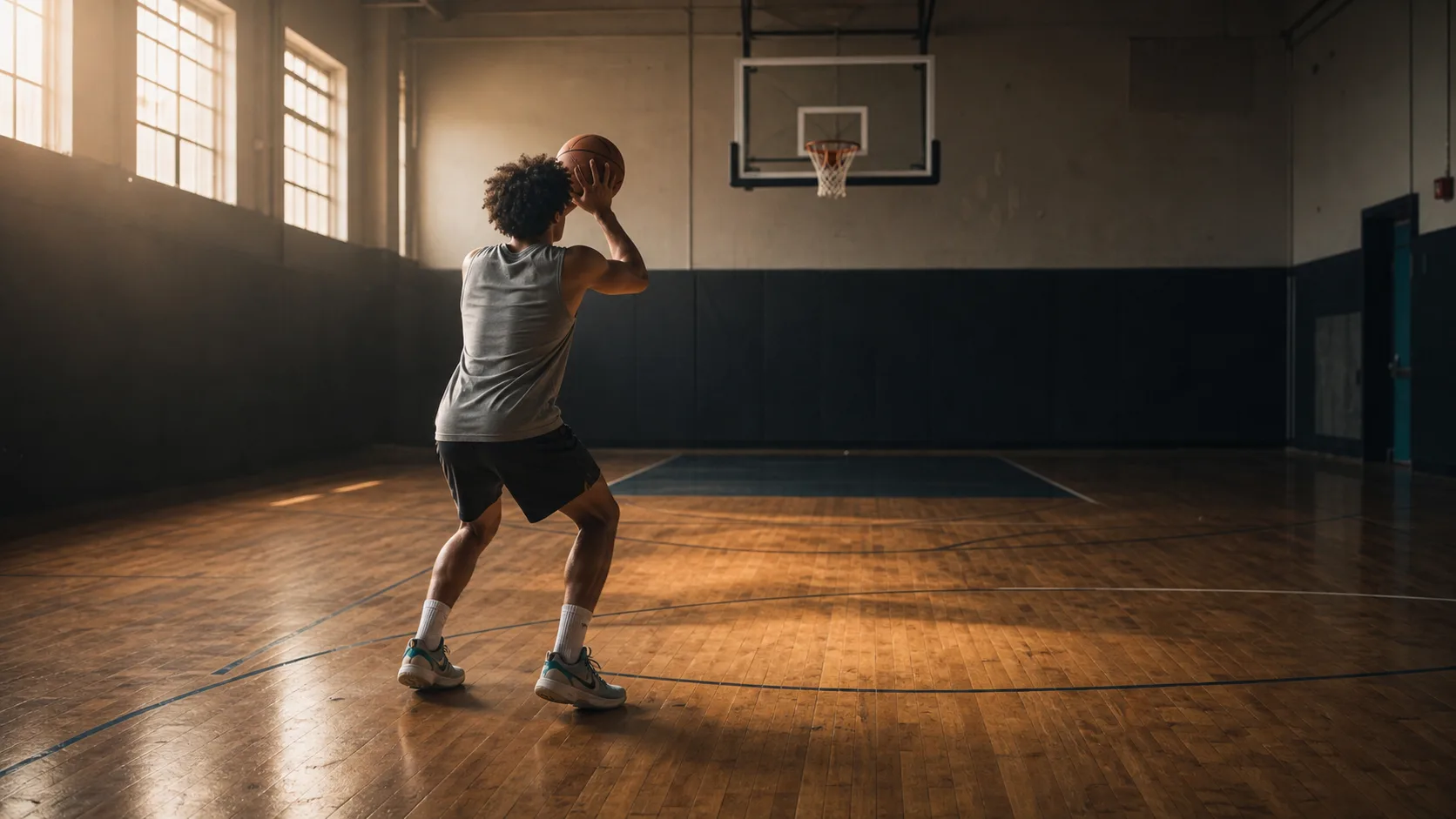
The short answer: A 90%+ free throw shooter has three things, identical mechanics every time (feet, hips, shoulders, elbow alignment), a relaxed wrist on release, and a pre-shot routine that survives pressure. Mechanics matter more than rhythm; rhythm makes mechanics repeatable in clutch moments. Most 70%-75% shooters fail on consistency, not technique.
Free throws are the only shot in basketball with no defender. The rim is the same height. The distance is fixed. The ball is yours. There is no excuse for missing one.
And yet, NBA-wide free throw shooting hovers around 78%. College is ~72%. High school is ~65%. The numbers tell a clear story: most players have not mastered the easiest shot in their sport. The reason isn't talent. It's that nobody coaches free throws as a discrete skill with a discrete protocol.
The Mechanical Checklist
Every 90%+ shooter has the following alignment:
Feet: shoulder-width apart, with the shooting-side foot slightly forward (1-2 inches). Toes pointed at the rim. Weight evenly distributed.
Hips: square to the rim. If the hips are angled, the shoulders will be angled, and the shot will pull to one side.
Shoulders: square to the rim. Same logic. A 5-degree shoulder rotation produces a 2-foot lateral miss at the rim.
Elbow: directly under the ball, pointing at the rim. Most amateur shooters have the elbow flared out, that's the source of 80% of mechanical inconsistency.
Wrist: relaxed, pointed up. The release is wrist-driven, not arm-driven. The arm guides; the wrist finishes.
If any of these five elements is misaligned, the shot is mechanically inconsistent. Fix the alignment, and you've solved 70% of the free-throw problem.
The Pre-Shot Routine
Mechanics produce the shot. Routine produces the mechanics under pressure.
A pre-shot routine has three jobs: 1. Trigger the right physical setup (mechanics). 2. Quiet the nervous system (breathing). 3. Anchor focus on a single point (the rim).
The shape doesn't matter. Steph Curry's routine is different from Kawhi's, which is different from Jokic's. What matters is that it's identical every time.
Build yours. A common version: - Bounce the ball three times. - Spin it once in the hands. - Take one slow breath out. - Look at the rim (specifically: the front of the rim, the back of the rim, or the center of the net, pick one and never change). - Release.
Use it in every shot in practice. Use it in every shot in games. Use it on a free throw down 1 with 0.3 seconds left. Same routine, every time. That's how clutch is built.
The 80%-to-90% Gap
The gap between an 80% shooter and a 90% shooter is almost entirely consistency, not mechanics.
An 80% shooter has good mechanics 80% of the time. The other 20%, something drifts, a foot pointed slightly off, a breath held too long, a hand tension that wasn't there yesterday. Each drift produces a miss.
A 90% shooter has the same mechanics 95%+ of the time. The way they get there: a routine that catches drift before the shot. They notice the foot is off. They reset. They restart the routine. They never shoot from a flawed setup.
This is why some 50% three-point shooters are 80% free throw shooters. The shot is the same; the discipline isn't.
Practicing Under Fatigue
Most amateurs practice free throws fresh, first thing in a workout, before they're tired. Then they get to the line in the fourth quarter, exhausted, and their mechanics fall apart.
The fix: practice free throws after sprint sets, after defensive slides, after any conditioning that elevates your heart rate above 160 bpm. Shoot 10 free throws in a row at that heart rate. Track make percentage.
Make percentage at 160+ bpm tells you how clutch you actually are. If you're 95% fresh and 65% tired, you're a 65% shooter when it matters.
The Pressure Transfer Drill
Coach calls "GAME ON THE LINE" before you shoot. The drill: any miss is 25 push-ups. Make all 10 in a row, the team runs no sprints. Miss any, the team runs full-court suicides.
The drill creates artificial pressure that mimics real-game stakes. Players who can shoot 90% in this drill can shoot 90% in clutch games. Players who can't, can't.
Run the drill weekly. Track make percentage over a season. The number will rise.
Frequently Asked
Should I copy a specific NBA player's routine? No. Build your own. The mechanics are universal; the routine is personal. Stealing someone else's routine puts you in their head, not yours.
How long does it take to install a new routine? ~6 weeks of daily practice for it to become automatic. Less time than most players think.
Why do some elite shooters miss clutch free throws? Because pressure compresses time. Their routine speeds up. The breath skips. The focus point shifts. The fix is more reps, not more thought.
The Quiet Edge
A 90%+ free throw shooter is worth 5-7 points a game over an 70% shooter just on free throws alone. Across a 30-game season, that's 150-200 points, enough to swing 5-10 games.
Most teams treat free throws as practice filler. Treat yours as a discrete skill, drill the mechanics, install the routine, practice it under fatigue, and you'll move from 70% to 85% in a season. From 85% to 90% in another. From 90% to 92% in a career.
The shot is yours. The rim is the same height. There is no excuse.
Keep reading: mental toughness training, the pre-game routine, and playing through a slump.