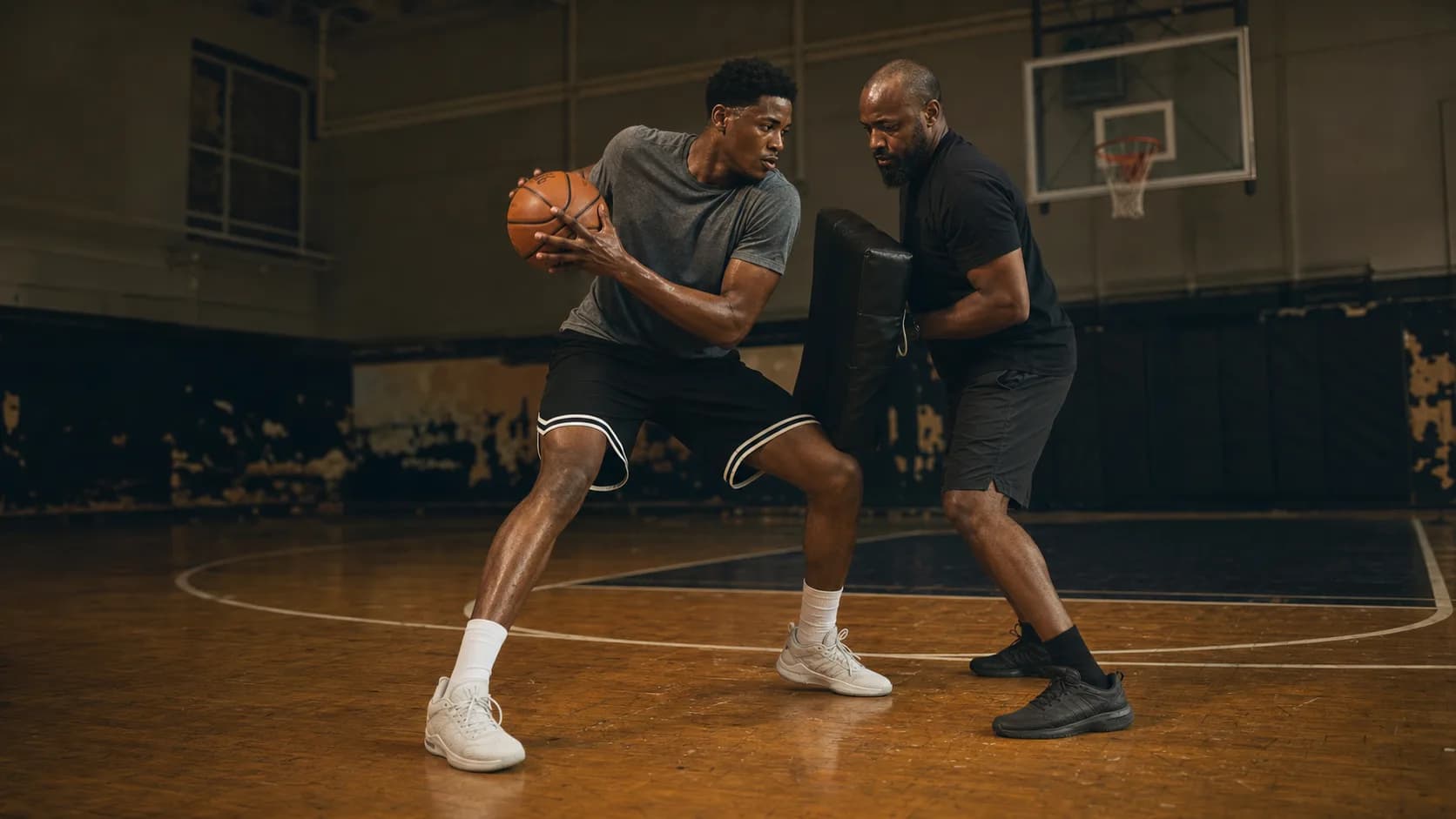
Scouts grade guards on a different rubric than wings or bigs. The seven traits that matter most for a backcourt profile are pick-and-roll IQ, decision speed at the rim, pull-up symmetry, defensive switchability, off-ball value, motor under fatigue, and the trust signal from the player's own coach. This piece walks through each one, why it matters, how scouts measure it, and how a young guard can develop it.
This is the guard-specific companion to our broader what NBA scouts look for in middle school and high school players piece. For wings, see what NBA scouts look for in wings. For bigs, see what NBA scouts look for in bigs.
The 7 Guard-Specific Traits
- Pick-and-roll IQ across all four coverages.
- Decision speed at the rim (finish, kick, dump, or floater).
- Pull-up symmetry (right hip vs left hip, off the dribble).
- Defensive switchability (can guard 1s and 2s; ideally 3s).
- Off-ball value (cutting, screening, spacing).
- Motor under fatigue (third-quarter sprint-backs, late-game help rotations).
- The trust signal (does your own coach use you in the last 90 seconds).
Trait 1: Pick-and-Roll IQ Across All Four Coverages
The single most-watched guard skill in 2026 scouting. The lead guard runs 30-50 pick-and-rolls per game in the NBA; scouts grade decisions across all four common coverages (drop, hedge, switch, blitz).
What scouts watch:
- vs drop: does the guard take the mid-range pull-up or the step-back?
- vs hedge: snake dribble + kick, or split through and attack the back?
- vs switch: iso against the bigger defender or kick to the rolling big in 4-on-3?
- vs blitz: short-roll pass or skip to the weak-side corner?
A guard who has the right counter for all four coverages is a primary handler at every level. A guard who only has counters for two is a secondary handler. A guard with counters for one is a college role player.
Our pick-and-roll coverages explained piece walks through each coverage in detail, including the counter library that beats each one.
Trait 2: Decision Speed at the Rim
When the guard breaks down the first line of defense, the next decision happens in roughly 0.4 to 0.8 seconds. The decision: finish, kick, dump to the big, or floater.
Scouts grade this by tagging 50-100 rim attacks across game film and counting the percentage of correct decisions. A guard above 80% projects to the NBA. Between 65-80% projects to college. Below 65% suggests skill gaps that won't close at the next level.
The training method: constraint-based film study. Watch a possession, pause at the moment the guard breaks down the first defender, predict the correct decision, then watch the result. Two weeks of this rewires game-speed reads.
Want to study NBA guard decision-making with NBA-staff tagging? Start a HoopBrief plan and pull every Brunson, SGA, Curry, or Luka rim attack tagged for correct/incorrect decision across the 12 lenses.
Trait 3: Pull-Up Symmetry
Most guards are pull-up dominant from one hip (usually the strong-hand hip). Scouts circle the guards who are symmetric, pull-up make rates within 5 percentage points across right and left hips.
Symmetry matters because NBA defenses scout it. If you're 45% from the right elbow and 30% from the left, the scouting report will say "force him left." If you're 40% from both, there's no shading available.
The training: deliberate 50/50 split in pull-up reps in practice. Most young guards take 70%+ of their pull-ups from the strong hip. Force the symmetric split for 8 weeks and the in-game numbers converge.
Trait 4: Defensive Switchability
Modern NBA defense requires guards to defend at least two positions (1 and 2). Elite guards defend three (1, 2, and 3 in switch situations).
What scouts watch:
- Lateral slide endurance, can the guard slide for a full possession without giving up the dribble?
- Closeout discipline, short-stride high-hand closeouts at speed, not flying-by closeouts that get beaten on shot fakes.
- Switch positioning, when switched onto a bigger player, does the guard front the post or play behind?
- Recovery after a beat, what happens after the guard gets beaten on the first step?
A switchable guard is worth 2-3 points of net rating in the modern NBA. A non-switchable guard either limits your defensive scheme or has to be hidden, which limits offensive flexibility.
Trait 5: Off-Ball Value
The traits most fans miss. A guard with off-ball value does at least one of these on roughly 60% of possessions they don't touch the ball:
- A baseline cut when the help defender's head turns.
- A pin-down screen for a teammate.
- A relocation that drags a defender out of help position.
- A space-clearing lift to the wing.
Off-ball value is what turns a "ball-dominant scorer" into a "winning player." Scouts know the difference matters at the NBA level, you can only have one or two ball-dominant players on the floor at a time, so a third or fourth guard who can play off the ball is more valuable than one who can't.
Trait 6: Motor Under Fatigue
Three of the eight scouts we interviewed for our main scouts piece independently used the phrase "third-quarter motor." That's the tell.
In a single game, almost any guard can play hard. In the second game of a tournament weekend, in the third quarter, with the score close, that's the motor that translates. Scouts will sit through three games of an EYBL session specifically to watch the same guard in the third quarter of game three.
The four motor signals:
- Sprinting back on defense after a missed shot.
- Closing out at full speed in possession 75+.
- Recovering after a defensive mistake instead of arguing the call.
- Boxing out on every possession, including non-natural matchups.
You can choose to be the high-motor guard. It's the single highest-leverage choice in your scouting profile.
Trait 7: The Trust Signal
The scouting trait that's hardest to fake. Scouts watch the last 90 seconds of close games to see who the head coach trusts.
If your coach trusts you in winning time, that trust is real information about your composure, decision-making, and basketball IQ in the moments that matter most. If your coach takes you off the floor in winning time, that's also real information, usually meaning the coach doesn't trust you to make the right play under pressure.
You can't manufacture this trust. You earn it by:
- Not turning the ball over in close games.
- Taking the right shot instead of the high-volume shot.
- Defending the other team's best player in the last possession.
Coaches give that trust to the players who deserve it, and scouts notice exactly who that is.
Want to apply the 12-lens scouting framework to your own guard film? Start a HoopBrief plan today and the same lens system NBA staffs use is in your dashboard tomorrow.
How Guards Should Structure Their Development
If you're a young guard targeting one of these seven traits at a time, here is the priority order:
- Today's choice: motor, off-ball value, defensive intensity. All three are free, you can pick them in your next practice.
- Year-1 build: pick-and-roll IQ, decision speed at the rim. Both are film-study skills as much as physical skills.
- Year-2 build: pull-up symmetry, defensive switchability. Both require deliberate skill work over months.
- Career-long earn: the trust signal. Earned across hundreds of close-game possessions.
Where to Go Next
Companion scouting pieces by position: What NBA Scouts Look For in Wings, What NBA Scouts Look For in Bigs.
Trait deep-dives: How Scouts Evaluate Decision-Making, How Scouts Grade Defensive Versatility, Why Motor Matters in Scouting Reports, Off-Ball Value: The Trait Most Fans Miss.
Hub: NBA Scouting Hub.
Archetype guides: Play Like Jalen Brunson, Play Like Shai Gilgeous-Alexander, Play Like Steph Curry, Play Like Luka Dončić.