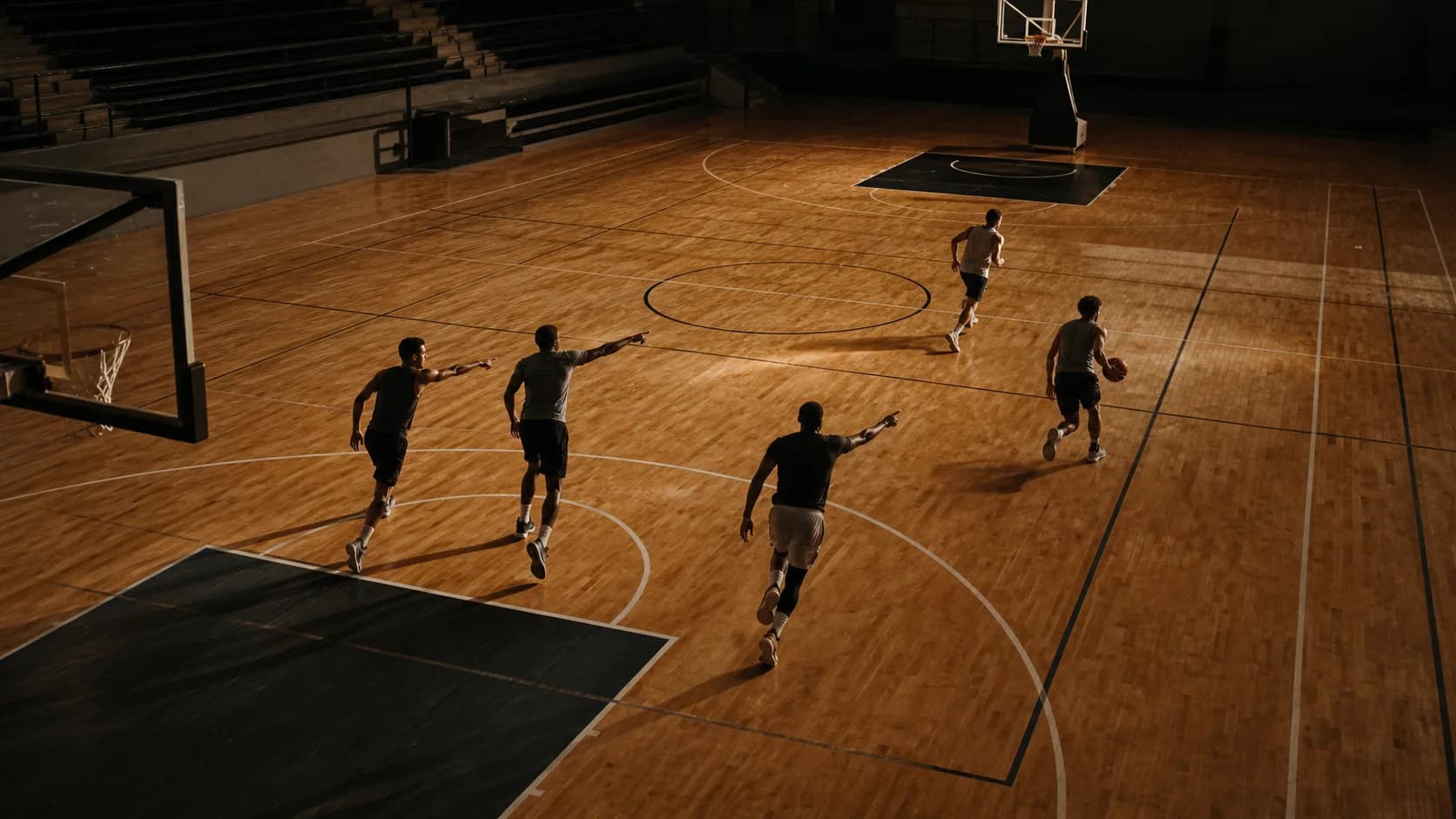
Decision-making is the trait every NBA scout we asked named first. Eight scouts, eight different teams, the same answer: "How fast does he see it?" Scoring is downstream of decisions. A scorer with slow decision-making projects to a college role player. A non-scorer with elite decision-making projects to an NBA point guard. This piece is the rubric scouts actually use and the training method to close the gap.
This is part of the NBA Scouting Hub cluster, the trait deep-dives that explain how scouts evaluate each of the eight traits that move a recruiting profile.
The 4-Component Rubric Scouts Use
When NBA scouts evaluate decision-making, they break the trait into four components:
- Decision speed, time from defensive cue to offensive read.
- Decision accuracy, percentage of correct reads across 50+ tagged possessions.
- Decision consistency, does accuracy hold under fatigue, pressure, and against higher competition?
- Decision recovery, what happens after a wrong read?
An NBA-projectable player scores well on all four. A college-projectable player scores well on two or three. A non-projectable player scores well on one or none.
Component 1: Decision Speed
The 0.4-second window. When a defender shows a coverage (a hedge on a pick-and-roll, a help rotation, a closeout), the offensive player has roughly 0.4 to 0.8 seconds to make the correct read.
What the windows mean:
- 0.4 seconds and faster: NBA-projectable. The read is instant; the body executes before the defender can adjust.
- 0.4 to 0.6 seconds: college-projectable. The read is clean but the defender has time to adjust.
- 0.6 to 0.8 seconds: mid-major or developmental-projectable. The read is late but available.
- 0.8 seconds and slower: the read is closed by the time it happens. Projectable only at the current level.
You can train this. The constraint-based film study method is the gold standard, see Component 4 for the drill.
Component 2: Decision Accuracy
Decision speed without accuracy is just fast wrong choices. Scouts grade accuracy by tagging 50-100 possessions on film and counting the percentage of correct reads.
What "correct" means depends on context:
- In pick-and-roll: did the handler take what the coverage gave?
- At the rim: did the finisher finish, kick, dump, or shoot the floater correctly based on help geometry?
- In transition: did the handler push, pull back, or call a set correctly based on numbers?
- In iso: did the scorer attack, kick, or reset correctly based on defender positioning?
The benchmarks:
- 80%+ correct reads: NBA-projectable.
- 70-80%: high-major college projectable.
- 60-70%: mid-major projectable.
- Below 60%: suggests fundamental skill gaps that don't close at higher levels.
Component 3: Decision Consistency
Accuracy in a 50-possession sample is one thing. Accuracy across a full season, across high and low energy games, against weak and strong competition, that's consistency.
Scouts cross-check accuracy by competition level. A player who reads 85% correctly against weak competition and 65% against EYBL competition has a translation problem. A player who reads 75% across both has a consistency win.
The hardest version of consistency to grade is fatigue. Did the player's decision accuracy drop in the third quarter of consecutive games? That's the tell scouts use to project NBA conditioning.
Component 4: Decision Recovery
What happens after a wrong read?
- Best case: the player recognizes the mistake, recovers position or executes a correction, and prevents the negative outcome.
- Middle case: the player accepts the mistake, returns to the next possession with the same focus.
- Worst case: the player argues, sulks, or repeats the same mistake.
Decision recovery is the trait that most distinguishes mentally-tough players from mentally-fragile ones. Scouts watch the next two possessions after a wrong read to see which category the player fits.
HoopBrief currently turns basketball and matchup questions into structured reports using public statistical and play-by-play context. It does not accept film uploads or provide possession-level video tagging.
The Training Method: Pause-and-Predict
The single most effective decision-making training drill. It takes 30-45 minutes per session and produces measurable improvement in 2-4 weeks.
How to run it:
- Step 1: Pick an NBA game. Start the film.
- Step 2: Watch each possession until the defense reveals its coverage (typically the moment the on-ball defender commits to a coverage or the help defender starts to rotate).
- Step 3: Pause the film.
- Step 4: Predict the correct offensive read out loud (or write it down). Be specific, "pull-up jumper" beats "shoot."
- Step 5: Press play. Watch what the actual NBA player did.
- Step 6: If your read matched, mark a hit. If not, ask why, what was the read you missed?
- Step 7: Track your accuracy across 50 possessions per session.
The goal: 70%+ accuracy by week four. Repeat with a different team each week to broaden the pattern recognition.
This drill works because it forces you to commit to a read before seeing the outcome. Most film study is passive, watching what happened. Constraint-based film study trains the actual cognitive process scouts grade.
How to Improve in Real Games
Three habits that translate film study to live games:
- Pre-game scouting. Read the opponent's scouting report. Know their primary coverages, their preferred matchups, their key players' tendencies. The more you know before tip, the faster you can read in-game.
- Possession-by-possession reset. After every possession, take one breath and identify the next defensive setup. This sounds simple; most players don't do it.
- Post-game film review. Watch your own possessions within 24 hours. Identify the 3-5 possessions where your read was slow or wrong. Plan the correction for next game.
A player who does all three for a full season improves their decision speed by 100-150 milliseconds, enough to move from college-projectable to NBA-projectable for prospects on the bubble.
Where to Go Next
Companion trait deep-dives: How Scouts Grade Defensive Versatility, Why Motor Matters in Scouting Reports, Off-Ball Value: The Trait Most Fans Miss.
Position scouting pieces: What NBA Scouts Look For in Guards, What NBA Scouts Look For in Wings, What NBA Scouts Look For in Bigs.
Hub: NBA Scouting Hub.
Foundation reading: the 12-lens framework, the basketball film study guide, basketball IQ, what it actually means.