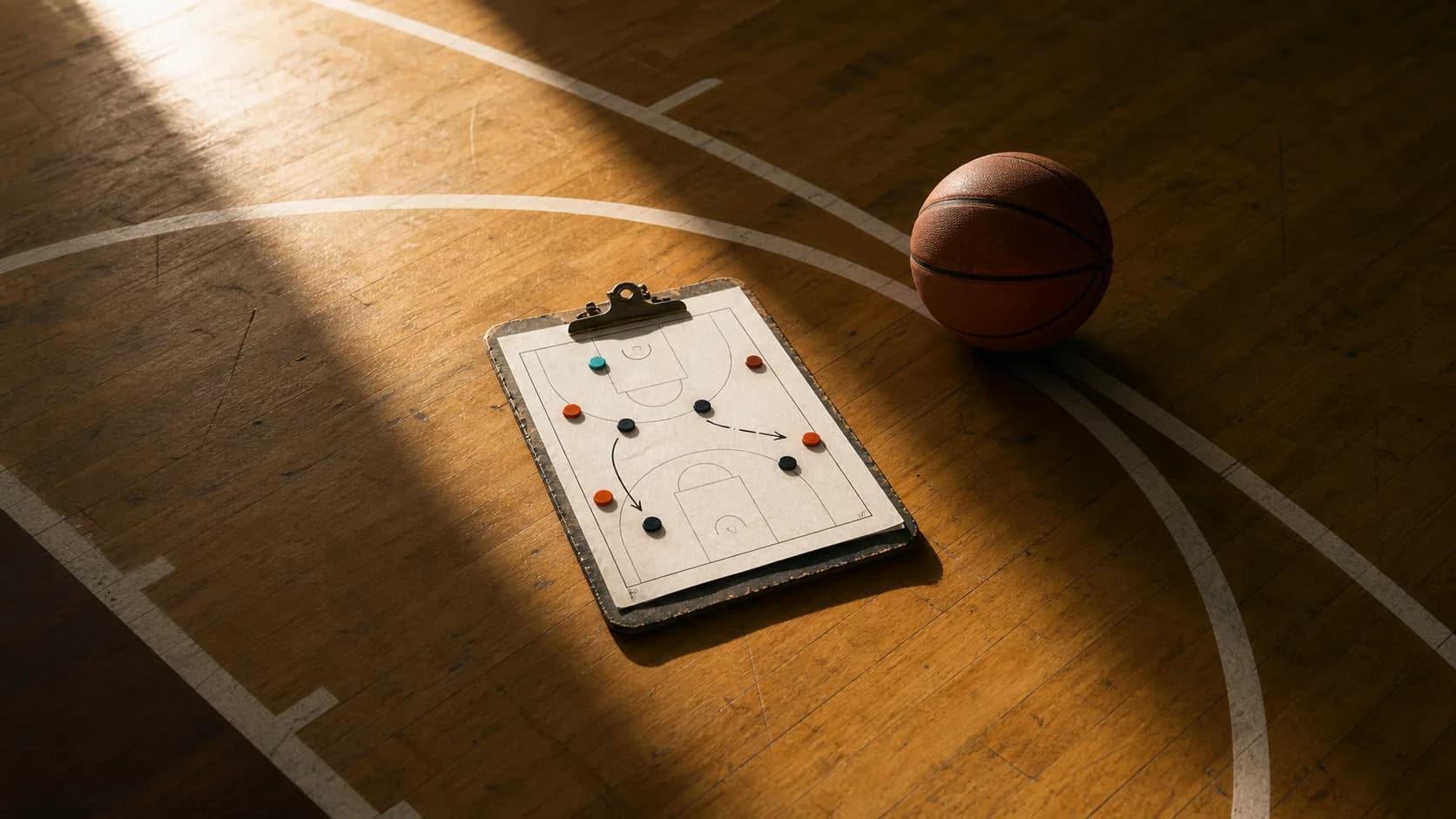
Every time defenses switch, a small mismatch is created. But most players waste possessions trying to punish switches that aren't really mismatches, or attacking the wrong part of the mismatch.
First Question: Is It Actually a Mismatch?
A switch only matters if it creates a real edge. A 6'3 guard now on a 6'7 wing isn't much, the wing isn't giving up that much in speed, the guard isn't big enough to post. A 6'1 point guard on a 6'10 big? That's a mismatch on both ends.
Before you attack, ask: can I get a shot the prior assignment wouldn't have given me? If the answer is no, keep flowing.
Size Mismatches (Big on Small)
Attack before help arrives. Bigs close to a smaller ballhandler at a different speed, they need two or three dribbles of space to recover. Attack the first-step angle immediately, before the help side can tag the roller or cheat into the gap.
Don't: wait, iso, or hold the ball above the break. Every second you delay, the shell resets.
Speed Mismatches (Small on Big)
Post early, post deep. A smaller defender on a big can give up two things: post position and offensive rebounds. The read isn't a 10-second post-up, it's a quick catch on the block, one dribble, and a kick if help comes.
Don't: try to back down for eight seconds. That's how you pick up an offensive foul. Use the size advantage for catch-and-attack, not for isolation.
The Hidden Mismatch: Foul Trouble
Sometimes the best switch to attack isn't the biggest size gap, it's the defender in foul trouble. Forcing their fourth foul in the third quarter is worth more than getting a single bucket.
The Switch-and-Re-Attack
Elite offenses don't just attack the first switch, they manipulate the next one. Hit the first switch, draw help, kick to the weak corner, and now the new closeout is the real advantage.
This is why HoopBrief's lens system matters: a Matchup Hunter attack looks very different from a Precision attack, even against the same defense.
The 5-Second Rule for Hunting a Mismatch
The window for attacking a switch mismatch is roughly 5 seconds. After that, help arrives, the defense resets, and the advantage disappears. The decision tree for the 5-second window:
1. Seconds 0-1: Read the mismatch. Size differential, foot speed, foul count. 2. Seconds 1-3: Engage. Drive, post-up, or call the off-ball action that exploits the mismatch. 3. Seconds 3-4: Decision moment. If help arrives, kick out. If not, finish. 4. Seconds 4-5: Reset. The window has closed; move the ball.
The pick-and-roll counter library covers the offensive counters that exploit specific switch types.
What Defenders Do to Survive the Switch
The defending the star piece walks through the 5-layer playoff defense built around switching. The key defender response: low base, no reach, force the contested shot rather than try to win the matchup.
Keep reading: all four pick-and-roll coverages, and reading help defenders.