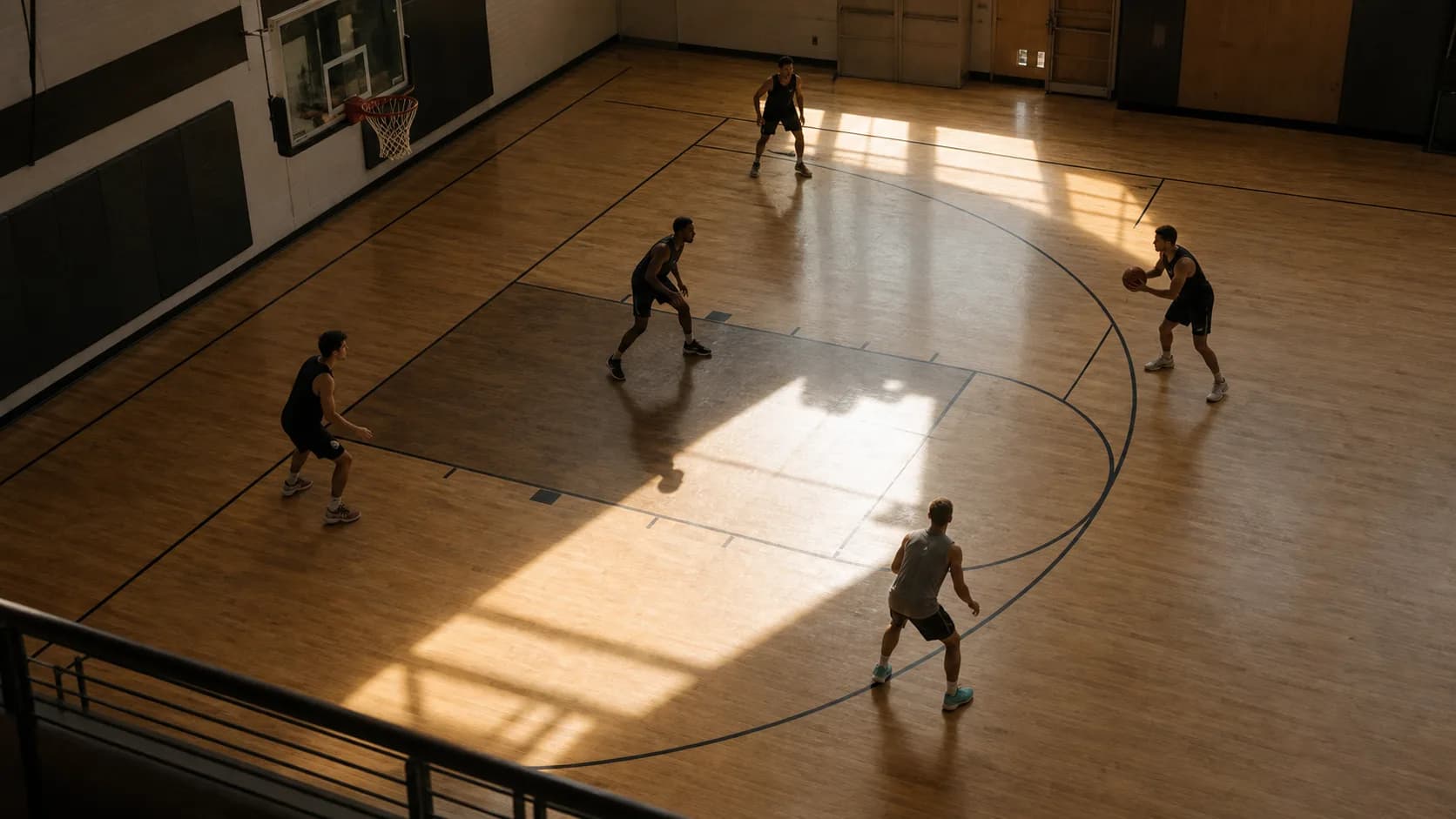
There's a misconception in basketball that defense is about athleticism. It's not. The best defenders in the NBA are rarely the fastest or most athletic players on the court. They're the best positioned.
Top Foot and Body Angle
The most fundamental positioning concept is top foot placement. Your top foot dictates which direction you're influencing the ball handler to go. If your top foot is left, you're pushing them right. If it's right, you're pushing them left.
This isn't random - it's strategic. You position your top foot based on what the ball handler wants to do and where your help is loaded. If help is at the nail, you push the ball handler toward the nail. If help is loaded low, you push them baseline.
Gap Management
Gap is the distance between you and the ball handler. Too tight and you get blown by. Too loose and they pull up for an easy jumper. The right gap depends on the player, the situation, and the shot clock.
Above the break, most defenders can give a little more gap because help is closer. Inside the arc, you tighten up because the driving angle is more dangerous. Late in the shot clock, you can afford to be more aggressive because the clock is your friend.
Help Positioning
Where you stand when you're not guarding the ball is arguably more important than when you are. Help positioning - being in the right spot to help a teammate without completely abandoning your man - is the foundation of team defense.
The key positions are the nail (free throw line area), the low block, and the split line (halfway between the ball and your man). Where you stand depends on where the ball is, where your man is, and where the likely attack is coming from.
Screen Navigation
How you position yourself before a screen arrives determines everything. If you're set up correctly - in the right stance, with the right gap, anticipating the screen angle - you can navigate it cleanly. If you're late or out of position, you're fighting from behind.
The best screen navigators get skinny early, make contact with the screener on their terms, and recover to a strong position on the other side. They don't wait for the screen - they anticipate it and start adjusting two steps before it arrives.
The Positioning Advantage
When you watch film of elite defenders, pay attention to where they stand before the action starts. Most of the time, they're already in the right position before anything happens. They don't need to be the fastest player on the court because they don't have to cover as much ground.
This is what Positioning IQ means - and it's one of the most trainable skills in basketball. You don't need more athleticism. You need better positioning.
The Three Layers of Defensive Positioning
Defensive positioning operates on three layers simultaneously, and most defenders only consciously manage one or two:
1. Ball position. Where am I relative to the ball-handler? This is the layer most defenders focus on entirely. 2. Help position. Where am I relative to the nail (the center of the foul line)? Help defenders should be at the nail when their man is two passes away. 3. Recovery position. Where do I need to be when the ball moves? Pre-rotation is what separates great defenders from reactive ones.
The reading help defenders piece covers the offensive side of this, exploiting defenders who don't manage all three layers.
The Drills That Train Positioning
Four drills that build positioning IQ specifically:
1. Shell drill. Five defenders in a half-court shell. Coach moves the ball; defenders adjust to ball position and nail position simultaneously. 2. Two-pass-away drill. Defenders practice the help position when their man is two passes from the ball. 3. Closeout-to-shell. Sprint closeout, force a kick, recover to next shell position. The closeout footwork piece covers the mechanics. 4. Live read drill. 5-on-5 half-court with a coach calling out positioning notes after each possession.
The how to improve your basketball defense piece walks through the broader defensive development framework these drills fit inside.
Keep reading: closeout technique, becoming a better defender, and reading help defenders.