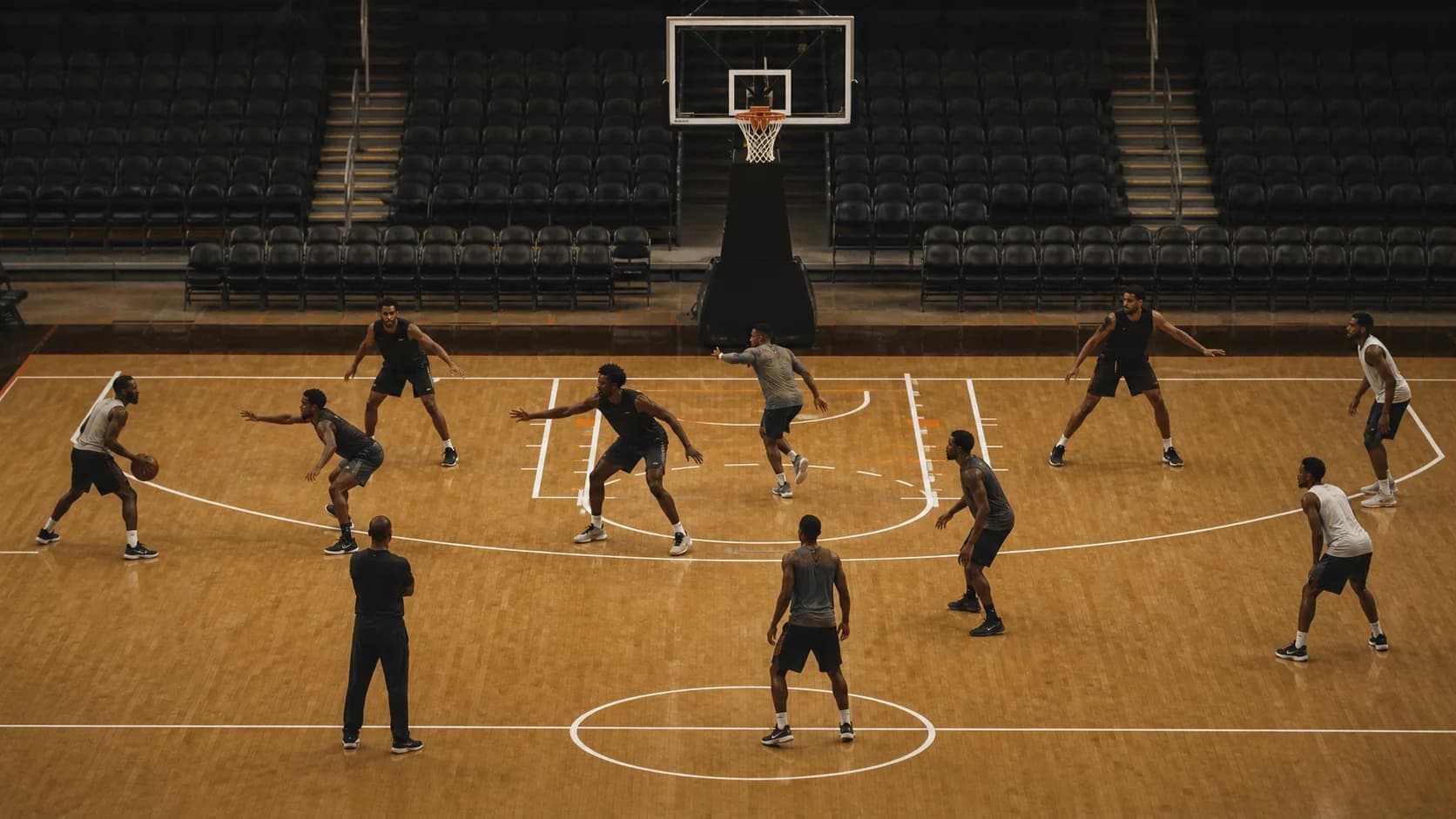
The cues worth training first:
- Passer's eyes and shoulders, which point to the pass
- Ball handler's hips and pivot foot, which show drive direction
- The screen angle, which dictates the coverage and counter
- Floor spacing, which tells you where help has to come from
- A defender's top foot, which invites the ball one way
What is the difference between reacting and anticipating?
Reacting is moving after the play happens. Anticipating is moving as the cue appears, before the ball leaves the hand. That gap of a half-second is the whole game, because it is the difference between arriving on time and arriving late.
The key insight is that anticipation removes the need for elite speed. A slow defender who reads the passer's shoulders can jump the lane on time, while a fast defender who waits for the ball is always chasing. You are not trying to be quicker. You are trying to leave earlier. Our overview of improving basketball IQ frames anticipation as the core trainable edge.
Which cues tell me a pass is coming?
The passer's eyes and shoulders. Most players, especially young ones, look where they intend to throw and square their shoulders to the target before they release. That is a tell that fires a beat before the ball, and it is remarkably reliable.
Here is a worked example. You are guarding a wing on the weak side. The ball handler drives and gets stopped. You see his eyes snap to your man in the corner and his shoulders rotate that way. That is your cue. You break for the passing lane as he gathers to throw, and you pick it clean. To the crowd it looks like quickness. It was reading his eyes a half-second early.
Advanced passers hide this with looking off, so calibrate to your competition. Against most players, eyes and shoulders are gold. Against a real point guard, you read hips and hesitation instead. Our guide to reading help defenders off the ball drills the weak-side version of this scan.
How do the ball handler's hips tell me where he is going?
Hips and the pivot foot commit before the ball does. A player can fake with the ball and the head, but to actually drive a direction his hips have to turn and his lead foot has to point that way. Watch the hips, not the ball, and the dribble stops fooling you.
A concrete read. On a closeout, the offensive player jab-steps right but his hips stay square and his weight stays back. That is a fake. His hips never committed, so no real drive is coming. Ignore the jab and hold your ground. Now the same look, but his hips turn and his lead foot points to the baseline. That drive is real, and you slide to cut it off before he takes his second dribble.
This hips-over-ball habit is the difference between a defender who bites on every fake and one who never does. HoopBrief flags exactly these micro-behaviors, the confidence-rated tells that reveal intent, the way an advance scout would. Our breakdown of reading a defense builds the offensive side of the same read.
How does spacing let me predict where help comes from?
Spacing tells you the geometry of the next rotation. If you know where every player stands, you know who is the low man, who has to tag the roller, and where the open pass will be after help commits. Anticipation on offense is often just doing this math a beat before the defense does.
Think it through. You drive baseline and you already clocked that the defender guarding the opposite corner is the nearest help. The instant he steps to stop you, his man is open, because he cannot guard two people. You are throwing to that corner before the helper has fully committed, which is why it arrives on time. Our piece on positioning IQ and where to stand maps these help relationships in detail.
The same spacing logic works on defense. If you read that the offense has emptied the strong-side corner, you know the drive has nowhere to kick on that side, so you can help harder off the ball. Reading the floor is reading the future.
How do I train anticipation off the court?
Pause-and-predict film reps. Watch a possession, stop the frame a beat before the ball moves, and call the next action from the cues you see. Then play it and check. You are teaching your eyes to find the tell before the outcome, which is the exact skill live play demands.
Run it on 15 possessions with one cue at a time. One session watching only eyes and shoulders. The next watching only hips. The next watching only spacing and help. Isolating a single cue builds the read faster than trying to watch everything at once. The 10-possession method in how to study a player in ten possessions is a clean structure for this.
Here is the honest beat. Anticipation carries a cost: when you read wrong, you are badly wrong, because you already committed. A defender who jumps a lane and guesses gives up a layup. If you are not willing to be occasionally burned while you calibrate, you will never learn to read early, and you will stay a reactor forever. The players who anticipate best all ate some bad gambles while their pattern library filled in.
The common mistake is guessing and calling it anticipation. Real anticipation is tied to a specific, repeated cue. Jumping a lane on a hunch is gambling. Jumping it because you read the passer's shoulders is a skill. Keep every early move tied to a tell you can name, and you stay on the right side of that line.
The Bottom Line
Anticipating plays is reading cues before the ball moves: eyes and shoulders for the pass, hips and pivot foot for the drive, spacing for where help must come. It is pattern recognition, not instinct, which means you can train it. Rep pause-and-predict film with one cue at a time, accept a few burns while you calibrate, and keep every early move tied to a tell you can name.
To see cue reading done at a scouting level, ask the HoopBrief Matchup Engine how a specific player tips his next move, and study the tells it flags.