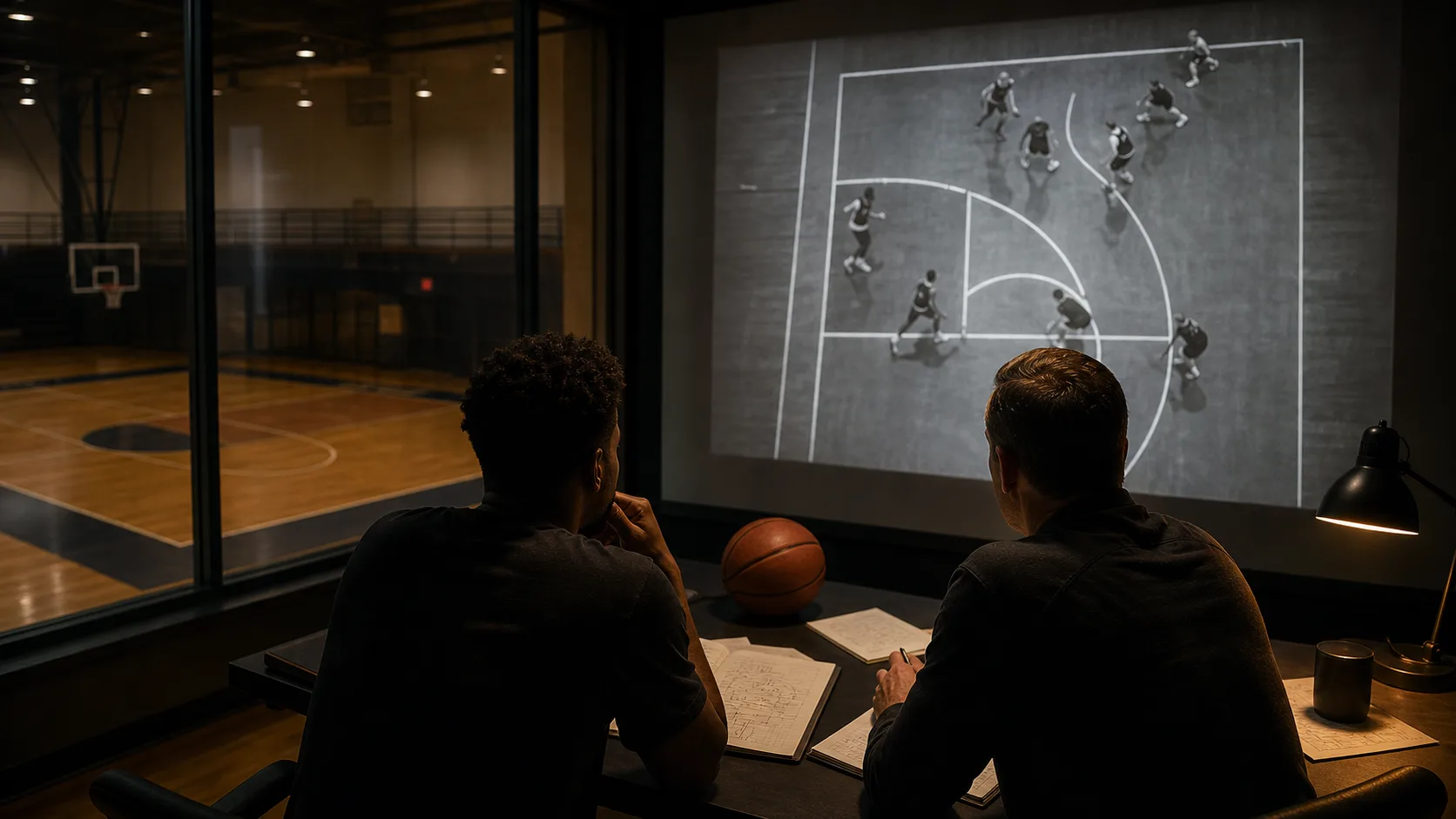
The scouting report on you already exists. The question is whether you've seen it.
Self-scouting is harder than scouting an opponent because you have a bias: you watch your own team with the context of what you meant to do, not what you actually did. Cut through that bias, and you find advantages opponents are already attacking.
1. Late-Clock Possessions
When the clock is under six seconds, where does the ball go? Be honest, it's probably the same three actions every time. Mix it up or your opponent will pre-rotate.
2. After-Timeout Tendencies
Teams run their favorite play out of timeouts. That's fine, but if it's the same play every time, the defense already knows. Keep a chart: what you ran, whether it worked, what the defense gave up.
3. First-Action Reads
What's your default first action out of a half-court set? Pick and roll left? Post-up right? Whatever it is, opponents see it on tape. Vary your entry.
4. Substitution Patterns
If your sub rotation is predictable, the opponent can hunt specific matchups. Watch when you bring in your bench, does the opponent always have a specific lineup answer?
5. Foul-Trouble Habits
Do you get aggressive after picking up an early foul, or do you play scared? Opponents read this. Some coaches deliberately attack your defender right after a foul, knowing they'll back off.
6. Ball Movement on Missed Shots
How does your spacing change on the second action? Often, when the first read gets cut off, everyone stands. That's when defenses load up and turnovers happen.
7. Transition Defense Discipline
Which player is always the last one back? Which player never hits their spot? This is usually the single biggest efficiency leak on any team.
8. Screen Navigation Habits
Do your guards always go over? Always go under? A shooter will hunt the lock-and-trail defender, knowing they can catch half a step of separation.
9. The Star's Shot Selection Late
Does your best scorer take a hero shot every time the game tightens? That's a pattern the opponent prepares for. Counter actions should pull him off the ball.
10. The "Safe" Pass
Every team has a player who always makes the safe pass instead of the right pass. Opponents bait this player, knowing they won't try the skip.
Self-scouting is not enjoyable. It is also the single highest-leverage activity a coach can do between games.
How to Build a Self-Scouting Routine That Actually Works
Most self-scout routines fail because they're informal, coaches glance at film, take a few mental notes, and move on. A structured weekly self-scout routine:
- Monday (60 min): Watch the previous game's possessions in three passes. Pass 1: defense. Pass 2: offense. Pass 3: transition.
- Tuesday (30 min): Tag the 5 most-revealing breakdowns. Write a 1-sentence root cause for each.
- Wednesday (30 min): Translate to actions. What practice rep fixes each breakdown? Assign to a specific player.
- Thursday (15 min): Brief the team. The fixes get reinforced in the pre-game film session.
The scouting report build framework walks through the same process for opponent prep. The scouting report evolution piece covers how this updates across a playoff series.
The Pattern Coaches Miss Most
Of the 10 blind spots, the one coaches miss most consistently is the late-clock pattern. The coaching prep piece covers why, late-clock possessions are emotionally weighted (they're the memorable ones), so coaches focus on outcomes ("did we score?") instead of patterns ("are we predictable?"). Self-scouting fixes this by forcing a structural review independent of emotion.
Keep reading: how to build a scouting report, self-scouting yourself as a player, and the film study guide.