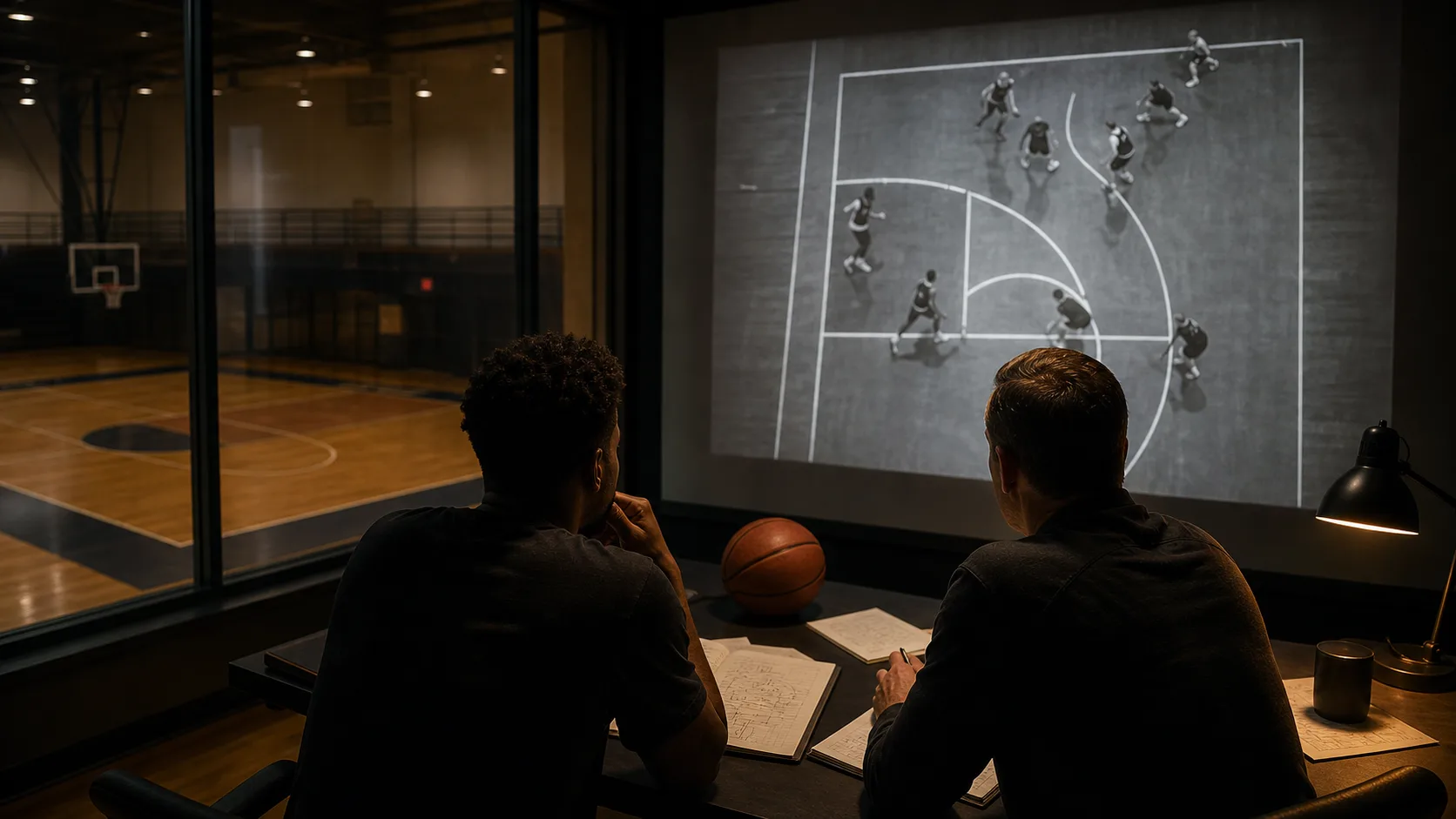
The reading order, top to bottom:
- Man or zone: cut a player and see who follows.
- On-ball coverage: how do they guard the ball screen?
- Help geometry: where is the low man and the weak-side tag?
- Rotation: who covers if help commits?
- Counter: attack the spot the coverage gives up.
Each of these has a deeper piece linked below. This page is the map. The specific reads are the roads.
How Do You Tell Man From Zone in One Possession?
Cut a player through the defense and watch who tracks him. In man, one defender chases the cutter across the whole floor. In zone, the cutter gets passed from defender to defender and nobody travels with him. That single cut answers the biggest question on the floor.
If a live cut is not available, read the eyes and hips. Man defenders keep their head on a swivel, splitting attention between their man and the ball, and their hips turn to deny. Zone defenders lock their eyes on the ball and slide with every pass, hips square to the ball. Once you have named man or zone, you have cut the problem in half. Against zone, the attack shifts entirely, which is the whole point of how to beat a zone defense. Against man, you move to the next read.
The habit of naming coverages fast is the core of how to improve your basketball IQ. Slow players guess. Fast players name.
How Do You Name the Pick-and-Roll Coverage?
Watch the screener's defender at the moment of the screen. Where he goes tells you the whole coverage. There are four to recognize on sight, and each gives up a different shot.
Drop: the big sags toward the rim and lets the ball handler turn the corner, conceding the mid-range pull-up. Switch: the two defenders trade men, which hands you a mismatch to hunt. Blitz: both defenders jump the ball to trap it, which means a four-on-three behind them and a roller diving into space. ICE: the on-ball defender jumps to the top-foot side and forces the ball away from the screen toward the sideline, killing the middle drive.
The full breakdown of each and its counter lives in pick-and-roll coverages explained: drop, switch, blitz, ICE. Here is the worked read: the big is at the level of the screen and both defenders show at the ball. That is a blitz. You do not try to split it. You hit the short roll, and now your roller is attacking a two-on-one against the low help. Naming blitz picked the pass for you.
Where Do You Look to Find the Help?
Find the low man and the weak-side tag before you drive. The help defense is where the second and third defenders stand, and it decides whether your drive gets a layup or a wall. Read it before contact, not during.
Two spots matter. The low man is the defender one pass away on the baseline side who is responsible for stopping the roller or the drive at the rim. The weak-side tag is the defender on the far side who has to choose between his shooter and helping at the rim. When the low man steps up to your drive, his man, the corner, is open. When the weak-side tag pinches, the skip to the far wing is open. Reading that second defender before you leave your feet is the entire skill in reading help defenders off the ball.
The read is a chain. Low help commits means his man is open. That man's help commits means the next man is open. You are not finding one open player. You are finding which domino the defense knocked over first.
How Do You Read the Rotation Behind the Help?
The rotation is who covers for the helper. When a help defender leaves his man to stop the ball, someone has to cover the man he left, and someone covers that man, in a chain. Read the chain and you find the man who is a beat late.
Here is the geometry against a drive that pulls in the low man. The low man stops the ball. The weak-side defender rotates down to cover the low man's roller. The top defender drops to cover the weak-side shooter. That leaves the very last man, usually the opposite corner or wing, as the one the defense cannot reach in time. The pass that beats a rotation is rarely the first kickout. It is the second, the extra pass, that arrives before the last rotation closes. On film this pattern jumps out, which is why studying it is the point of how to read NBA defensive coverages on film.
Can You Read a Defense Before the Ball Is In Play?
Yes, and elite players do. The defense tells you its plan on the catch, in the stance and the gaps, before anyone dribbles. Read the pre-snap picture and you are a step ahead of the whole possession.
Look at three pre-play tells. First, the on-ball defender's top foot: if he is angled to force one direction, ICE or a hard force is coming. Second, the gaps: a defender sagging two steps off a non-shooter is telling you he is loading to help, which means his man is your release valve. Third, the screener's defender depth: if he is already sagging before the screen, drop is coming and the pull-up is there. Naming the coverage this early is what separates a player who reacts from one who dictates.
What Is the Common Mistake When Reading Defense?
The common mistake is reading only the on-ball defender and ignoring the other four. Players tunnel on the man guarding them, make one read, and get surprised by help they never looked for. The ball defender is one fifth of the picture.
Not everyone needs the full pillar at once. If you are early in your development, master man-versus-zone and the four pick-and-roll coverages first, then add help and rotation later. Trying to read all five defenders before you can name the on-ball coverage just freezes you. Build the reads in order. This umbrella exists so you know what comes next, not so you learn it all in one film session.
The Bottom Line
Reading a defense is a fixed sequence, not a gift. Name man or zone, name the on-ball coverage, find the help, trace the rotation, and attack the spot the coverage gives up. Every specific read, the switch, the drop, the zone, the help on the wing, hangs off this frame. Learn the order and the counters stop being guesses.
To name the coverage a specific opponent runs and get the exact counter before tip-off, the HoopBrief Matchup Engine reads the defense and prescribes the attack in seconds.