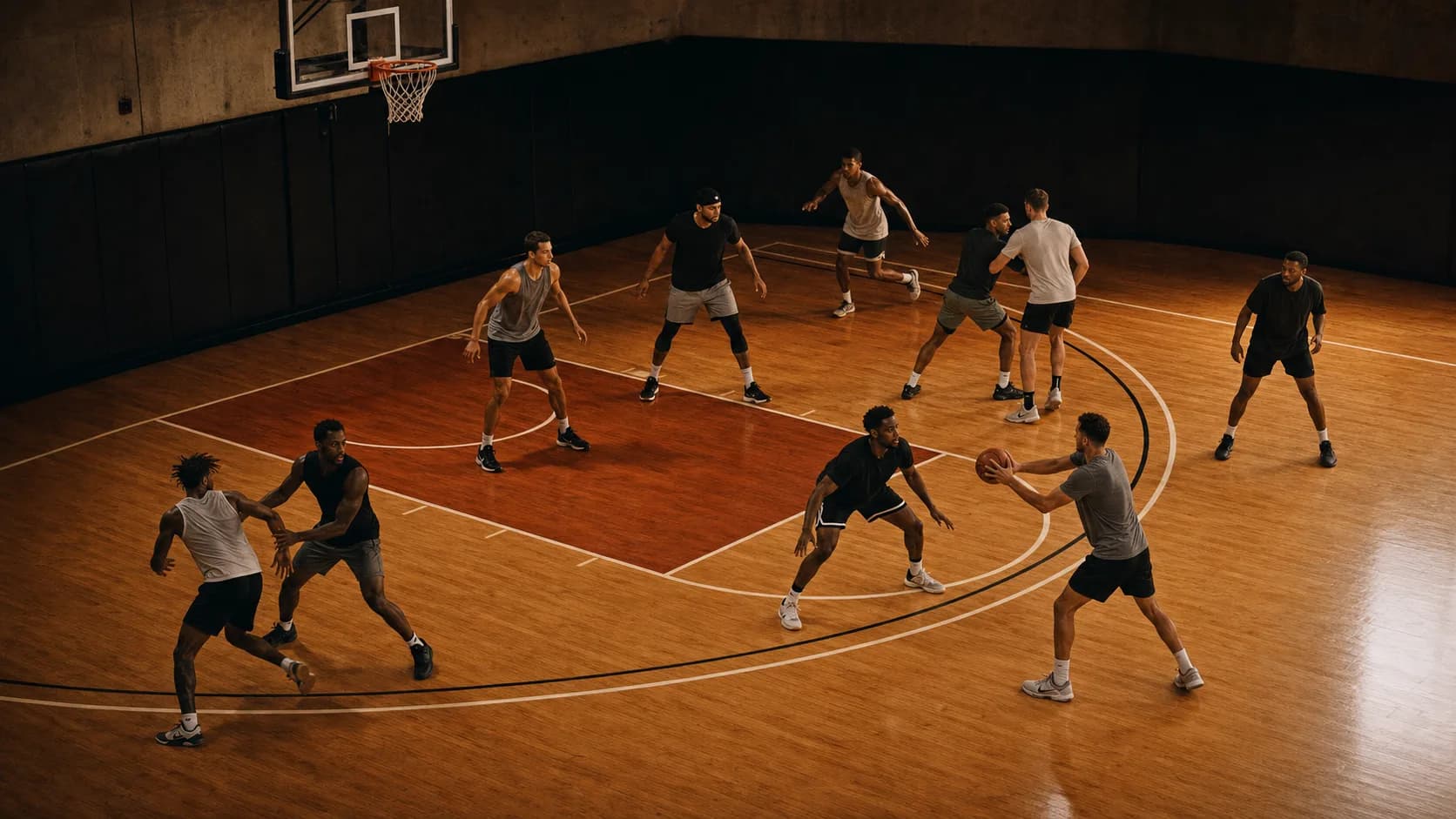
- ball
- defender
- offense
- the read
Here is the short version before the film-room breakdown:
- Flash a player to the high post or free throw line to freeze the middle defender.
- Overload one side with three attackers so two zone defenders have to guard three men.
- Skip-pass across the top or from corner to corner to beat the slide.
- Attack closeouts once you force the zone to fly at a shooter.
- Screen the zone: pin the back line or screen the top so a defender cannot slide.
How Do You Read a Zone Before You Attack It?
First, name it. Count the top line: two defenders up top is a 2-3, one up top is a 1-3-1 or 1-2-2, three up top is a 3-2. That count tells you where the seams live. Naming the coverage before you attack is the same habit that carries over to man defense in how to read a defense in basketball.
A 2-3 protects the paint and concedes the elbows and short corners. A 3-2 protects the perimeter and concedes the middle and the block. A 1-3-1 traps the wings and concedes the short corner and the weak-side baseline. Every zone gives something up. Your job in the first two passes is to find out what.
Watch the top defenders' hips. If they turn to trail the ball on a swing, the seam behind them is open for a flash. If they stay square and pass you off, the gap is in the next slide over.
Why Does Flashing the Middle Break a Zone?
The middle of the zone is the one spot no defender wants to leave. Put a player at the free throw line or high post and the zone has a decision no zone wants: collapse and give up a shooter, or stay home and give up a catch at the nail with the whole floor in front of him.
Here is the worked example. Against a 2-3, your point guard dribbles to the wing. Your best passing big flashes to the free throw line and catches. Now the middle defender steps up to him, the back line is a man short, and the weak-side short corner is wide open. The high-post player turns, reads the back line, and either feeds the short corner or hits the opposite low block on a duck-in. One catch in the middle turned a five-man wall into a scramble.
The high post is the control tower. Reading the second defender from that spot is the same off-ball skill covered in reading help defenders off the ball, just run in reverse: instead of helping, you are punishing the help.
Where Do You Put Your Players Against a 2-3?
Fill the gaps, not the guarded spots. Standing where a defender already is lets the zone stay set. Standing in a seam forces someone to choose. Against the most common front you will see, here is where each spot lives and what it does.
| Spot | Where to stand | The job |
|---|---|---|
| High post | Free-throw line, facing the rim | Force the back-line big to commit, then shoot, drive, or pass high-to-low |
| Short corner | Just outside the lane on the baseline | Catch behind the big and finish, or kick to the corner |
| Wing gap | Between the top and bottom defenders | Attack the seam off the catch to collapse the zone |
| Corners | Both corners, deep | Spot up for the skip and the inside-out kick |
| Ball reversal | Top and both slots | Swing the ball fast enough that the zone is never set |
The alignment that stresses a 2-3 most puts a body in all three soft spots at once: a passer at the high post, a player in each short corner, and shooters spotted in both corners and a wing. Five defenders cannot cover that much floor.
The high post also unlocks the best pass in zone offense, high-to-low. The post catches at the free-throw line, the middle back-line defender steps up, and the ball goes over the top to the short corner or the opposite block for a finish. That is the exact layup a 2-3 is built to prevent, which is why forcing that one decision is worth so much.
Underneath all of it sits one habit: pass, do not dribble. Every dribble lets the zone reset. Get an inside touch, let the zone collapse to the rim, then kick out to the shooter the defense left behind. That inside-out sequence, not swinging the ball around the arc, is where the open threes come from.
How Does Overloading a Side Beat a Zone?
Overload means putting three offensive players on one side of the floor where the zone only has two defenders. Now two defenders are guarding three men, and one attacker is always open. The zone has to rotate a third defender over, and that rotation is where the ball beats them.
Set it up like this against a 2-3: point at the top, wing and corner filled on the strong side, and a short-corner player sitting on the block below the wing defender. That is a triangle of three on the right with two zone defenders. Swing the ball wing to corner and the corner defender is pulled to the baseline, which frees the short corner for a catch under the rim. If they cover the short corner, the corner three is open. You are forcing a two-guards-three math problem on every catch.
The counter the defense wants is a hard tilt of the whole zone to your overload. That is exactly what sets up the skip.
When Should You Skip-Pass Against a Zone?
Skip the ball the moment the zone has fully tilted to your overload. A skip pass travels from one side of the floor to the opposite wing or corner, over the top of the zone, and it arrives before the back-line defenders can slide all the way across. The zone is only as good as its slowest rotation.
The tell is the weak-side wing defender. When you overload right, that left wing defender pinches in toward the ball to help. His hips turn away from his man. That is your window. The skip from the right corner to the left wing beats him to the spot, and now the left side attacks a scrambling closeout. Attacking that late closeout is a live drive, not a settle. The read is identical to the wing help read in how to read help defense on the wing.
One skip rarely finishes the possession. Two skips usually do. Ball reversal plus a skip means the zone has now slid, recovered, and slid again, and the fourth defender is a full beat late.
Can You Screen a Zone Defense?
Yes, and most teams forget you are allowed to. Screening the zone means picking a specific defender so he cannot slide to his spot. You are not screening a man, you are screening a zone responsibility.
Two that work. First, the back screen on the middle defender in a 2-3: as the ball goes to the corner and the middle man drops to protect the block, a screener pins him from the high side, and a cutter slips to the front of the rim for a catch. Second, screen the top of a 1-3-1: pick the point defender so the ball handler turns the corner into the free throw line, which forces the wings to make a choice they cannot win. Running two-man actions into a zone is the same pick and roll footwork, aimed at a zone slot instead of a man.
What Is the Common Mistake Against a Zone?
The most common mistake is standing still and swinging the ball slowly around the arc. Perimeter passing with no cutting lets the zone slide with every pass and reset. You look busy, but you never make a defender guard two things at once.
This approach is not for a team without a middle-of-the-floor passer. If nobody on your roster can catch at the free throw line and make the read, the high-post attack stalls and you are back to settling for contested threes. Build that passer first, or attack with dribble penetration into the gaps instead and kick from there. Know your personnel before you pick your plan.
The Bottom Line
Beating a zone is a reading problem, not a play-calling problem. Name the front, find the two soft spots, put a body in the middle, overload a side, and skip the ball ahead of the slowest slide. Do that and the zone stops being a wall and starts being five defenders chasing the ball.
If you want to know exactly which gap a specific team's zone concedes, and the fastest action to punish it, the HoopBrief Matchup Engine reads the coverage and prescribes the counter in seconds.