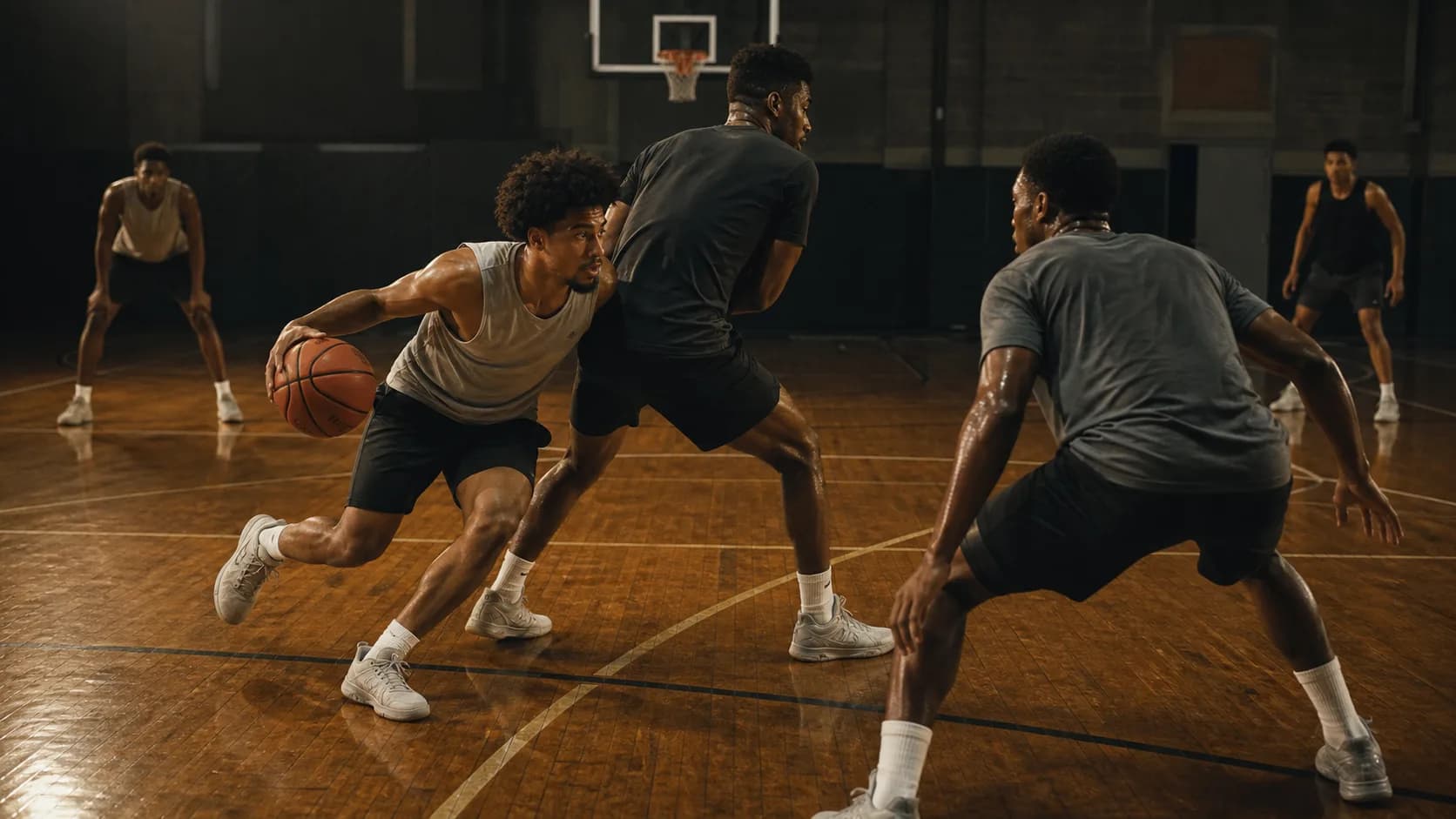
The screen game is the most common action in basketball because it manufactures a numbers problem the defense has to solve on the fly. Master the reads and you play a half-step ahead every possession.
The pick-and-roll decision loop: - Set the angle so the defense has to commit to a direction - Read the screener's defender first, not the on-ball defender - Name the coverage before you turn the corner: drop, switch, blitz, or ICE - Take what that coverage gives up, do not force your first idea - Punish the same coverage twice and the defense has to change it
Most players treat the pick-and-roll as a green light to score. It is not. It is a way to make the defense declare, and then to attack the thing they gave up to stop your first option.
How Do You Set the Screen Angle?
Set the angle before the screen arrives, because the angle decides which way the ball handler can attack. A flat screen, set square to the sideline, funnels the ball handler downhill toward the middle. A steep or side screen turns him toward the baseline. The two of you agree on the direction first, so the screener is not chasing a moving guard.
The ball handler's job is to sell a real threat in the other direction, then use the screen tight, shoulder brushing the screener's chest. Refuse the screen and reject it toward the vacated side when the defender cheats over the top. Reading the whole floor first makes this automatic, and how to read a defense covers the pre-snap scan that tells you which way the help is loaded.
How Do You Read Drop Coverage?
In drop coverage the screener's defender sinks toward the rim and the on-ball defender chases over the screen. The defense is conceding the pull-up jumper and the pocket area to protect the rim. So take the pull-up if you can shoot it, and hit the pocket pass if the big steps up to you.
The pocket pass is the money read here. It is a low, one-handed pass into the gap between you and the dropping big, delivered right as the screener rolls. The roller catches it on the move with a runway. The full menu of what each coverage concedes is broken down in pick-and-roll coverages explained. Read the big's feet: deep drop means shoot, high drop means pass.
Worked example. The big sits at the level of the free-throw line, splitting the difference. That is a soft drop trying to take both the pull-up and the roll. Attack it by getting downhill hard to the nail, which forces the big to fully commit, then read his hips: if they turn to the roller, pull up; if they stay on you, drop the pocket pass behind him.
How Do You Attack a Switch or a Blitz?
On a switch, the two defenders trade men and you now have a mismatch, either a big guarding you or a small on your screener. Attack the mismatch immediately, before the defense can send help to bail it out. A small on the roller means throw it deep and let the big seal. A big on the guard means isolate and cook off the dribble.
On a blitz or hard hedge, two defenders jump the ball, which means someone is open behind the play. Do not try to split it every time. Get off the ball to the screener rolling into a four-on-three, and let him make the next read against the scrambling defense. The concept of hunting the weaker defender is the same one in what is a mismatch in basketball and how to exploit a matchup. ICE, where the defense forces you baseline and away from the screen, just tells you the middle is the counter, so re-screen or reject.
When Should the Screener Roll, Pop, or Slip?
The screener chooses based on his own shot and what the help does. Roll when the paint is open and the drop gives a runway. Pop when the screener shoots it and the low help rotates up to tag the roll, because that rotation vacates the space he is popping into. Slip the screen early when the defender jumps out to blitz, ducking to the rim before contact.
The screener is a reader too, not a bystander. He watches the tagger, the low man on the weak side. If the tagger sinks to stop the roll, the weak-side shooter is open and the screener should relocate to keep a passing lane clean. Where that help comes from is the whole subject of reading help defenders.
What Is the Most Common Pick-and-Roll Mistake?
The most common mistake is deciding what you are going to do before the defense shows you anything. A player who has already decided to pull up will pull up into a wall, and a player set on the pass will force it into traffic. The pick-and-roll punishes pre-decision.
The second mistake is using the screen too early or too loose, so the on-ball defender slides under clean and the coverage never has to commit. Wait for the screen, use it tight, and let the defense declare first. Training the read itself, not the move, is what how to improve basketball decision-making is built around.
Who This Is Not For
This is not for the player who wants a set play he can run on autopilot. The pick-and-roll rewards live reading, which means you will get it wrong for a while as you learn to see the coverage in real time. If you would rather memorize one move and repeat it, a simpler action will frustrate you less.
But if you are willing to read the big's feet and take what the defense gives, the pick-and-roll is the single most efficient way to bend a defense until it breaks.
The Bottom Line
Set the angle, read the screener's defender, name the coverage, and take what it gives up. Drop concedes the pull-up and pocket pass. Switch hands you a mismatch. Blitz opens the back line. The screen is not the play, your read is.
One way to train the read off the court: ask how a staff would defend a specific pick-and-roll and study the coverage they would show. The HoopBrief Matchup Engine turns that into a concrete breakdown you can rep, and Starter is $9.99/mo.