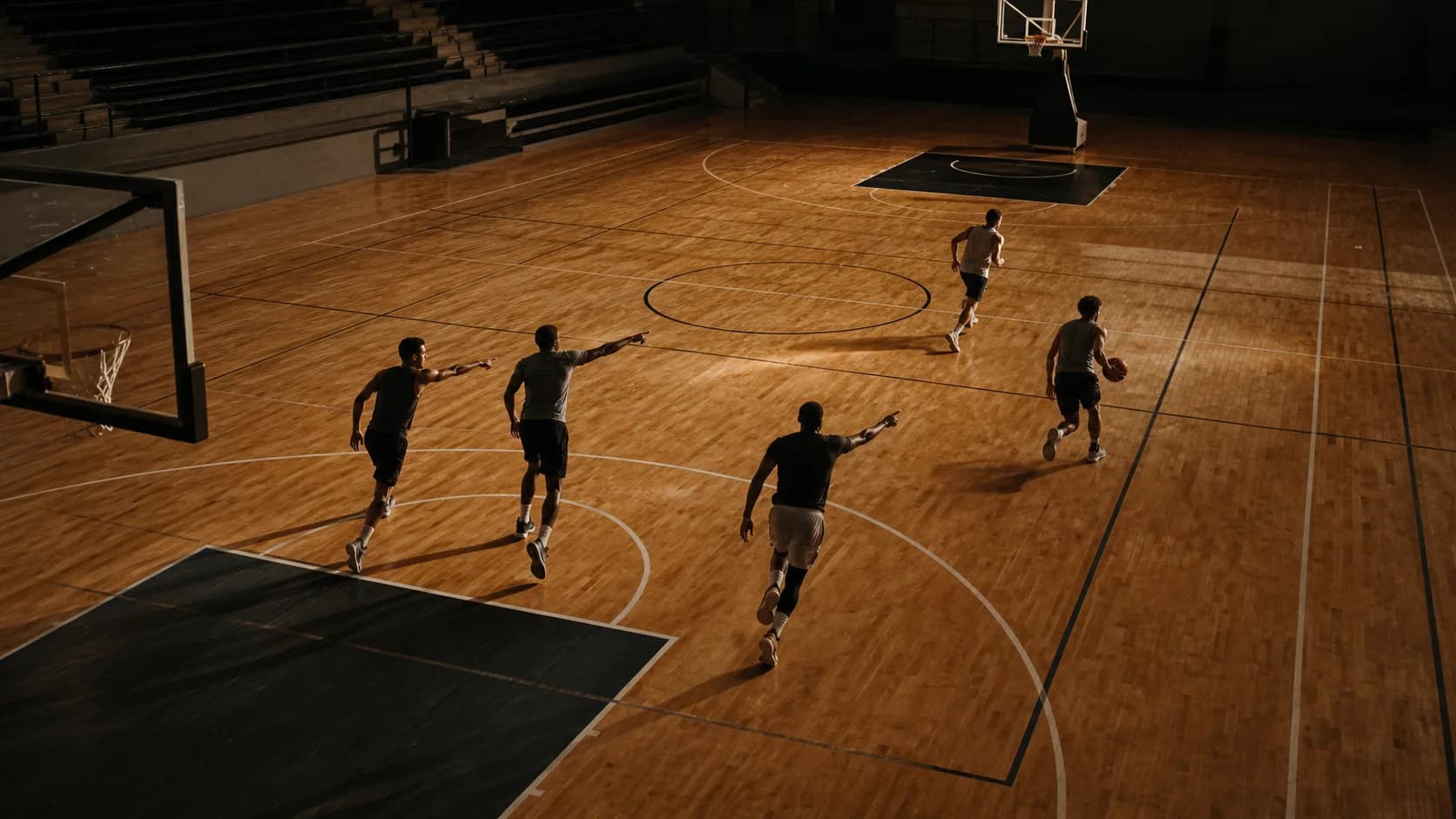
This is the wing-driver's read. The single highest-leverage offensive read in modern NBA basketball. It's not a guess, it's a specific scan pattern that elite scorers run on every drive. This piece is that scan pattern.
The 4 Defenders You're Reading
When you drive from the right wing, four defenders are in motion:
- D1: The on-ball defender (the one you just beat). Recovering from behind.
- D2: The weak-side help defender (guarding the player at the left elbow extended area). Rotating into the lane.
- D3: The corner help defender (guarding the left corner). Reading whether to rotate.
- D4: The strong-side big (often the screener's defender or the help from your own side). Wall-up or step-up.
You're not watching all four. You're watching one, D2, the weak-side help defender. Their movement triggers your read.
The D2 Read
D2 has three possible reactions to your drive:
Reaction A: D2 Rotates Hard Into the Lane
D2 steps into the lane to stop your drive. Their man (the player they were guarding) is now open.
Your read: kick to D2's man. Quick one-handed kick across your body. The pass arrives before D2 can recover.
Common mistake: kicking with two hands (slow), or kicking to a different player (the open one is the one D2 left).
Reaction B: D2 Stays Home
D2 doesn't rotate. Their man stays covered.
Your read: the help is coming from somewhere else, usually D4, the strong-side big. If D4 walls up, dump off to your rolling big (or take the floater if no roller). If D4 stays at the rim, you have 1-on-1 recovery from D1, finish through contact.
Common mistake: kicking when there's no help. If D2 stayed and D4 walls up, there's no open shooter, the only read is the finish or the dump.
Reaction C: D2 Stunts and Recovers
D2 fakes a rotation, then recovers to their man.
Your read: the stunt is meant to slow you down without committing. Recognize the fake, continue the drive, finish at the rim or take the floater. Don't kick, D2's man isn't actually open.
Common mistake: treating the stunt as a full rotation and kicking to a covered man. Turnover.
The Pre-Drive Read
Before you even start the drive, scan D2's body posture:
- Hips squared to their man, feet flat: likely to stay or stunt.
- Hips angled toward the lane, feet shaded toward the ball: likely to rotate hard.
- Hips fully open to the ball, lead foot into the lane: already rotating before you've committed.
The pre-drive read tells you which of the three D2 reactions is most probable. Combined with the post-drive read, your decision speed compresses from 0.5 seconds to 0.2-0.3 seconds.
HoopBrief currently turns basketball and matchup questions into structured reports using public statistical and play-by-play context. It does not accept film uploads or provide possession-level video tagging.
The Second-Level Read: D3 vs D2
Elite wing scorers read both D2 and D3 simultaneously. When D2 rotates hard, the question is whether D3 (the corner help defender) "X-rotates" up to cover D2's vacated man.
- D3 X-rotates up: the corner is now open. Your kick should go to the corner, not to D2's original man.
- D3 stays home: D2's original man is open. Standard kick.
The X-rotation read takes 0.1-0.2 additional seconds to process. At the NBA level, scorers like Tatum, Jaylen Brown, and Paul George run this read automatically. At the high school level, it's the upgrade that turns a good wing scorer into an elite playmaker.
The Drill Progression
To install the D2 read into your own game:
Weeks 1-2: Stationary Read
- 5-on-5 setup with everyone stationary except you and one defender at the wing.
- Drive from the wing. Coach calls out D2's reaction ("D2 rotates!" or "D2 stays!" or "D2 stunts!").
- You make the matching read.
- 20 reps per day.
Weeks 3-4: Live D2
- Same setup, but D2 is live (a coach or partner) and reacts based on the drive.
- You read D2's actual movement, not a verbal call.
- 30 reps per day.
Weeks 5-8: Full 5-on-5 Application
- Live scrimmage with the explicit rule that every wing drive must finish with a verbal call ("D2 rotated, kicked corner!" or "D2 stayed, finished rim!").
- Forces you to verbalize the read, which trains the cognitive workflow.
By week 8, the D2 read happens automatically in unstructured scrimmage.
Why This Read Matters More Than Any Other
A typical NBA possession has 1-2 drives. The wing drive is the most common drive type. If you're a wing scorer averaging 12-15 drives per game, the D2 read happens 12-15 times per game.
The PPP gap between elite reads and average reads on those possessions is 0.15-0.20 PPP, across 12 drives, that's 2-3 points of offensive efficiency per game.
A wing scorer who upgrades from average D2 reads to elite D2 reads improves their team's offense by 2-3 points without changing a single physical skill. It's the highest-leverage skill development available to a wing scorer in modern NBA basketball.
HoopBrief currently turns basketball and matchup questions into structured reports using public statistical and play-by-play context. It does not accept film uploads or provide possession-level video tagging.
Where to Go Next
Foundation reading: how to improve basketball decision-making, the basketball film study guide.
Sibling pieces: how NBA guards manipulate pace to get to their spots (the speed that makes the read possible), off-ball value: the trait most fans miss (the other side, being the player who's open when D2 rotates).
Next step, combine reads with shot creation: how to improve pull-up creation and shot balance.
Hub: Player Development Hub.