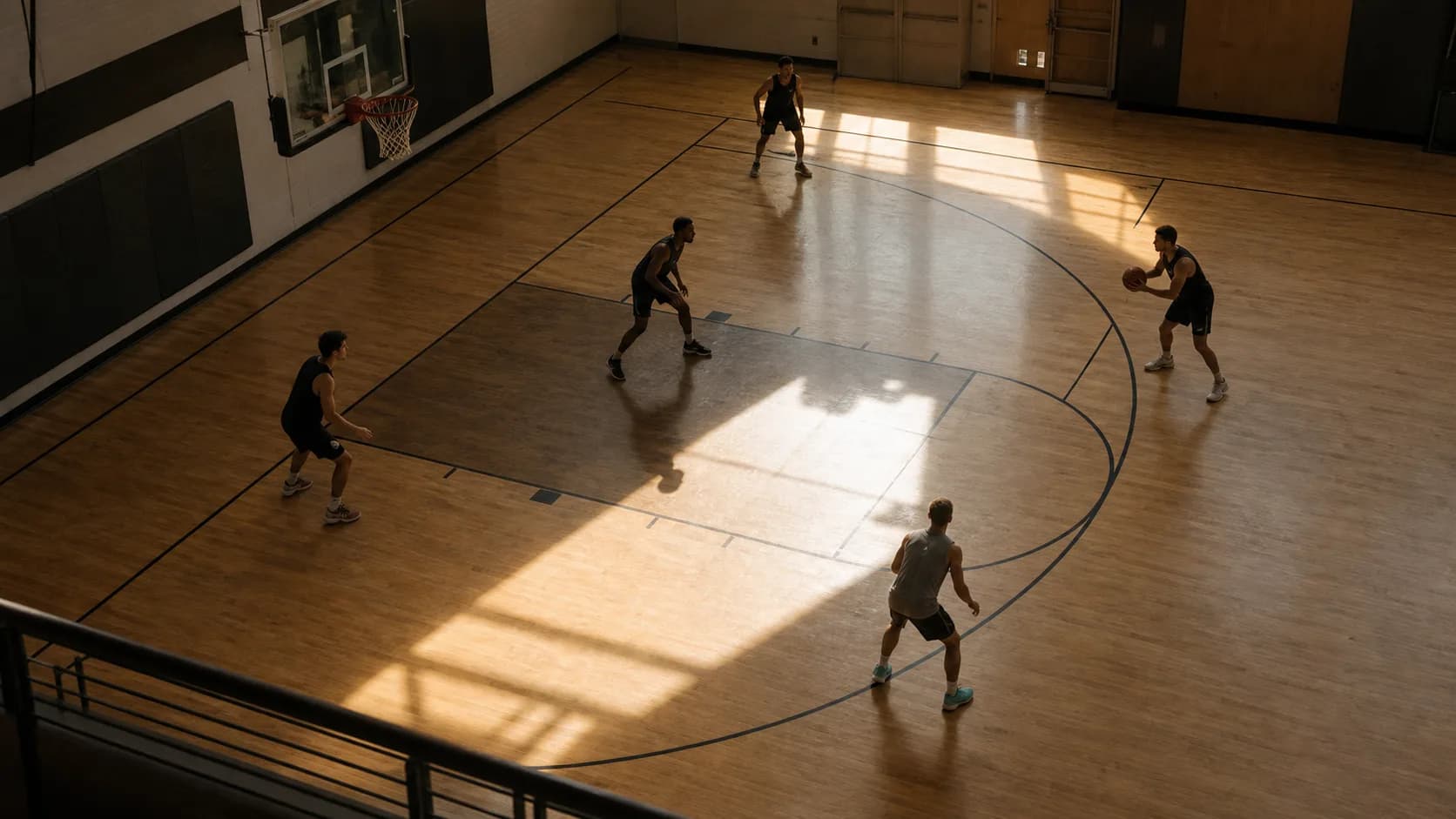
The reason isn't athleticism. It's pace control. And pace control is the single most copyable elite skill in basketball, because it doesn't require any physical gift, it requires deliberate footwork training.
This piece is the breakdown of how NBA guards manipulate pace: the three-speed framework, the patterns elite guards use, and the drill progression to build pace control into your own game.
The Three-Speed Framework
Elite NBA guards operate at three distinct dribble speeds:
- 30% (controlled). Patient, low, surveying. The defender thinks the possession is in reset.
- 70% (committed). Driving, attacking, reading. The defender backs into recovery posture.
- 100% (explosive). The full sprint, the move, the burst. Reserved for the moment of attack.
Most young guards operate at two speeds: 70% (default drive) and 100% (when they want to score). The defender reads both speeds easily because there's no variation.
Elite guards operate at three speeds, with constant variation. The defender can't anticipate the next gear because there's no pattern, the speed shifts feel random even though they're precisely scripted to defensive cues.
The Core Pattern: Slow-Fast-Slow
The single most-used pace pattern by elite NBA guards is slow-fast-slow:
- Slow (1.0-1.5 seconds). Drive at 30-50% speed. The defender matches. The possession looks idle.
- Fast (0.4-0.6 seconds). Burst to 100%. The defender's matching speed becomes their commitment, they're now planted in the position they were defending the slow drive from.
- Slow (0.3-0.5 seconds). Hard deceleration into a stop or pull-up. The defender is still in their fast-position commitment when you've already shifted to the shot.
The whole sequence is 1.7-2.6 seconds. The defender's brain processes the speed shifts on a roughly 0.4-second delay. Stack three speed shifts in under 2 seconds and the defender is mathematically late on the third one.
Brunson runs slow-fast-slow on roughly 60% of his scoring possessions. Luka runs it on 50-55%. SGA stacks it with the deceleration step we covered in how to create separation like Shai Gilgeous-Alexander.
The Secondary Pattern: Slow-Slow-Fast
The patience pattern. Used by Luka most prominently, by Brunson and Chris Paul as a secondary tool.
- Slow. Dribble at 30%, surveying.
- Slow. Continue at 30-40%, dribble through legs, no commit.
- Fast. Sudden burst to 100% into the gap that the patient setup opened.
The pattern works because the defender's energy drops during the prolonged slow phase. They expect the burst to come at a transition; when the burst comes 1.5+ seconds later than expected, the defender is mentally settled and physically unprepared.
Luka runs this pattern 8-12 times per game. The first time defenders see it, they get caught flat. By the third or fourth time in a game, defenders try to anticipate it, which Luka counters by using slow-fast-slow instead, exploiting the over-anticipation.
The Tertiary Pattern: Fast-Slow-Fast
The trap pattern. Used by SGA and Anthony Edwards most often.
- Fast. Initial burst forces the defender into full sprint.
- Slow. Sudden deceleration; the defender's sprint carries them past.
- Fast. Second burst while the defender is recovering.
The two-burst pattern works against defenders with elite recovery quickness, because the second burst arrives during the recovery window. SGA uses it most in transition; Edwards uses it most off side ball screens.
The Drill Progression
To build pace control into your own game, work through this progression over 12 weeks:
Weeks 1-2: Three-Speed Foundation
- Set 3 cones in a line, 8 feet apart.
- Dribble at 30% to cone 1, 100% to cone 2, 30% to cone 3.
- 10 reps right hand, 10 reps left, 10 reps alternating.
Daily. The goal is automatic speed variation in a low-stakes drill.
Weeks 3-4: Add the Pull-Up
- Same drill, but finish with a pull-up jumper at the end of the 30% deceleration.
- Track make rate. Goal: 50%+ by end of week 4.
The shot at the end of the deceleration forces you to actually stop, not just slow down.
Weeks 5-8: Add a Defender (Half-Speed)
- Same drill, but a partner defends at 50-70% intensity.
- The defender's job is to stay between you and the basket.
- Your job is to use the three-speed variation to create separation.
The defender at 50-70% lets you experiment with timing without game pressure.
Weeks 9-12: Full-Speed Scrimmage Application
- Live scrimmage with the explicit rule that every drive must include at least one speed shift.
- Track make rate weekly.
- After three weeks of full-speed application, the pace patterns become automatic.
HoopBrief currently turns basketball and matchup questions into structured reports using public statistical and play-by-play context. It does not accept film uploads or provide possession-level video tagging.
The Mistake Most Young Guards Make
Trying to learn pace control at game speed without doing the foundational drill work first.
Game speed is too fast for new motor patterns to install. You'll revert to your default two-speed game in the second possession because the brain defaults to what's already wired. The drill work has to happen at slow speed first, then medium, then full, because the neural pattern has to be built before it can be deployed.
Most young guards skip the slow-speed drill phase because it feels uncool. They run pace drills at full speed, the patterns don't lock in, and three months later they're still operating at two speeds in games.
Slow-speed drill work is the path. There's no shortcut.
Why Pace Beats Athleticism at the NBA Level
Top NBA defenders are fast enough to recover from any single offensive move. A 6'1" guard isn't out-quicking a 6'7" wing defender in a straight line. So the differentiator at the NBA level isn't who's faster, it's who controls the speed.
A defender who's been matching your 70% pace for 1.5 seconds is committed to a 70% recovery. Your 100% burst beats that recovery because of the momentum gap, not the speed gap. The defender's recovery wasn't built for the speed you just shifted to.
This is why pace is the equalizer skill: a smaller, less athletic guard with three-speed control beats a bigger, faster guard with two-speed control on most possessions. It's why Brunson, Luka, SGA, and Haliburton score efficiently against defenders who, on combine metrics, should bother them.
HoopBrief currently turns basketball and matchup questions into structured reports using public statistical and play-by-play context. It does not accept film uploads or provide possession-level video tagging.
Where to Go Next
The pillar archetypes that exemplify pace: Play Like Jalen Brunson, Play Like Luka Dončić, Play Like Shai Gilgeous-Alexander.
Sibling pieces: how to create separation like SGA, how to improve pull-up creation and shot balance.
Next step, apply pace control inside a real read: how to read help defense on the wing.
Hub: Player Development Hub.