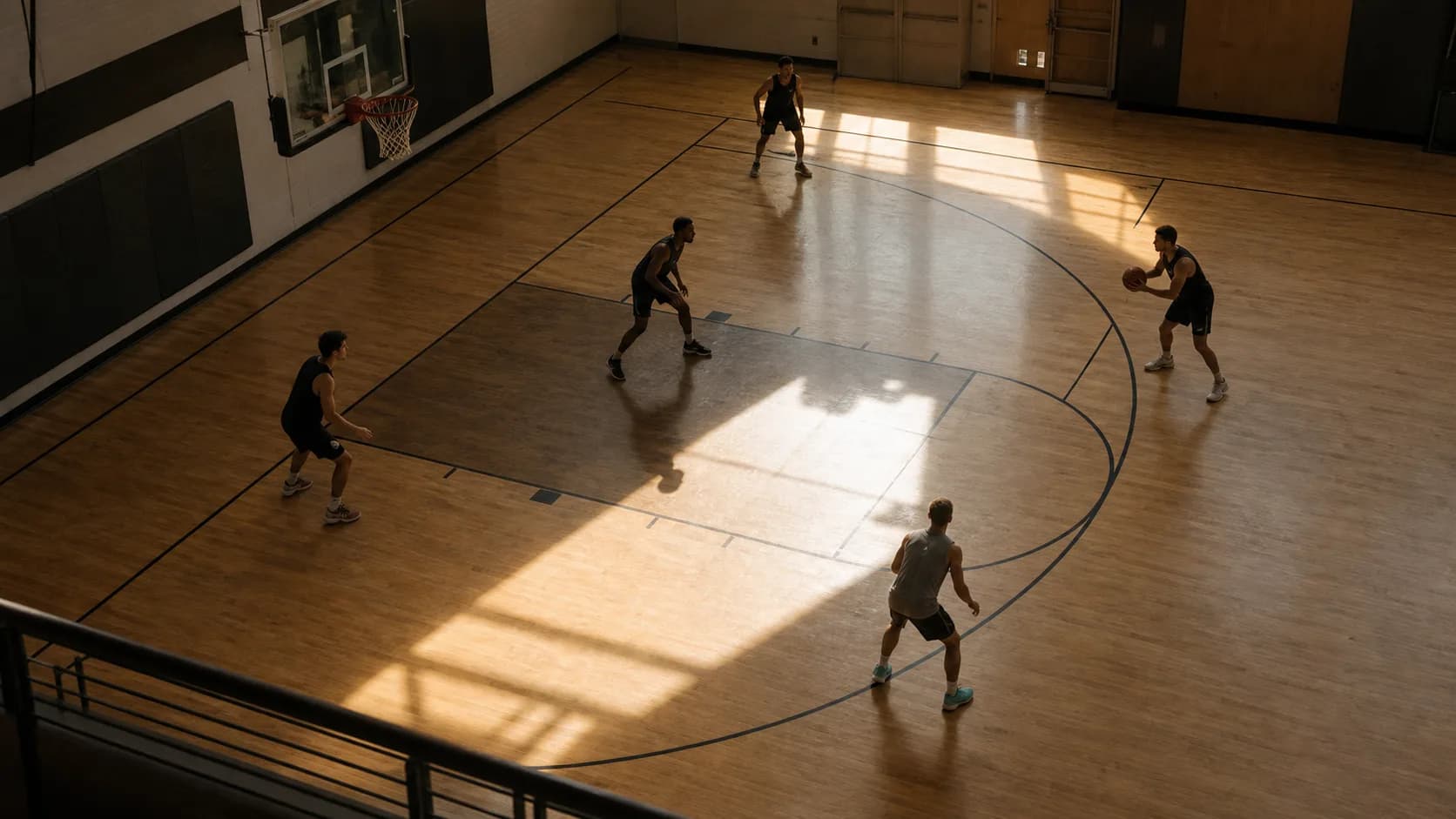
Watch SGA get a clean 18-foot pull-up against Jaden McDaniels. McDaniels is a top-5 NBA wing defender, 6'9" wingspan, top-quartile lateral quickness, fully scouted on SGA's tendencies. The possession lasts 4.2 seconds. SGA uses three different moves in those 4.2 seconds. The shot goes in. It looks effortless. It's not.
The reason SGA is one of the most efficient high-volume scorers in modern NBA history isn't athleticism. It's a four-move toolkit that creates separation against defenders who, on raw measurables, should be able to bother him. This piece is each move broken down: what it is, why it works, and the rep pattern to install it in your own game.
Move 1: The Deceleration Step
What it looks like: SGA attacks at a controlled 70% off a side ball screen. The on-ball defender backpedals. At a specific spot, usually the elbow extended, SGA plants his lead foot hard and drops speed by 40-60% in one stride.
Why it works: the defender has been moving backward to stay between SGA and the rim. They've matched the 70% pace. When SGA hits the brake, the defender can't decelerate in the same window, they either keep moving backward (giving SGA the pull-up) or they stop and reset their feet (giving SGA the gather window).
The micro-detail: SGA's planted foot lands with the toes turned 30-45 degrees toward the sideline. The lateral lean means he's not just stopping, he's loading a step-back if he needs one. The defender can't read whether the next move is a shot or another move.
Rep pattern: - 10 reps from the right side, controlled 70% drive, plant at the elbow, gather into pull-up. - 10 reps left side. - 10 reps alternating, with a partner shouting "shoot" or "step-back" at the moment of the plant. Forces decision after deceleration.
Three weeks of this and the deceleration step becomes a default tool.
Move 2: The Snake Hesitation
What it looks like: Out of a side ball screen, SGA rejects the screen and attacks middle. As the on-ball defender recovers, SGA pulls the ball back across his body with a stutter on the middle dribble, left-right-pause-left, then commits back to the original side.
Why it works: the on-ball defender has reset their feet on the first commit (the reject). The stutter forces a second reset. The third commit catches them flat. Most NBA defenders survive two coverage shifts in a single possession; three is where the math breaks.
The micro-detail: SGA's eyes never leave the rim during the snake. The hesitation is in his hands, not his head. Defenders who watch eyes can't read the hesitation; defenders who watch hands are already late.
Rep pattern: - Chair at the right elbow as the screen. - Attack the chair, reject left, snake back right with the stutter, finish with a pull-up between the elbow and foul line. - 20 reps each side.
By rep 100, the hesitation timing is automatic. By rep 300, it shows up in scrimmage without conscious thought.
Move 3: The Shoulder Lean-By
What it looks like: Coming off a ball screen, the defender chases over the top. SGA's outside shoulder makes contact with the defender's lower hip, legal contact, not an offensive foul, and that contact redirects the defender's chase angle by a few degrees away from the rim.
Why it works: when the chase defender's angle changes by 2-4 degrees, the path to the rim opens up by 6-10 inches at the point of attack. That's enough for SGA to clear the defender into a pull-up or step-through.
The micro-detail: the contact is initiated with SGA's *shoulder*, not his forearm or hand. Shoulder contact at hip height is legal basketball; forearm contact at chest height is a moving screen call against the offensive player. The line between the two is a few inches of body position.
Rep pattern: - Padded dummy (or partner with a foam pad on their hip) at the screen spot. - Drive past the dummy with deliberate shoulder contact on the lower hip. - Finish at the rim or pull up. - 15 reps each side. The pad ensures legal contact; build the body memory before applying to a real defender.
Want to see this move tagged across every SGA possession of the 2026 season? HoopBrief subscribers get the micro-behaviors lens applied to the entire NBA library, including every shoulder lean-by SGA used to win the MVP.
Move 4: The Two-Foot Freeze
What it looks like: SGA attacks, two-foot stops in the lane, and pivots, but doesn't pivot all the way. He freezes at the 90-degree mark, ball above his head, eyes on the rim, defender already committed to the contest. He releases the shot at the freeze, not after a full pivot.
Why it works: the defender has timed their contest to a full pivot motion. The freeze breaks their timing, they go up early. SGA goes up late, in the half-second window the defender's early jump opens.
The micro-detail: the freeze duration is roughly 0.2-0.3 seconds. Long enough to bait the contest, short enough that the defender can't recover. Too long (0.5+) and the defender either smartly stays down or a help defender arrives.
Rep pattern: - Two-foot stop drill: drive to the lane, plant on two, freeze for 0.2 seconds, release. - 25 reps each side. - Add a partner standing in the lane with a small dummy contest, partner reaches up early; you release late.
How the 4 Moves Compound
The moves aren't four separate weapons. They're a sequence. SGA's typical scoring possession uses two or three of them stacked:
- Deceleration step → defender resets feet → snake hesitation → defender resets again → two-foot freeze → pull-up.
- Shoulder lean-by → defender's angle slips → deceleration step → defender stops backpedaling → pull-up.
The defender survives one move. They might survive two. They almost never survive three in 4 seconds.
This is why SGA scores efficiently against elite defenders even though those defenders, on tape alone, look like they should bother him. The toolkit is too deep for one defender to handle. By the time a help defender arrives, the shot is already up.
Why Pace Is the Whole Game
All four moves are pace tools. SGA isn't fast, he's *variable*. The defender can't anticipate the next speed because there's no pattern to anticipate. Pace control is the master skill that makes the four-move toolkit work, and it's the skill that translates to any guard, any height, any league.
For the broader Brunson + SGA + Luka pace blueprint, see our Play Like Shai Gilgeous-Alexander piece. For pace as a stand-alone skill, see how NBA guards manipulate pace to get to their spots.
HoopBrief currently turns basketball and matchup questions into structured reports using public statistical and play-by-play context. It does not accept film uploads or provide possession-level video tagging.
Where to Go Next
The pillar archetype: Play Like Shai Gilgeous-Alexander.
Sibling pace and pull-up pieces: how NBA guards manipulate pace to get to their spots, how to improve pull-up creation and shot balance.
Next step, apply the framework to film: how to study a player in 10 possessions.
Hub: Player Development Hub.