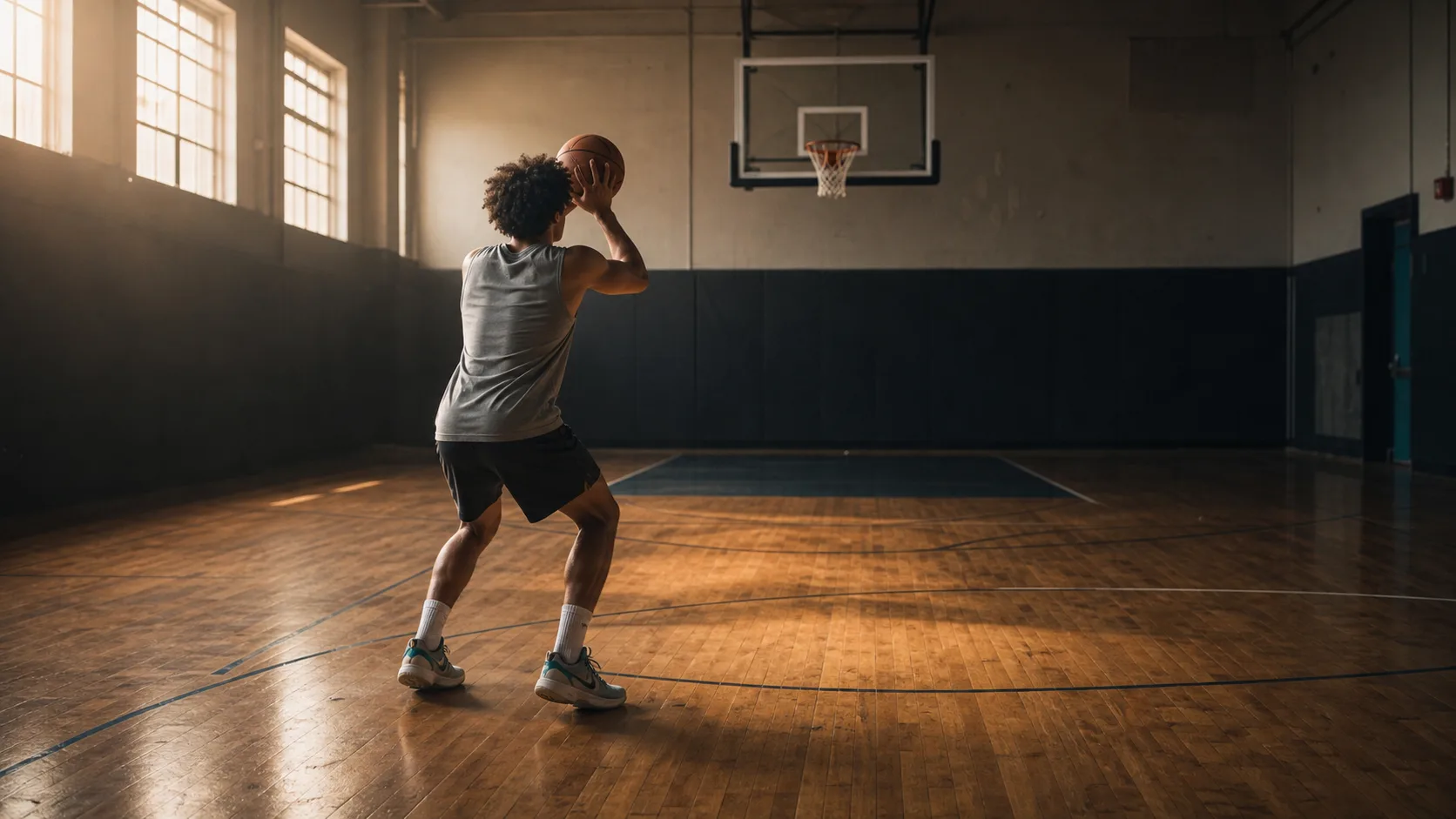
The pull-up jumper off the dribble is the hardest shot in basketball. Four difficult elements combine in one motion: moving balance, one-handed gather, repeatable release, defender timing. Get any one of the four wrong and the shot misses. Get all four right and you're shooting 50%+ from 18 feet against NBA defenders, the SGA standard.
This piece is the 6-week mechanics build for pull-up creation and shot balance. Not a magic fix, a structured progression that has produced measurable shooting gains for guards at every level when followed consistently.
The 6-Week Build
- Week 1-2: Foundation footwork.
- Week 3: Gather mechanics.
- Week 4: Balance under deceleration.
- Week 5: Release-point repeatability.
- Week 6: Game-speed application.
By end of week 6, the mechanical pattern is installed. Months 2-6 are about scaling it under increasing defensive pressure.
Week 1-2: Foundation Footwork
The single most-trainable shooting fundamental. Two patterns to drill:
Two-foot stop (default pattern):
- Drive with two hard dribbles.
- Plant both feet simultaneously at the gather point.
- Feet roughly shoulder-width apart, toes aligned with the basket.
- Weight evenly distributed across both feet.
Drill: spot-shooting from the elbow. 50 reps right side, 50 left side, daily for 14 days. Focus only on the footwork, the shot can be average if the feet are correct.
One-foot stride-stop (situational pattern):
- Drive with two hard dribbles.
- Plant the inside foot at the gather point.
- Step into the shot with the outside foot already moving upward.
- Used in transition or against soft contests.
Drill: same elbow setup, but use stride-stop instead. 25 reps each side, daily.
Week 2 add the no-shot constraint: do the footwork drill without shooting. Just plant, hold balance for 1 second, lower the ball. Builds the body-memory before adding the shot.
Week 3: Gather Mechanics
The gather is the 0.3-0.5 second window between the last dribble and the release. Most pull-up misses happen here.
The mechanics:
- One-handed control during the gather. The shooting hand brings the ball to the shot pocket; the off-hand joins at the pocket, not before.
- Shot pocket at hip height. Not chest height (too high, slows release) and not knee height (too low, adds vertical motion).
- Ball lifted in a straight vertical line. No looping motion. No swinging.
Drill: gather check. Slow-motion drive (50% speed) into a planted two-foot stop. Pause at the gather. Coach or partner checks: is the ball at hip height? Is the off-hand on the ball? Is the elbow aligned with the rim? 30 reps daily, with feedback on every rep.
By end of week 3, the gather is mechanically clean even at slow speed.
Week 4: Balance Under Deceleration
The week the pull-up actually becomes a pull-up. The mechanics:
- Drive at 70%, decelerate hard into the gather.
- Land on the same spot you took off from, no forward drift, no backward fade.
- Hold the landing for 1 full second after the release. If you stumble forward or backward, the balance failed.
Drill: deceleration pull-up. Drive at 70% from the wing, plant at the elbow, pull-up, land on the takeoff spot, freeze for 1 second. 25 reps each side, daily. Track the percentage of reps where you held the landing, goal: 80%+ by end of week.
If you can't hold the landing, you're either decelerating too late (driving past the gather point) or jumping forward (using horizontal momentum incorrectly). Slow the drive speed down until you can hold; then build speed back up.
Want to compare your shot balance to NBA pull-up shooters with NBA-staff tagging? Start a HoopBrief plan and the shot-quality lens tags balance quality on every shot.
Week 5: Release-Point Repeatability
The mechanic that separates 40% pull-up shooters from 50%+ shooters. The mechanics:
- Same release point regardless of dribble setup.
- Same release point regardless of defender contest.
- Same release point regardless of court location.
- Release at the peak of the small jump, not on the way up.
Drill: video your shots. Watch in slow-motion. The release point should look identical across 10+ consecutive shots. If the release point varies by more than 4-6 inches, the consistency is breaking somewhere, usually in the gather (week 3 issue) or in the deceleration (week 4 issue).
Goal: by end of week 5, the release point varies by less than 4 inches across consecutive reps. Most young guards have a release-point variance of 8-12 inches; getting to 4 inches is the NBA threshold.
Week 6: Game-Speed Application
The week the drill work meets reality. The mechanics:
- Live scrimmage application of weeks 1-5.
- Track make rate on pull-ups specifically (not all shots).
- Focus on form preservation under defensive pressure.
Drill: live scrimmage with the explicit rule that every pull-up must be taken with two-foot stop, hip-height gather, deceleration land. If form breaks, the shot doesn't count for the day's tracking.
The first three days of week 6 will feel ugly, game speed compresses the mechanics. By day 7, the form holds under live pressure.
Month 2-6: The Long Build
After week 6, the daily maintenance is:
- 100 form pull-ups per day (any spot, mechanics-focused).
- 20-30 game-speed reps per practice.
- Weekly video review with release-point check.
The make-rate gains show up at months 4-6, not months 1-2. Most young guards quit at month 2 because the gains aren't visible yet. Stick with it, the gains arrive on a delayed timeline, but they arrive.
The Mistake Most Young Shooters Make
Building shot volume before shot mechanics. Taking 500 pull-ups a day with broken mechanics doesn't improve your shot, it locks in the broken mechanics.
The volume-only approach produces shooters who plateau at 38-42% on pull-ups by their senior year of high school. The mechanics-first approach produces shooters who hit 48%+ as juniors and 50%+ as seniors.
Mechanics first. Volume second. The reverse is the most common reason high school shooters never become college-level shooters.
HoopBrief currently turns basketball and matchup questions into structured reports using public statistical and play-by-play context. It does not accept film uploads or provide possession-level video tagging.
Where to Go Next
The pillar archetype: Play Like Shai Gilgeous-Alexander.
Sibling pieces: how to create separation like SGA, why the mid-range still matters in today's NBA.
Next step, apply the pull-up against a real defense: how to read help defense on the wing.
Hub: Player Development Hub.