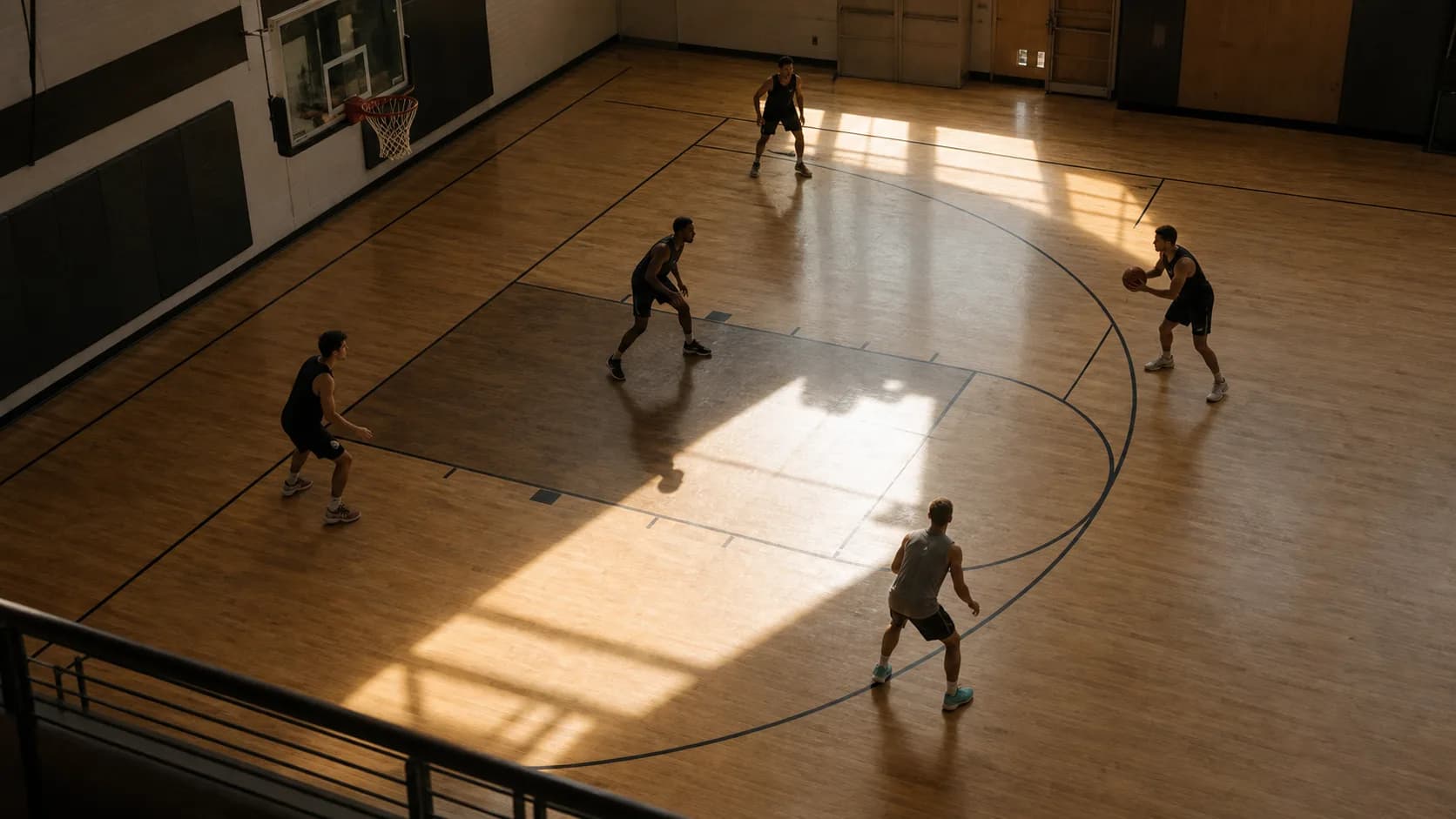
How do you make the NBA? You clear four checkpoints: clean fundamentals by age 14, a roster spot on a sanctioned summer circuit by 16, a Division I scholarship offer by the end of junior year, and one season of draftable college, international, or G League film by 19. About 60 of the 540,000 boys playing US high school basketball are drafted each year. Everything below is how each checkpoint gets cleared.
The real odds, stage by stage: - About 540,000 boys play high school basketball - About 18,500 reach NCAA basketball at any division - About 4,000 play Division I - About 60 are drafted into the NBA each year - The average NBA career lasts about 5 years
Those numbers are intimidating, but the path itself is not random. It is a set of habits, checkpoints, and development patterns, the same ones scouts look for, that you can start building right now.
The Truth About Talent
Here's what nobody tells you: the NBA is full of players who weren't the most talented kids in their high school. What they had was relentless work ethic, high basketball IQ, and the ability to improve year over year.
Talent gets you noticed. But preparation, coachability, and competitive toughness are what get you to the next level - and the level after that.
The Four Checkpoints
If you remember nothing else from this piece, remember these four. Almost every NBA player who came through the US basketball pipeline cleared at least three of them.
- Checkpoint 1 (age 14): Clean fundamentals. Shot mechanics, footwork, off-hand handle.
- Checkpoint 2 (age 15-16): A roster spot on a sanctioned circuit team (EYBL, 3SSB, UAA) for the 16U summer.
- Checkpoint 3 (age 17): A scholarship offer from a Division I program by the end of junior year.
- Checkpoint 4 (age 18-19): One year of high-level college performance, or an international or G League contract, that produces draftable film.
Players who miss Checkpoint 1 rarely catch up, because foundational habits are sticky. Players who miss Checkpoint 2 can still make it through the high school film route, but the path narrows. Players who miss Checkpoint 3 usually have to take a longer route through the transfer portal or international leagues. Players who miss Checkpoint 4 are running out of runway, because the league has gotten more competitive every year.
Step 1: Master the Fundamentals (Ages 12-15)
Before you worry about crossovers and step-back threes, master the basics: - Shooting form. Consistent mechanics, not just making shots. - Ball handling with both hands. Not tricks - functional dribbling under pressure. - Defensive stance and footwork. Lateral movement, closeouts, help positioning. - Passing. Seeing the floor, making the right pass, not the flashy one.
These fundamentals are the foundation everything else is built on. The players who skip them end up hitting a ceiling later.
Step 2: Build Your Basketball IQ (Ages 14-17)
This is where most young players fall behind. They work on their body and their skills, but they don't work on their mind.
Basketball IQ means: - Understanding spacing and why it matters - Reading defensive coverages in real time - Knowing what to do before you get the ball - Making decisions quickly under pressure - Understanding your role in a system
You build this by watching film, studying the game, and playing against better competition. Not just playing - studying. A fast way to train the reads off the court: ask a specific basketball question and study how a scout would break it down. That is what the HoopBrief Matchup Engine does, and Starter is $9.99/mo.
Step 3: Get Seen (Ages 15-18)
You can be the best player in your gym, but if nobody sees you, it doesn't matter. Here's how to get on the radar:
Play AAU/travel basketball. This is where most college recruiting happens. The exposure is essential.
Attend camps and showcases. College coaches attend these events specifically to evaluate talent.
Build a highlight film. But not just dunks - include clips that show your basketball IQ, your defense, your decision-making.
Reach out to coaches. Don't wait to be discovered. Email college coaches. Send them your film. Be proactive.
Step 4: The College Decision
If you're serious about basketball at the next level, college is still the primary path. Here's what matters:
Find the right fit. Don't just chase the biggest name. Find a program where you'll play, develop, and be coached by people who invest in their players.
Consider all levels. D1 isn't the only path to the NBA. Players have come from D2, D3, JUCO, and international leagues. What matters is development, not the logo on your jersey.
Step 5: The Professional Path
From college, the paths diverge: - NBA Draft, for the elite of the elite. Roughly 60 players per year across two rounds. - G League, the NBA's development league. Players signed to two-way contracts split time with their parent NBA team; G League Ignite was an alternate path before its closure in 2024. - International, playing overseas develops your game, builds film, and creates NBA opportunities. EuroLeague, ACB, CBA, Australia's NBL, Israel's BSL, all produce NBA players annually. - NBA Summer League / training camp invites, where undrafted players earn their shot. Roughly half the league's role-player jobs are filled through this funnel.
The role-player blueprint walks through how non-stars carve out decade-long NBA careers, and the answer is rarely about athletic talent, almost always about role specificity plus the coach trust that comes from being the same player every game.
Ages 12-13: What to Build, and What to Skip
This is when motor patterns become permanent. What you build here, you keep. What you skip here, you usually cannot build later.
Priorities: - Shot mechanics. Feet aligned with the rim, balanced on both feet, hands on the seams, release at the peak. Hundreds of shots per week, all from form-shooting distance. Do not push range until the form is automatic. - Both-hand handle. Crossovers, between-the-legs, behind-the-back, all with both hands. The off-hand bias you set here is close to irreversible. - Footwork. Pivots inside and outside, jump stops, drop steps. Practice these without a ball before you practice them with a ball. - Defensive stance. Wide base, low hips, hands active. It sounds basic, and it is the habit that defines defensive instincts at 18. - Pickup games. Unstructured, low-stakes play builds creativity that drills cannot. Do not let structured practice replace creative play.
What not to do at 12-13: - Do not pick a position. The kid who plays only point guard at 12 has a narrower skill stack at 17 than the kid who played every position. - Do not specialize in one sport year-round. Cross-sport athleticism transfers. Soccer for footwork, swimming for shoulder health, tennis for hand-eye. - Do not max out strength training. Body weight and bands at this age. Barbell work starts later.
By 14, the honest test for Checkpoint 1 is simple: can you run your three best moves at full speed against a real defender without your form breaking? If yes, move into skill stacking. If no, go back to fundamentals, because at 15, 16, and 17 the kid with fundamentals keeps adding and the kid with flash plateaus. This is also the age to start a film habit, one full game per week with a notebook. The film study guide walks through the method.
Ages 15-16: Getting on a Sanctioned Circuit
Step 3 says get seen. This is the specific version. The fastest path to exposure is a sanctioned summer circuit team, and there are three that matter:
- Nike EYBL (Elite Youth Basketball League). The biggest and most heavily scouted circuit, roughly 40 teams nationally.
- Adidas 3SSB (3 Stripes Select Basketball). Strong in the Midwest and Southeast.
- Under Armour Association (UAA). Smaller, but extremely well scouted.
How to get on a circuit team: - Local performance first. Be the best player on your high school team, or one of the top few in your region. - Attend exposure camps and showcases. NBPA Top 100, Pangos, USA Basketball mini-camps. - Send game film to circuit team coaches. Cold outreach with edited film works more often than players expect. - Use AAU as a stepping stone. A strong AAU spring can get you in front of circuit coaches for the summer.
The realistic timeline: if you are not on a circuit team by your 16U summer, the path narrows. Not impossible, but everything after it has to be more deliberate. The aau-vs-high-school distinction explains what evaluators watch in each setting, because the two viewing contexts reveal different traits.
Ages 16-17: The Skill Stack and the High-Major Offer
By 16, fundamentals are in place and you are getting seen. The skill stack this year should include:
- A two-point shot you can get to anywhere. A pull-up from at least three spots, the shot bigger defenders cannot contest cleanly.
- A reliable three-point shot. 35% or better from college-line range on catch-and-shoot. This is the floor for being recruited, not a differentiator.
- A pick-and-roll arsenal. Read drop, switch, hedge, and ICE. The pick-and-roll coverage guide is the framework.
- One reliable defensive matchup. You should be the best on-ball defender on your team against at least one position.
- An off-ball role. Cutting, screening, spacing. The trait that moves you from "scorer" to "winning player."
Academics ramp here too. GPA and test prep are recruiting variables, not a side project.
By the end of junior year, Checkpoint 3 asks one question: do you have a Division I scholarship offer? High-major in 2026 means the ACC, Big Ten, Big 12, SEC, Big East, plus the top of the AAC and the West Coast Conference, and those are the programs whose players appear in mock drafts most consistently. If you have a high-major offer, senior year is about choosing a fit rather than generating offers, and the senior-year timeline covers the month-by-month work. If you do not, the mid-major path plus a transfer-portal move after a productive freshman year is the common catch-up route, and the junior-year timeline covers it.
Ages 18-19: The Decision and Draftable Film
Senior year is a decision year, not a generation year. Three decisions:
- Which college. Fit over ranking. The right system, the right coach, a real development plan.
- Whether to go international or professional early. Real options for elite prospects. Paid earlier and in a professional environment, but with less exposure and often weaker development infrastructure than the best college programs.
- Whether to take a prep or gap year. Increasingly common for late-developing bodies that need weight and skill before college.
The single most important variable in that decision is freshman playing time. A freshman who plays 25 minutes a game at a mid-major produces more draftable film than a freshman who plays 12 minutes at a high-major. Scouts watch the player, not the jersey.
Checkpoint 4 is the draftable film question: did you produce 30 or more games of film at a level where NBA scouts can project you? The signals they pull from it:
- Per-possession efficiency against high-major opponents.
- Translatable skills, meaning shot mechanics, decision speed, and defensive ground covered.
- Athletic measurables at the combine: height in shoes, wingspan, standing reach, vertical, lane-agility time.
- Interview signals, meaning composure, basketball IQ, and coachability.
Most players who clear Checkpoint 4 as freshmen declare. Most who do not stay in college and try to clear it as sophomores or juniors.
The Eight-Trait Evaluation Framework
NBA scouts evaluate prospects on eight traits, in a specific order. The what NBA scouts look for piece walks through the full rubric, but the short version:
1. Motor and effort, door 2. Defensive ground covered, door 3. Decision-making under pressure, differentiator 4. Off-ball value, differentiator 5. Response to adversity, door 6. Skill ceiling, differentiator 7. Physical tools and frame, door 8. Coachability and locker-room presence, door
Doors close the evaluation at the bottom. Differentiators decide draft slot. Most players underinvest in the doors because they think the differentiators carry the evaluation, but a failed door closes the whole thing regardless of differentiator strength.
The Six Skills Scouts Actually Grade
The eight traits are how an evaluation is gated. The six skills below are what you actually train, and they are where a scouting report spends most of its ink. Most "how to make the NBA" advice lists thirty things and prioritizes none. Scouts do not work that way.
Skill 1: Shot-making under duress
The most predictive skill on the list. The gap that matters is pull-up threes and mid-range twos against a real closeout, not catch-and-shoot.
- Pull-up threes: 35% or better at meaningful volume, roughly three or more attempts per game, projects as rotation shooting.
- Mid-range from 8 to 14 feet: 45% or better off the dribble projects as an NBA finisher.
- Catch-and-shoot: 40% is a baseline, not a separator. Every NBA player does this.
The distance between your pull-up number and your catch-and-shoot number is the separator. A 40% catch-and-shoot with a 28% pull-up reads as a specialist. A 38% catch-and-shoot with a 36% pull-up reads as a creator. Train it with off-the-dribble progressions against a live contest, two-ball series into a pull-up, and one-more-move-then-shoot sequences. See how to improve pull-up creation and shot balance.
Skill 2: Decision speed
The invisible gap between a great college player and an NBA player. Rotation-level decision speed is roughly 0.4 to 0.6 seconds from cue to action. Good college players sit at 0.7 to 1.0 seconds. That gap is what "the game is too fast" actually describes.
What scouts time: ball-catch to decision on a closeout, screen contact to read in a pick-and-roll, and turnover to first defensive action.
How to train it: a film loop with one question per session, constrained reps where the defensive read changes every rep, and anticipation work watching pro film through a single lens. See how to improve basketball decision-making and reading help defenders.
Skill 3: Defensive versatility
The modern league's most coveted defensive trait. The test: at your natural position, can you also credibly guard one position bigger and one position smaller? A 6'6" wing who can switch onto fours and stay in front of quick twos passes. A 6'6" wing who can only guard threes does not.
The four sub-skills graded: stance and hip mobility, weak-side rotation timing, post positioning without fouling when guarding up, and recovery-rep quality after an initial breakdown. See how scouts grade defensive versatility.
Skill 4: Off-ball value
The trait most fans miss and every scout weights. Not the presence of cuts and screens, the timing of them.
- Cut timing. Does your cut arrive as the help defender's eyes go to the ball, or half a second late?
- Screen intent. Do you make real contact and read what the ball-handler needs, or stand there like a cone?
- Spacing IQ. Are you 22 feet from the ball when the play calls for spacing, or drifting to 18?
- Off-ball defensive position. Two gaps away and ready to rotate, or one gap and easy to screen?
See off-ball value: the trait most fans miss and how to become a better off-ball player.
Skill 5: Frame and reach
The largely genetic one. Wingspan two or more inches over height changes how you are scouted, because it is worth real inches of effective height on defense. Standing reach around 8'8" for wings and 8'11" for bigs is the working baseline. You cannot add wingspan, but functional strength is trainable and underrated: a 6'5" wing at 175 pounds who fills out to 200 by age 20 is a materially different prospect. For the full height picture, see how tall do you have to be to make the NBA.
Skill 6: Coachability
The measurable version of a fuzzy word. Do you integrate correction between reps? Evaluators watch you at camps and workouts specifically to see whether the second rep of a drill reflects the correction on the first.
High coachability looks like walking through the correction between reps, the fix showing up on the next rep even imperfectly, and asking a specific question instead of nodding. Low coachability looks like the same mistake across three reps, body language changing on correction, and a vague "got it" followed by no visible change.
How Scouts Weight the Six Skills
Rough weighting, if you had to put it on a single rubric:
| Skill | Weight |
|---|---|
| Shot-making under duress | 25% |
| Decision speed | 20% |
| Defensive versatility | 20% |
| Off-ball value | 15% |
| Frame and reach | 15% |
| Coachability | Multiplier on the total |
Coachability sits last on the list and matters most over time, because it is a multiplier rather than an addition. A player grading 80 out of 100 on skills 1 through 5 with high coachability projects better than a 90 with low coachability, because the three-year trajectory favors the coachable one.
How Fast Each Skill Moves
Not every skill is equally trainable, and time is the resource you are actually allocating.
- Shot-making under duress: highly trainable but slow, 18 to 36 months of focused reps to move materially.
- Decision speed: 6 to 12 months with the right film and rep loop.
- Defensive versatility: 12 to 18 months. Footwork is the bottleneck.
- Off-ball value: 6 to 9 months. Mostly a habit and film-IQ shift.
- Frame and reach: height and wingspan are fixed. Functional strength moves in about 12 months.
- Coachability: a habit change that can shift in weeks.
If you have 18 months before a recruiting cycle, the fastest-moving skills are off-ball value, coachability, and decision speed. Pull-up shooting is the highest-value skill in absolute terms, and it is the slowest, which is exactly why it starts now rather than later.
What Scouts Do Not Weight
Naming what evaluators grade also names what they do not. These carry surprisingly little weight in a real report:
- Total AAU tournament points. Volume scoring against uneven competition does not project.
- Highlight-reel dunks. Athleticism markers matter, but three dunks does not beat 30 possessions of decision-speed evidence.
- Height alone. Frame and reach is one of six skills, weighted around 15%, not 50%.
- Recruiting rankings before junior year. Rankings before 17 predict very little about NBA outcomes.
- Counting stats in a small sample. Possession-level tape is the signal.
If your current improvement plan is weighted toward the things in this list, the plan is aimed at the wrong evaluators.
The Honest Statistical Floor
Even if you do everything right, clean fundamentals at 14, a circuit team at 16, a high-major offer at 17, and a productive freshman year at 18, the league still picks about 60 players out of a pool of thousands of credible candidates. Some players who do everything right do not get drafted.
That is why the path matters more than the destination. The skills, habits, and discipline that get you to the door of the NBA also get you to the door of European pro basketball, the G League, college coaching, or a front-office job. The work is not wasted if the last door does not open.
An 18-Month Build Order
If you are 15 to 18 and serious, work in this order rather than all at once:
- Months 1-6: off-ball value, the coachability habit shift, and the decision-speed film loop. Fast wins that also build the film case.
- Months 6-18: defensive versatility drill work plus a real strength build. The moderate-timeline skills.
- Every month, all four years: pull-up shooting reps. The slow skill that quietly becomes the biggest separator.
- Ongoing: honest self-scouting across all six. See high school to NBA: scouting yourself.
What You Can Do Right Now
You don't need to wait. Start today:
1. Watch one NBA game per week with purpose. Pick one thing to study, a specific player, a coverage, a play type. The film study guide covers the structured habit. 2. Record your own games and watch them honestly. The self-scouting framework is built for this. 3. Work on your weakest skill for 15 minutes every day. Compounded across a year, that's 90 hours of weak-skill work. 4. Learn basketball terminology. Coverages, actions, positions. The pick-and-roll coverage guide is the right vocabulary primer. 5. Study how your favorite NBA player prepares, not just how they play. The on-court product is downstream of habits you can copy.
The Recruiting Reality
The recruiting timeline matters as much as the development one. The junior-year recruiting timeline and senior-year timeline walk through what to do month by month. The most common mistake is treating recruiting as a one-time event ("get an offer") instead of a multi-year campaign ("build a profile coaches trust enough to offer").
The Bottom Line
The path to the NBA isn't about hoping you get lucky. It's about becoming the kind of player that coaches trust and scouts notice. That starts with preparation, and it starts now.
Of the roughly 60 players drafted each year, most were not the most talented kids on their high school teams. They were the kids who prepared the hardest, accepted coaching the most readily, and made the right decisions when nobody was watching.
The talent gets you noticed. The preparation gets you drafted. The trust gets you a 10-year career.
More From the Player Development Hub
Odds and realism: how hard is it to make the NBA, the real odds by path, height, and age and how tall do you have to be to make the NBA.
Evaluation: the 8-trait rubric in what NBA scouts actually look for in middle school and high school players, plus how scouts evaluate decision-making and why motor matters in scouting reports.
Archetype guides by projected adult body: Play Like Jalen Brunson (sub-6'4" craft), Play Like Shai Gilgeous-Alexander (6'4"+ patient mid-range), Play Like Anthony Edwards (explosive wing), Play Like Victor Wembanyama (tall + perimeter).
Hub: Player Development Hub.