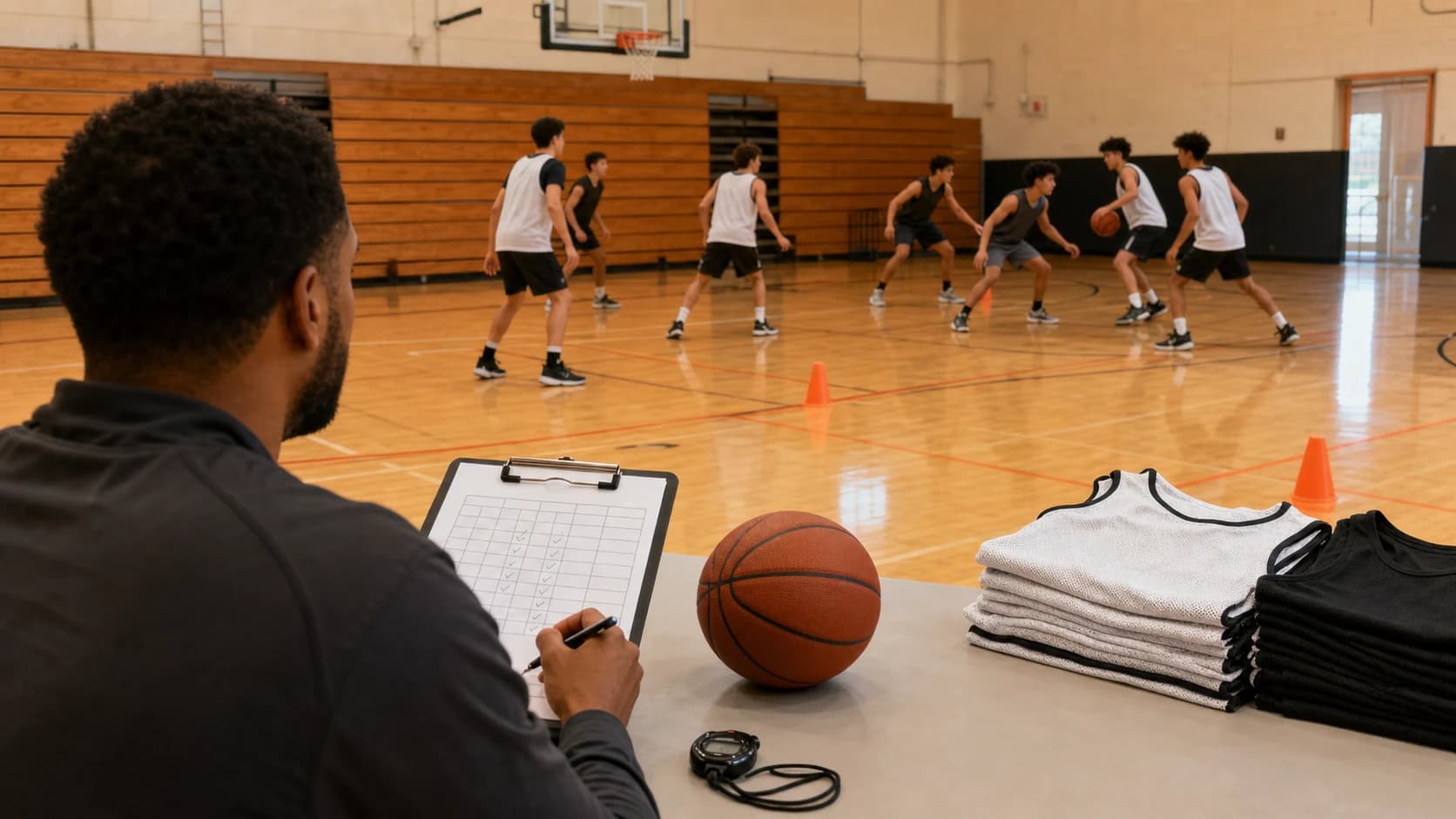
A fair tryout is not the one with the most drills. It is the one that gives each player comparable chances to reveal a role.
The design problem is simple: isolate enough to see the skill, then add defenders fast enough to see whether the skill survives a decision.
Players preparing for this format can use the companion 30-day basketball tryout plan. Coaches can connect the evaluation to the wider season practice-planning workflow.
The 90-Minute Basketball Tryout Plan
Prepare groups, pinnies, balls, cones, clipboards, and evaluator assignments before players enter. Dead time creates uneven rep counts.
| Time | Segment | Primary evaluation |
|---|---|---|
| 0-8 min | Briefing and dynamic movement | Listening, movement control, pace |
| 8-18 min | Variable finishing | Footwork, both-hand control, touch |
| 18-28 min | Pass, cut, and advantage | Timing, vision, spacing |
| 28-38 min | Relocation shooting | Preparation, balance, response |
| 38-50 min | Constrained one-on-one | Creation, containment, shot selection |
| 50-67 min | Continuous three-on-three | Decisions, help, communication, role fit |
| 67-77 min | Numbers transition | Sprint habits, cross-matching, advantage reads |
| 77-90 min | Controlled scrimmage | Full-lineup value and late-possession judgment |
Use a visible clock. End the segment on time even when one group is struggling. Fairness depends on comparable exposure.
Drill 1: Dynamic Movement Screen
Setup: Put players in small waves. Use forward and backward movement, lateral pushes, closeout footwork, controlled stops, and short accelerations. Add a ball only after the first pass through the sequence.
Score: Balance, body control, instruction retention, pace, and whether the player can change direction without standing upright.
Do not overvalue: Raw straight-line speed. The useful question is whether the player arrives under control and ready for the next action.
Jr. NBA practice plans treat warmup as both preparation and fundamental movement work. Use it the same way. Observe without turning the first eight minutes into a silent cut round.
Drill 2: Variable Finishing Windows
Setup: Start players from the wing. A coach or defender gives one of three cues after the first dribble: stay back, step to the ball, or take away the strong side. The player must choose a direct finish, a controlled stop, or a weak-side finish.
Score: Eyes up, two-foot balance, both-hand comfort, finish choice, and ability to absorb a miss without changing pace.
Do not overvalue: A difficult make after the wrong read. Record the decision and execution separately.
Run equal repetitions on each side. A station that gives one line twice as many left-side attempts creates noisy evidence.
Drill 3: Pass, Cut, and Advantage
Setup: Play three offensive players against two defenders in a constrained half-court space. Offense scores by reaching the paint or creating a clean catch-and-shoot attempt. The passer must cut or screen after moving the ball.
Score: Pass timing, spacing, ability to see the second defender, purposeful movement after the pass, and the choice to finish or make one more pass.
Do not overvalue: Ball dominance. The drill should reveal players who create an advantage without needing every touch.
This is the first station where a quiet connector becomes visible.
Drill 4: Relocation Shooting
Setup: Use groups of three: passer, shooter, rebounder. The shooter begins with a short cut or relocation, receives on balance, and takes a game-speed shot. After several reps, add a live closeout that changes the read.
Score: Footwork before the catch, readiness, shot selection, communication, and the next response after a miss.
Do not overvalue: A hot three-minute streak. Track process first, makes second.
Pure spot shooting rewards familiarity with one drill. Relocation reveals whether the player can prepare while the possession moves.
Drill 5: Constrained One-on-One
Setup: Begin from the wing, slot, and elbow. Give the offense three dribbles and eight seconds. The defender starts one step out of position so the possession tests both advantage creation and recovery.
Score on offense: First-step purpose, change of pace, use of space, shot selection, and ability to stop when the advantage disappears.
Score on defense: Stance, angle, chest containment, hand discipline, recovery, and finish with a rebound.
Do not overvalue: Isolation volume. The constraint exists to reveal decisions, not crown the player with the deepest move collection.
Rotate matchups. A player should face at least one similar athlete and one different body type.
Drill 6: Continuous Three-on-Three
Setup: Play short possessions to one shot. The offense stays only after a score or a coach-defined winning action. New groups enter immediately. Change teammates across rounds.
Score: Spacing, cutting, screening, help position, closeouts, communication, next-pass decisions, and response to changing teammates.
Do not overvalue: Total points. Three-on-three removes hiding places and shows who can read a possession.
USA Basketball's 2026 3X Play initiative also uses structured three-on-three formats for skill development. For evaluation, the smaller game is useful because every player must participate in creation, defense, and transition between roles.
The same format is one of the best ways to teach basketball IQ through decisions, because the player cannot wait off the ball for the possession to end.
Drill 7: Numbers Transition
Setup: Begin with three attackers against two defenders, then release a trailing defender. On the next possession, reverse direction and change the numbers. Require defenders to protect the basket before finding perfect matchups.
Score: First three steps, rim protection, communication, cross-matching, lane spacing, pass timing, and whether the ballhandler attacks before the advantage closes.
Do not overvalue: Conditioning theater. The drill should stay short enough that decision quality remains visible.
Transition exposes habits that stationary stations miss. Players must recognize who is open, who protects the rim, and when the numerical advantage has ended.
Drill 8: Controlled Scrimmage
Setup: Use five-minute running periods with preassigned lineup questions. One period may require man-to-man defense. Another may start every possession from a sideline entry or late-clock situation. Rotate players through at least two lineup contexts.
Score: Role fit, organization, pace, shot quality, defensive coverage, communication, and whether earlier feedback appears in live play.
Do not overvalue: The loudest scorer on the strongest group. Keep lineup strength in the evaluator's notes.
The scrimmage is not the whole evaluation. It is where evidence from the earlier segments either connects or breaks.
The 100-Point Basketball Tryout Evaluation Rubric
Use the same categories for every player. A guard and center may demonstrate them differently, but the weights stay stable.
| Category | Weight | Observable evidence |
|---|---|---|
| Decision-making | 25 | Sees help, chooses on time, protects advantage, avoids repeated errors |
| Defense | 20 | Contains, helps, communicates coverage, contests, rebounds |
| Role skill | 15 | Executes the player's likely lineup job at game speed |
| Passing and spacing | 15 | Delivers on time, moves after passing, keeps useful floor balance |
| Motor and pace | 10 | Repeats effort, changes ends, works without rushing decisions |
| Communication | 10 | Gives early, specific information and receives teammate cues |
| Coachability and response | 5 | Applies feedback and resets after mistakes |
| Total | 100 | Score only what the evaluator observed |
Add two text fields:
- Best lineup fit: one sentence describing the player's usable role.
- Evidence note: one possession that explains the strongest or weakest score.
The evidence note prevents the roster meeting from becoming a contest between vague impressions.
How to Keep Basketball Tryouts Fair
Fair does not mean every player gets the same result. It means every result comes from comparable opportunity and documented evidence.
Equalize Repetitions
Count reps by station. Do not assume lines stayed balanced. If one basket breaks or one group has an extra player, adjust before moving on.
Rotate Teammates and Matchups
A point guard paired only with non-shooters receives a different test than one playing with space. A center facing only smaller players may look dominant without showing coverage decisions. Change context before final scoring.
Use Independent Evaluators
Assign each evaluator two or three rubric categories. Score independently before the staff discussion. Early group conversation creates anchoring, where the first strong opinion shapes every later score.
Delay Final Decisions
Do not cut from the warmup or first shooting station unless safety or conduct requires it. Some players need live context to reveal value. Others look excellent in lines and disappear once defenders arrive.
Separate Performance From Projection
Current performance asks who helps today. Projection asks who may develop with coaching. Put those on separate lines. Mixing them produces inconsistent decisions, especially with younger players.
Keep Short Possession Notes
Write observable language:
- Called the weak-side screen before contact.
- Repeatedly crowded the driver from the corner.
- Applied the closeout correction on the next rep.
- Created paint touches but missed two early kick-outs.
Avoid labels such as "winner," "not skilled," or "low IQ" without evidence.
How to Adjust the Tryout by Age and Level
For younger players, reduce shooting distance, shorten the one-on-one space, and increase the weight of movement, listening, passing, spacing, and response. Do not project future positions from current height.
For middle school, keep both-hand finishing, defensive stance, small-sided decisions, and coachability central. Add role language without forcing specialization.
For high school, increase pace, ball pressure, coverage communication, shot selection, and lineup fit. Use position-specific role skills after the common evaluation.
For a final varsity callback, reduce the number of stations. Spend more time in three-on-three, transition, special situations, and scrimmage lineups. At that stage, the question is less "can this player perform a skill?" and more "which combinations help us win possessions?"
The Roster Meeting
Have every evaluator total scores before discussion. Start with clear selections, then spend time on the close group.
For each close player, answer four questions:
1. What role can this player perform now? 2. Which lineup need does that role fill? 3. What possession evidence supports the score? 4. Is the disagreement about current value or future projection?
Document the reason for the final decision. If program policy allows feedback, give the player one strength and one specific development priority.
A tryout should help the staff build a team and help the player understand the next step. The same evidence can do both.
Want to turn evaluation notes into a sharper player or opponent read? Try the HoopBrief scouting experience and move from observation to a structured plan.